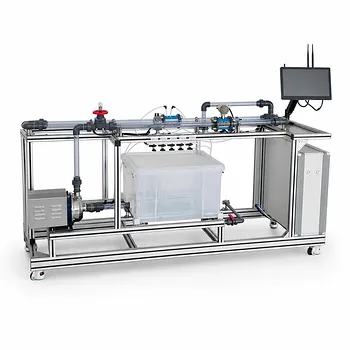
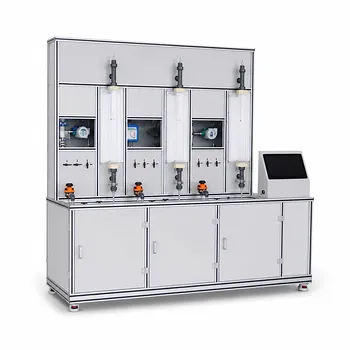
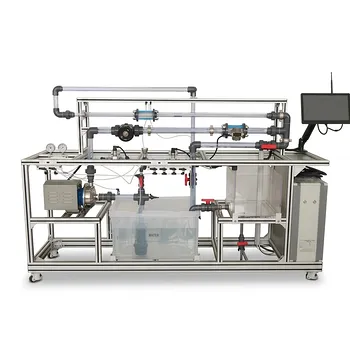
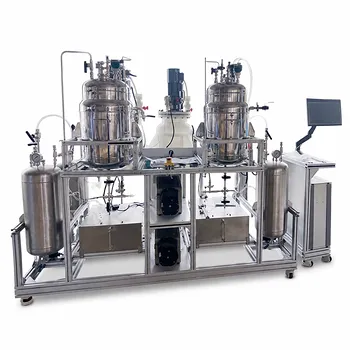
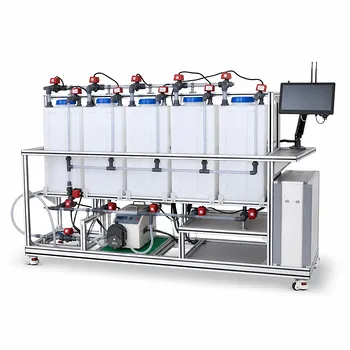
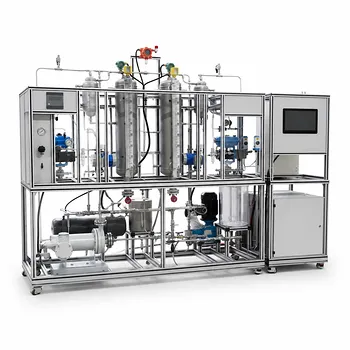
The secret to recovering heavy metals from water that looks clean but isn’t is overcoming a fundamental transport bottleneck. In a flow-through porous electrode pilot plant, chemical engineering students feed dilute, ppm-level streams directly through a high-surface-area carbon or metal felt. The intense solution–electrode contact slashes mass transfer resistance, allowing metals like copper, silver, or mercury to plate out as solids while the outlet concentration drops below 1 ppm – sometimes into the ppb range. It is a hands-on, visible demonstration of electrowinning, heterogeneous kinetics, and the core environmental unit operation of turning a waste liability back into a resource.
Flow-through porous electrodes turn a mass transfer limitation into a design advantage. By forcing a dilute wastewater to weave through a bed with an enormous internal surface area, the pilot plant shows students that even single-digit ppm contaminants can be recovered efficiently – transforming a separation challenge into a tangible product and a teachable moment on reaction engineering, electrochemistry, and sustainable process design.
Why Dilute Feeds Demand a Different Electrochemical Approach
The Mass Transfer “Wall” in Dilute Solutions
When a metal ion concentration falls below about 100 ppm, the rate of the desired electrochemical reaction stops being controlled by electron transfer and is dictated by how fast ions can reach the electrode surface. In a standard parallel-plate cell, the boundary layer acts as a bottleneck, and current efficiency collapses. Students quickly observe that without active convection or a radical increase in surface area, the recovery becomes economically and practically unfeasible.
Where the Porous Electrode Changes the Game
A flow-through porous electrode, typically a bed of carbon felt, metallic foam, or sintered fibers, provides a specific surface area that can exceed 10,000 m² per cubic meter. Because the liquid is pumped directly through the matrix, ions do not have to diffuse across a thick stagnant film. The result is an apparent mass transfer coefficient hundreds of times higher than in an open channel. This lets pilot plant operators sustain a meaningful deposition current even when the bulk metal concentration is barely a trace.
How the Pilot Plant Transforms Theory into Practice
Seeing Electrowinning in Real Time
The pilot unit is transparent or equipped with sampling ports, so students watch a dilute copper sulfate feed turn from faint blue to colorless as it passes through the cathode bed. Post-run mass balances confirm that the metal ending up as a solid deposit on the electrode fibers matches the dissolved metal removed from the water. This reinforces Faraday’s laws in a context far more relevant than textbook electrolysis of concentrated salts.
Measuring and Modelling the Mass Transfer Coefficient
By varying the flow rate through the porous electrode and recording the limiting current, students determine the overall mass transfer coefficient ($k_m a$) – the product of the intrinsic mass transfer coefficient and the volumetric surface area. Plotting limiting current against flow rate directly connects dimensionless correlations (e.g., the Sherwood–Reynolds number relationship for packed beds) to real performance data. This transforms abstract transport phenomena into a practical design tool.
Achieving Sub-ppm Outlet Concentrations
The combination of high surface area and plug-flow-type liquid residence time distribution makes it possible to reach exhaustive removal. In a classroom pilot plant, an inlet concentration of 20 ppm copper can be reduced to consistently below 0.05 ppm at the outlet by adjusting the cell potential and residence time. This hands-on demonstration of “parts-per-billion” polishing is a powerful lesson in separation science that no slide deck can replace.
Integrating the Electrode into Broader Unit Operations Thinking
Electrowinning as the Final Polishing Step
While other pilot plant modules – precipitation, chemical reduction, ion exchange – handle bulk loads, the flow-through porous electrode tends to shine as the polishing unit. After a precipitation step removes 90% of a metal, the dilute overflow becomes an ideal feed for the electrochemical bed. Students learn to link multiple unit operations: using $K_{sp}$ principles to crash out the bulk, then mass-transfer-intensified electrochemistry to capture the remnants.
Connecting to Environmental Metrics and E-Factors
Running the porous electrode pilot plant generates practically no sludge and consumes only electricity (electrons as the cleanest “reagent”). By comparing the solid metal recovered with the small amount of waste produced, students calculate E-factors that are orders of magnitude lower than those of a traditional hydroxide precipitation process. It makes green chemistry and pollution prevention tangible.
Understanding the Trade‑offs and Engineering Challenges
Pressure Drop and Pumping Costs
A bed with enormous surface area also means restrictive flow paths. Students will measure a pressure drop that rises with velocity and bed depth. Part of the pilot plant exercise is finding the economic optimum: enough flow to boost mass transfer, but not so much that pumping energy overtakes the value of the recovered metal. It’s a classic chemical engineering trade-off, now observed live.
Uneven Current and Potential Distribution
In a three-dimensional electrode, the ohmic resistance of the electrolyte phase can create a non-uniform potential distribution. Portions of the bed may sit below the deposition potential, while others climb into the hydrogen evolution regime. By sectioning the cathode current collector and measuring segment currents, students can diagnose this issue and propose fixes – such as using a more conductive feed, staged cell designs, or flow-by instead of flow-through configurations.
Long‑term Fouling and Bed Regeneration
Over extended runs, precipitated hydroxides, sulfate scale, or fine particulates can coat the electrode fibers and raise the pressure drop further. The pilot plant offers the chance to backwash the bed or reverse the polarity briefly to clean the surface. This maintenance step drives home the reality that even elegant electrochemical solutions require sound mechanical and operational design.
Making the Right Choice for Your Learning Objective
Adopting a flow-through porous electrode pilot plant can serve different educational priorities. Focus the laboratory or research agenda based on the primary goal:
- If your primary focus is teaching mass transfer fundamentals: Use the pilot plant as a dynamic Sherwood number experiment. Have students vary flow rate and measure limiting currents to extract $k_m a$, linking transport theory directly to metal removal efficiency.
- If your primary focus is environmental process design: Build a chain starting with chemical sulfide precipitation for bulk removal, then feed the overflow to the porous electrode cell for polishing. Let students perform the full techno‑economic and E-factor comparison.
- If your primary focus is scale‑up and reactor engineering: Challenge students with the measured pressure-drop data and ask them to propose a commercial‑scale stack design. Introduce flow distribution manifolds and parallel vs. series electrode arrangements as optimization variables.
- If your primary focus is material recovery and circular economy: Combine the cell with a simple acid‑leach step that strips the deposited metal from the felt, producing a concentrated metal salt for reuse. This closes the loop and demonstrates resource valorization.
A single pilot plant with an intelligent electrode bed does more than remove a few milligrams of copper – it gives future chemical engineers a vivid, data-rich platform to discover that the most diluted, “waste” streams are often just a mass transfer problem away from becoming a recovered product.
Summary Table:
| Learning Focus | Key Experiment / Measurement | Educational Value & Insight |
|---|---|---|
| Mass Transfer | Vary flow rate & measure limiting currents | Calculate $k_m a$ mass transfer coefficients |
| Process Design | Combine precipitation with electrochemical polishing | Teach multi-step unit operations & E-factors |
| Reactor Scale-up | Measure pressure drop vs. fluid velocity | Address operational trade-offs & stack design |
| Circular Economy | Run acid-leach step to strip deposited metal | Demonstrate resource recovery & valorization |
Bring advanced green technology and hands-on learning to your institution. LABPARK provides state-of-the-art Educational and Vocational Unit Operations Pilot Plants in chemical engineering, bioprocess & biotech, and environmental & water treatment for universities, research institutes, and enterprises. Help your students master electrochemical wastewater treatment, mass transfer kinetics, and sustainable process design. Contact us today to customize the perfect pilot plant solution for your lab.
Related Products
- Orifice and Venturi Flowmeter Calibration Educational Pilot Plant for Fluid Mechanics Laboratory
- Comprehensive Fluid Mechanics Educational Unit Operations Pilot Plant
- Two Phase Flow Pattern Velocity Resistance Measurement Educational Pilot Plant
- Centrifugal Pump Performance and Orifice Flowmeter Calibration Educational Pilot Plant
- Electrolyte Distillation Purification and Formulation Educational Pilot Plant
People Also Ask
- What is the difference between static and stagnation pressure? Master Pilot Plant Flow Measurement
- How do pilot plants demonstrate siphon pressure variations? Visualizing Bernoulli's Energy Balance
- How do fluid mechanics training pilot plants facilitate the visualization and calculation of laminar and turbulent flows?
- How to update chemometric calibration models in pilot plants? Best practices for process engineers.
- Why are the laws of similitude critical in fluid flow pilot plants? Scale Up Safely