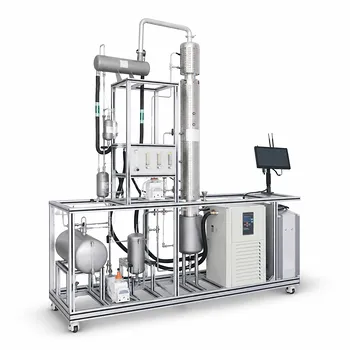
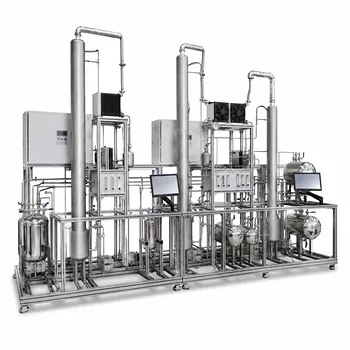
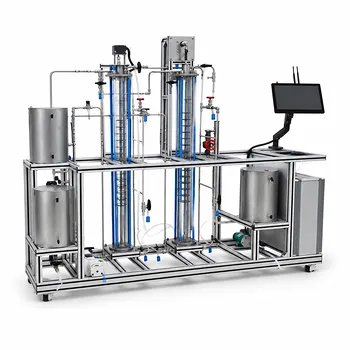
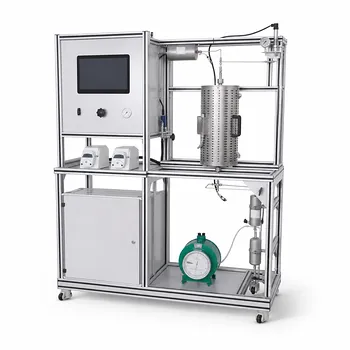
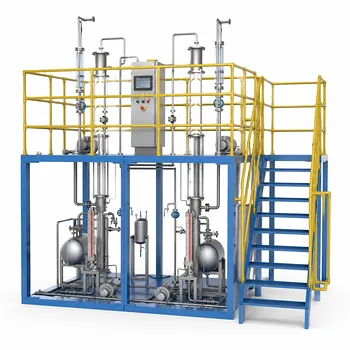
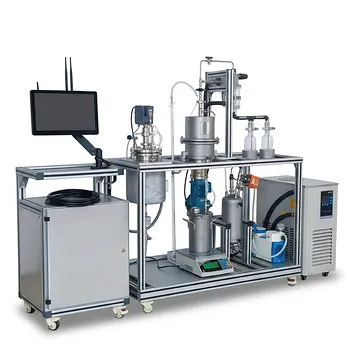
A hands-on pilot plant transforms a textbook azeotrope into an observable reality. A chemical engineering laboratory can demonstrate complex multi-column separation processes like the azeotropic distillation of ethanol and water by deploying a modular unit operations pilot plant. This physical system integrates two or more distillation columns in series with a decanter, transparent process equipment, and extensive instrumentation. Students and researchers can then directly witness phase separation, manipulate reflux, and collect real-time temperature and pressure data—bridging the gap between theoretical simulations and industrial reality.
Complex multi-column separations become tangible learning experiences when a pilot plant combines modular hardware with transparent components and true sensor data. For azeotropic distillation, this means physically observing how an entrainer breaks the ethanol-water azeotrope in a linked column-and-decanter setup, converting abstract vapor-liquid equilibrium concepts into an intuitive, hands-on demonstration.
The Anatomy of a Multi-Column Pilot Plant for Azeotropic Distillation
A pilot plant that teaches complex separations is not a single column—it is a carefully orchestrated system of unit operations. The heart lies in replicating industrial sequences at a manageable scale while preserving the core thermodynamic and hydraulic behavior.
Connecting Columns and Decanters to Mirror Industrial Sequences
The primary configuration chains two distillation columns in series, integrated with a decanter for liquid-liquid phase separation.
For an ethanol-water separation using an entrainer like cyclohexane or ethyl acetate, the first column produces a ternary distillate. This condensed distillate flows into a decanter, where it spontaneously separates into an entrainer-rich organic phase and a water-rich aqueous phase.
The organic phase is refluxed back to the first column while the aqueous phase is sent to a second column to recover ethanol. Students physically trace these liquid streams through glass piping, watching the phase split occur in real time.
Transparent Construction and Instrumentation Make Phase Dynamics Visible
Modern educational pilot plants use borosilicate glass columns that reveal internal hydrodynamics. You can observe froth height on sieve trays, liquid distribution in packed sections, and the formation of the organic–water interface inside the decanter.
Strategic placement of temperature, pressure, and flow sensors at key stages—reboiler, column stages, condenser, and decanter outlets—converts visual observations into hard data. Students log this information to calculate mass and energy balances, identifying the steady-state condition where the entrainer circulates with minimal net consumption.
How the Pilot Plant Unlocks the Science Behind Azeotropic Separation
The real pedagogical power emerges when learners connect the physical operation to the underlying thermodynamics. An ethanol-water mixture cannot be purified beyond 95.6% ethanol by standard distillation because the azeotrope behaves as a single component (relative volatility α=1).
Observing the Role of the Entrainer in Real Time
With a pilot plant, the entrainer addition becomes an active experimental variable. By raising the entrainer flow rate, students see the top temperature shift and the decanter interface move.
They witness how the entrainer creates a new low-boiling ternary azeotrope that preferentially carries water overhead. The subsequent decantation recovers the entrainer, and the ethanol-rich water stream is further distilled. This direct experience replaces memorization with visceral understanding.
Validating Thermodynamic Models Through Collected Data
Equipped with sensors, the pilot plant generates datasets for VLE validation. Students compare measured stage temperatures and compositions with predictions from activity-coefficient models like NRTL or UNIQUAC.
The difference between simulation and reality sharpens their engineering judgment. They learn that models are approximations—and that pilot-plant data is the ultimate truth check.
Extending the Pilot Plant’s Teaching Reach Beyond a Single Azeotrope
The modular nature of these plants makes them versatile teaching platforms. By reconfiguring piping and control logic, a single installation can demonstrate multiple separation strategies.
Demonstrating Pressure-Swing Distillation
With a pressure-rated pilot plant, operators can run the same ethanol-water mixture at two different pressures. At 101.33 kPa, the azeotropic mole fraction is 0.894 ethanol; at 13.33 kPa, it shifts to 0.992. Students observe the composition change and grasp how a two-column, pressure-swing arrangement can bypass the azeotrope without an entrainer entirely. Adjustable vacuum pumps and precision pressure sensors bring this concept off the page.
Switching Modes: Batch, Continuous, and Vacuum Operation
The same pilot plant often allows switching between batch and continuous distillation simply by repositioning feed inlets and activating feed pumps. Students can compare steady-state continuous profiles with the time-varying composition of a batch run.
For heat-sensitive materials, educators highlight the vacuum mode. A vacuum-rated column with a cold-trap and sensitive pressure controller shows how lowering the boiling point prevents thermal degradation—essential for teaching separation of fatty acids or pharmaceutical intermediates.
Understanding the Trade-offs
While pilot plants are transformative, their limitations must be framed honestly to build genuine engineering insight.
Scale Effects Are Real
A 50-mm column operates under different fluid dynamics than a 2-m industrial tower. Students may not experience the same degree of backmixing, entrainment, or weeping that plagues large-scale units. This can lead to an overestimation of tray efficiency if not explicitly discussed.
Cost and Complexity Can Limit Course Design
Multi-column setups with decanters and comprehensive sensor suites represent a significant institutional investment in equipment, maintenance, and instructor training. Laboratories must balance the richness of the data against the time required for students to reach steady-state during a single lab session.
Safety Must Still Be Managed
Although inherently safer than full-scale plants, pilot systems still handle organic solvents under vacuum or at elevated temperatures. The transparent glass carries a non-zero breakage risk. Robust standard operating procedures are a necessary component of the educational package, and this itself becomes a teaching moment about process safety culture.
Making the Right Choice for Your Educational Goal
The design and operation of your pilot plant must align with what you want your students to learn. Prioritize capabilities based on your core objectives.
- If your primary focus is teaching azeotropic distillation fundamentals: Opt for a two-column setup with a glass decanter. Ensure the columns have multiple temperature sensors and sample ports so students can trace composition profiles through the entrainer cycle.
- If your primary goal is training industrial operators: Choose a stainless-steel, pressure-rated system with a full DCS interface. The visual transparency of glass becomes less critical than learning to control the process from a screen.
- If you aim to demonstrate multiple separation strategies in a single semester: Invest in a modular plant with flexible piping, interchangeable column internals (trays and packing), and the ability to run batch, continuous, and vacuum modes. This maximizes educational return per square foot of lab space.
- If your focus is on rigorous research and model validation: Prioritize high-accuracy mass flow meters and online composition analyzers (e.g., density or near-IR). The quality of the thermodynamic data you collect will directly support publication-worthy research.
Pilot plants are the bridge where the abstract science of separations becomes a tangible skill. By choosing and operating them with clear intent, you equip chemical engineers with the intuitive, data-grounded confidence they will carry into any plant.
Summary Table:
| Separation Mode | Key Equipment Needed | Educational Value & Applications |
|---|---|---|
| Azeotropic Distillation | 2 Columns, Decanter, Sensors | Observing entrainer dynamics & phase separation |
| Pressure-Swing | 2 Columns (different pressures) | Visualizing VLE shifts without an entrainer |
| Batch & Continuous | Feed pumps, Modular columns | Comparing steady-state vs. dynamic behavior |
| Vacuum Distillation | Vacuum pump, Cold-trap | Separating heat-sensitive materials safely |
Bring Industrial-Scale Separations to Your Lab
Ready to elevate your curriculum or research? LABPARK designs and manufactures premium Educational and Vocational Unit Operations Pilot Plants in chemical engineering, bioprocess & biotech, and environmental & water treatment for universities, research institutes, and enterprises.
Our custom modular pilot plants enable students and researchers to physically trace phase dynamics, validate VLE thermodynamic models, and gain hands-on operational confidence.
Contact LABPARK today to request a catalog or discuss your lab's specific training requirements!
Related Products
- Multi-Functional Special Distillation Educational Pilot Plant
- Continuous Batch Extractive Distillation Educational Pilot Plant
- Ethyl Acetate Synthesis Unit Operations Pilot Plant for Practical Training
- Continuous Sieve-Plate Distillation Pilot Plant for Unit Operations Laboratory Education
- Green Anhydrous Ethanol Purification Extractive Distillation Unit Operations Training Pilot Plant
People Also Ask
- Why does simple distillation yield higher efficiency than flash distillation? Key thermodynamic differences.
- How does double temperature difference control improve distillation pilot plants? Stabilize purity.
- Why is the acentric factor important in pilot plants? Fluid property prediction.
- How Batch vs Continuous Configuration Affects Distillation Pilot Plant Versatility & Footprint
- How to Integrate Spectroscopy in Distillation Pilot Plants for Advanced Process Control