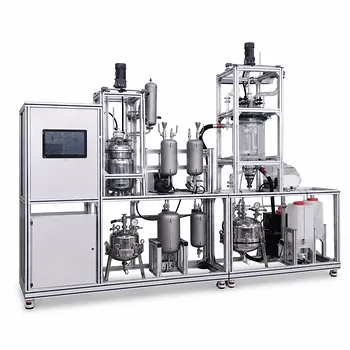
The key to mastering heavy metal removal lies not just in theory, but in translating solubility product constants into reliable, scaled-up operations. Chemical engineering and environmental unit operations pilot plants allow you to study precipitation equilibrium under dynamic, real-world conditions. Researchers and engineers use these systems to precisely control pH, dose chemical precipitants (like sulfide or hydroxide), adjust mixing intensity, and set residence times, then directly measure how each factor shifts the equilibrium toward the formation of insoluble metal precipitates and how efficiently those solids are separated.
Pilot plants serve as the essential bridge between equilibrium calculations and full-scale treatment. They reveal how kinetic factors, fluid dynamics, and operational constraints impact the practical success of precipitation-based heavy metal removal—enabling you to hit discharge limits reliably, not just on paper.
Moving from Theory to Practice in a Pilot Plant
To truly exploit precipitation equilibrium, you must see how it behaves outside a beaker. Pilot plants replicate industrial flow patterns, mixing regimes, and separation steps while still allowing flexible experimentation. This unlocks insights that equilibrium constants alone can never give you.
Simulating Continuous and Batch Operations
A pilot plant can be configured for batch precipitation or continuous stirred-tank reactors (CSTRs). Running both modes side by side lets you compare how residence time distribution affects the final dissolved metal concentration. In a continuous setup, you can observe how steady-state effluent quality responds to sudden changes in feed composition or chemical dosing—crucial for designing robust control strategies.
Manipulating the Core Variables of Precipitation Equilibrium
The solubility product ($K_{sp}$) dictates the ultimate driving force, but actual removal efficiency hinges on controllable process parameters. In a pilot plant, you systematically alter each one and measure the result.
pH Control and Chemical Dosing
For hydroxide precipitation, the equilibrium concentration of the metal ion is a direct function of pH. By using automated acid/base dosing pumps in the pilot reactor, you can map the exact pH window where a metal hydroxide exhibits minimum solubility, while avoiding re-dissolution at extreme pH (amphoteric behavior). When a sulfide precipitant is chosen—for example, to form copper sulfide (CuS) with its extremely low $K_{sp}$ of $6.3 \times 10^{-36}$—precise sulfide dosing becomes the critical lever. Adding too little leaves toxic copper behind, while excess sulfide can create odor and toxicity issues downstream.
Mixing Intensity and Particle Aggregation
Precipitation equilibrium tells you what will form, but not how easily you can separate it. In the pilot plant, you can vary impeller speed to study nucleation and crystal growth. Gentle mixing may favor larger, settleable flocs, while intense turbulence can break particles apart and create fines that escape the clarifier. Direct observation of sludge volume index (SVI) and effluent turbidity under different mixing regimes turns theoretical precipitation into a separation-ready process.
Harnessing the Common Ion Effect
A textbook concept comes alive when you push precipitation beyond the stoichiometric ratio. In pilot studies removing barium as barium sulfate, adding excess sulfate ions dramatically suppresses the residual dissolved barium concentration through the common ion effect. By running tests with varying precipitant excess, you can quantify just how far the solubility drops and identify the economically optimal overdose that meets environmental limits without wasting chemicals.
Expanding the Scope: Selective Separation and Complexed Metals
Real wastewater rarely presents a single heavy metal neatly waiting to precipitate. Pilot plants let you tackle complex mixtures and stubborn metal complexes using the principles of coordination chemistry.
Selective Precipitation Through Ligand Control
In a mixed precipitate containing zinc and magnesium hydroxides, simply adding ammonia shifts the equilibrium by forming the soluble tetraamminezinc(II) complex ($[Zn(NH_3)_4]^{2+}$). The magnesium hydroxide remains insoluble. This fractional precipitation can be run continuously in a pilot unit: you dose the ligand in a controlled reactor, monitor the dissolved zinc, and then separate the solid magnesium hydroxide. The pilot data tells you the exact ligand-to-metal ratio and residence time needed to maximize metal recovery.
Breaking Stable Complexes for Complete Removal
Metal complexes, like silver cyanide ($[Ag(CN)_2]^-$) from plating wastes, resist simple hydroxide precipitation. The equilibrium you must manipulate involves both the stability constant ($K_f$) of the complex and the ultra-low $K_{sp}$ of a target precipitate like silver sulfide ($K_{sp} = 6.3 \times 10^{-50}$). In a pilot plant, you can dose sulfide ions under precisely controlled pH and oxidation-reduction potential (ORP) to destroy the complex and form an insoluble sulfide. Testing different molar ratios and reaction times reveals how to push the competitive equilibria to achieve discharge-quality effluent without releasing toxic hydrogen sulfide gas.
Understanding the Trade-offs
Every precipitation strategy involves compromises that only pilot-scale testing can fully illuminate. Ignoring these can lead to failed full-scale installations.
- Excess chemicals and sludge volume: The common ion effect improves removal, but it generates more sludge that requires dewatering and disposal. Pilot studies help you balance chemical cost against sludge handling expense.
- Residual concentrations and polishing needs: Even with an enormous $K_{sp}$ advantage, kinetic hindrance or complexation may leave dissolved metals above ultra-low discharge limits. Pilot data often justifies a polishing step, such as media filtration or ion exchange, downstream of the precipitation clarifier.
- Interference from competing ions: A precipitant that works perfectly in distilled water may be consumed by other metals or ligands in real effluent. Only pilot runs with actual or simulated plant water reveal the true stoichiometric demand.
- Process control complexity: Sulfide precipitation demands tight pH and ORP control to avoid toxic hydrogen sulfide gas release. A pilot plant lets you test automated feedback loops and fail-safe interlocks before committing to full-scale construction.
Making the Right Choice for Your Specific Goal
How you use the pilot plant depends entirely on your end objective. Focus your experimental campaigns accordingly.
- If your primary focus is fundamental teaching or academic research: Run carefully controlled experiments varying one parameter at a time (pH, precipitant dose, mixing speed) and measure the corresponding ion concentration using ICP or AAS. Directly correlate the observed solubility with $K_{sp}$ calculations and identify deviations caused by kinetics or complexation.
- If your primary focus is developing a treatment process for a specific industrial effluent: Spike the pilot feed stream with the real wastewater matrix and run continuous tests. Optimize the dosing of precipitants and coagulation aids to achieve the required discharge standard, then measure sludge production and dewatering characteristics to generate full-scale design data.
- If your primary focus is compliance and metal recovery: Design trials that test selective precipitation sequences—first recovering a valuable metal by precipitating it under tightly controlled pH, then polishing the remaining stream. Use the pilot plant to obtain the mass balance and purity data necessary to justify capital investment in resource recovery.
Treat the pilot plant as your truth machine; it translates the clean promise of equilibrium constants into the messy, actionable reality of wastewater treatment, giving you the confidence to design, optimize, and operate full-scale systems that work every single day.
Summary Table:
| Parameter | Role in Precipitation Equilibrium | Practical Pilot Observation |
|---|---|---|
| pH Control | Shifts solubility ($K_{sp}$) window | Identifies minimum solubility & prevents re-dissolution |
| Mixing Intensity | Influences nucleation & crystal growth | Optimizes floc size and Sludge Volume Index (SVI) |
| Common Ion Effect | Suppresses residual metal concentration | Balances chemical excess against sludge disposal costs |
| Ligand/Complexes | Competes with precipitate formation | Determines molar ratios needed to break stable complexes |
Accelerate Your Wastewater Research and Process Scaling with LABPARK
Bridging the gap between theoretical chemistry and industrial application requires reliable, high-precision equipment. LABPARK provides premium Educational and Vocational Unit Operations Pilot Plants in chemical engineering, bioprocess & biotech, and environmental & water treatment tailored for universities, research institutes, and enterprises.
Our advanced pilot systems enable you to:
- Accurately simulate complex precipitation, mixing, and environmental treatment processes under real-world conditions.
- Optimize operating parameters (pH, chemical dosing, residence time) to minimize chemical waste and sludge volume.
- Equip students and researchers with hands-on, industry-relevant engineering skills.
Ready to elevate your research capabilities and design reliable full-scale systems? Contact LABPARK today to customize your pilot plant solutions!
Related Products
- Solid Waste Pyrolysis and Refining Educational Pilot Plant for Unit Operations
- Fixed-Bed Chemical Reaction and Gas Dust Tar Removal Unit Operations Pilot Plant
- Gallium and Indium Selective Extraction Educational Pilot Plant
- Natural Product Extraction Unit Operations Training Pilot Plant
- Dual-Mode Rectification Pilot Plant for Practical Training Unit Operations
People Also Ask
- How do educational unit operations pilot plants bridge theory and design? Bridge the Engineering Gap
- How do unit operation requirements differ between traditional chemical processes and bioprocesses? Build Better Pilot Plant Curricula
- How do educational unit operations pilot plants address safety and waste management when scaling up?
- How do educational unit operations pilot plants bridge theory and industrial process development? Hands-On Learning
- How can unit operations pilot plants demonstrate simultaneous removal of light and heavy impurities? Configure a modular setup