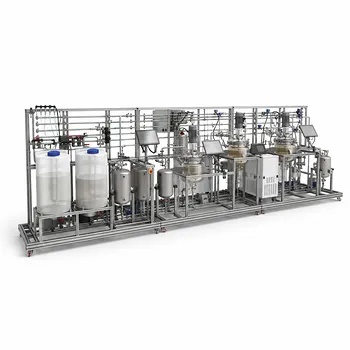
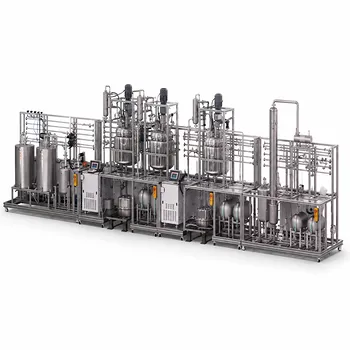
Green chemistry isn’t just a theory—it’s a measurable practice that bioprocess pilot plants bring to life. When you use a whole-cell biocatalyst to reduce a ketone, you’re already showing solvent-free, mild-condition synthesis. The real pedagogical and industrial leap comes when you regenerate the expensive coenzyme NADH in situ by coupling a glucose/glucose dehydrogenase system, achieving near-total conversion in water at room temperature without hazardous reagents.
Pilot plants move whole-cell biocatalysis from a flask to a scalable, data-rich environment where green chemistry’s 12 principles become tangible. The core demonstration is an enzyme-driven, cofactor-recycling reduction that runs efficiently under benign conditions—proving that high selectivity, low energy use, and waste prevention are commercially viable, not just aspirational.
The Core Green Chemistry Demonstration: Whole-Cell Biocatalysis with Cofactor Recycling
A bioprocess pilot plant is the ultimate stage for proving that a chemical synthesis can be both high-performing and inherently sustainable. The centerpiece is an asymmetric reduction using a whole-cell catalyst that carries its own dehydrogenase enzymes and the expensive, recyclable helper molecule NADH.
The Reduction Reaction at Mild, Aqueous Conditions
Whole cells—such as plant tissue slices or microbial pastes containing ketoreductases—are loaded into a stirred-tank bioreactor. A prochiral ketone substrate is added, and the dehydrogenase enzyme transfers a hydride from NADH to the substrate, forming a chiral alcohol.
The reaction proceeds in plain water, at room temperature, and at near-neutral pH. This directly demonstrates several green principles: safer solvents, energy efficiency, and catalysis at mild conditions. The pilot plant’s sensors log temperature, pH, and dissolved oxygen, creating a permanent record that the process avoids the extreme temperatures and toxic organic solvents of traditional stoichiometric reductions.
The Cofactor Regeneration Loop: Closing the Economic Circle
NADH is too costly to use as a single-use reagent. The pilot plant proves the power of regeneration by integrating a parallel enzymatic reaction. Glucose and a small amount of glucose dehydrogenase are added to the same vessel. This enzyme oxidizes glucose to glucono-δ-lactone, simultaneously reducing spent NAD⁺ back to fresh NADH.
The result is a closed cofactor cycle. Because the NADH is continuously recycled at a high turnover number, its effective cost plummets. Pilot-scale monitoring shows the ketone conversion reaching up to 98%, with virtually no stoichiometric waste. This directly exemplifies atom economy and waste prevention, while the gentle aqueous environment makes downstream processing simpler.
Analyzing the Reaction Metrics that Prove Green Credentials
Once the pilot run stabilizes, the data becomes a textbook green-chemistry scorecard. You can measure:
- Selectivity: Over 99% enantiomeric excess achievable, eliminating toxic separation steps.
- Energy footprint: Near-zero thermal input versus high-temperature chemical routes.
- Solvent inventory: Water as the sole medium, drastically reducing E-factor (kg waste/kg product).
- Catalyst reusability: Whole cells can often be filtered and reused for multiple batches, further cutting material demand.
How Pilot Plants Unlock the Full Potential of Biocatalysis
Moving beyond a single demonstration, the pilot plant environment allows you to systematically explore, optimize, and validate the broader green chemistry performance of whole-cell systems.
Bridging the Gap from Lab Curiosity to Scalable Process
Lab-scale reactions often ignore mixing times, bubble-induced shear stress, and sustained biocatalyst stability. A pilot bioreactor with precisely controlled impeller speed, gassing rate, and temperature forces you to confront mass transfer limitations. You can observe how substrate concentration gradients affect cell viability and adjust feeding strategies to maintain high cofactor recycling rates over a 24-hour continuous run.
This is where sustainability meets engineering reality. The pilot plant generates the mass balances and kinetic data needed to design a full-scale facility that genuinely prevents waste rather than treating it afterward.
Directly Comparing Green and Traditional Chemical Routes
The same pilot plant infrastructure that runs the biocatalytic reduction can be used for a conventional chemical synthesis—for instance, a borohydride reduction of the same ketone. By switching configurations, students and engineers can quantify the difference in:
- Hazardous reagent inventories (no metal hydrides or cooling baths in the biocatalytic route).
- Solvent recovery load (water versus THF or dichloromethane).
- Product workup complexity (simple filtration and extraction versus quench and salt removal).
This side-by-side analysis converts abstract green chemistry principles into measured dollar savings and risk reductions.
Demonstrating Continuous Operation and Process Integration
A staged setup—combining the bioreactor with a cross-flow filtration unit for cell recycling and a mild product adsorption column—shows how process intensification further reduces environmental impact. By running in continuous mode, you minimize downtime, improve space-time yield, and prevent the accumulation of inhibitory by-products. The pilot plant allows you to test these integrations safely and affordably before capital expenditure at production scale.
Understanding the Trade-offs
Demonstrating green chemistry through whole-cell biocatalysis is not without its challenges, and the pilot plant is the right place to expose them honestly.
- Biocatalyst stability: Whole cells can lyse or lose enzyme activity over time under shear. Pilot data must map the viable operational window and define a replacement or immobilization strategy.
- Substrate and product inhibition: High substrate concentrations, while good for throughput, may poison the dehydrogenase enzyme. The pilot plant helps identify the feed concentration that balances rate and cell health.
- Contamination risk: A nutrient-rich aqueous medium at room temperature is ideal for unwanted microbes. Sterility protocols and sanitization cycles become critical lessons in process design.
- Oxygen sensitivity: The glucose dehydrogenase reaction is oxygen-tolerant, but the overall cell metabolism may shift undesirably if dissolved oxygen is not carefully controlled. The pilot plant’s DO probes make this visible.
- Downstream purification: While waste is minimized, separating dilute product from a complex broth still requires careful design of extraction, distillation, or crystallization steps that the pilot flowsheet should include to give a complete life-cycle picture.
Making the Right Choice for Your Goal
The pilot plant is a versatile tool. How you configure and run it depends on the primary learning or validation objective.
- If your primary focus is teaching green chemistry principles: Use the whole-cell reduction with cofactor recycling as a visually compelling, single-experiment demonstration. Compare it immediately to a sodium borohydride route to make the waste, energy, and safety advantages unforgettable.
- If your primary focus is process optimization: Design a series of steady-state runs varying glucose-to-substrate ratio, cell loading, and residence time. Target the minimum cofactor leakage and maximum enantiomeric excess to define the true economic optimum.
- If your primary focus is scaling up for industrial deployment: Integrate continuous cell retention and downstream purification modules. Run the system for extended periods to generate reliability data, mass balances, and a full E-factor analysis that justifies the investment in biocatalysis over a petrochemical route.
- If your primary focus is expanding the biocatalytic toolkit: Use the same reactor base but swap in different whole-cell strains to compare performance on a series of ketone or aldehyde substrates, building a predictive map of selectivity and rate under NADH cofactor limitation versus regeneration conditions.
Every run in a bioprocess pilot plant transforms green chemistry from a list of ideals into a quantified, scalable manufacturing strategy. By coupling coenzyme regeneration with whole-cell catalysis under real-time sensor control, you don’t just demonstrate sustainability—you measure it precisely, making the business and environmental case unassailable.
Summary Table:
| Metric / Parameter | Traditional Chemical Route (e.g., Borohydride) | Biocatalytic Route (Whole-Cell + NADH Recycle) |
|---|---|---|
| Reaction Medium | Hazardous organic solvents (e.g., THF, DCM) | Safe, neutral aqueous solution (Water) |
| Operating Temperature | Extreme heat or cooling baths required | Mild, ambient room temperature |
| Selectivity | Variable (often requires toxic separation steps) | Extremely high (>99% enantiomeric excess) |
| Waste & E-Factor | High (stoichiometric reagents and salt waste) | Very low (continuous cell & cofactor recycling) |
Bring Green Chemistry to Life in Your Facility
LABPARK helps universities, research institutes, and enterprises bridge the gap between lab-scale theory and industrial reality. We provide advanced Educational and Vocational Unit Operations Pilot Plants in chemical engineering, bioprocess & biotech, and environmental & water treatment.
Ready to demonstrate sustainable manufacturing, optimize whole-cell biocatalysis, or train future engineers? Contact our team today to find the perfect pilot plant solution!
Related Products
- Bio-fermentation Ethanol Production Practical Training Unit Operations Pilot Plant
- Natural Product Extraction Unit Operations Training Pilot Plant
- High-Gravity Emulsification and Mass Transfer Educational Pilot Plant
- Continuous Batch Extractive Distillation Educational Pilot Plant
- Multi-Functional Special Distillation Educational Pilot Plant
People Also Ask
- Why Use PTFE & Hastelloy in Chemical Pilot Plants? Prevent Corrosion & Ensure Safety
- Why Compare Predicted and Experimental Excess Enthalpy? Key to Accurate Pilot Plant Scale-up
- Why is the chemical plant startup schedule crucial? De-risk scale-up with pilot plants.
- When to transition from PID to adaptive control in pilot plants? Key process indicators.
- Why must batch and fed-batch fermentation pilot plants be designed to accommodate changing rheological conditions?