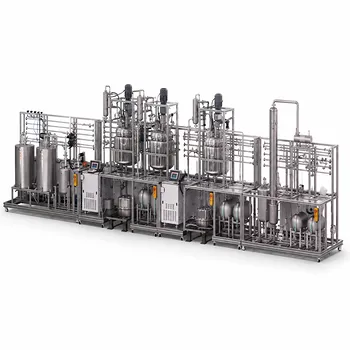
Knowledge Bioprocess and Biotechnology Education How can bioprocess pilot plants optimize temperature and pH? Achieve 60% Faster Batch Times
Author avatar

Tech Team · LABPARK

Updated 1 month ago

How can bioprocess pilot plants optimize temperature and pH? Achieve 60% Faster Batch Times


The path to a 60% faster batch time starts with a pilot plant's ability to turn guesswork into precision. Bioprocess pilot plants enable researchers and students to optimize temperature and pH profiles by running controlled batch fermentations under systematically varied conditions, measuring microbial kinetic parameters, and then using that data to build and validate predictive models. These models reveal the exact temperature and pH setpoints—and dynamic shifts—that maximize product yield and minimize processing time.

Temperature and pH optimization isn't about finding a single “best” number; it's about using pilot-plant data to understand how microbial growth and product formation respond to these parameters over time. Bioprocess pilot plants provide the controlled environment and sensor-rich infrastructure necessary to map those responses, leading to yield improvements around 15% and batch time reductions of up to 60%.

Mapping the Microbial Landscape Through Controlled Experimentation

Every microorganism has a unique relationship with its environment. Bulk textbooks offer general ranges, but precise optimization demands empirical data collected under your exact operational conditions. Pilot plants bridge that gap.

The Laboratory of Repeatable Runs

Unlike shake flasks, a pilot-plant bioreactor offers precise, automated control over temperature via heating/cooling jackets and pH through integrated acid/base dosing pumps. This allows you to run identical batch fermentations, altering only one variable at a time.

The result is a clean dataset. You can directly correlate a shift in temperature setpoint with a change in the maximum specific growth rate (μ_max), or tie a pH deviation to a measurable drop in enzyme activity. This removes the noise that plagues small-scale, manually adjusted experiments.

From Raw Data to Kinetic Models

The data you collect—biomass concentration, substrate depletion, product titer—feeds directly into kinetic modeling. For example, the relationship between μ_max and temperature typically follows an Arrhenius-type law below the optimum, then collapses rapidly above it as proteins denature.

By fitting experimental data to these models, you move beyond intuition. The model will mathematically identify the temperature that gives the highest growth rate, and just as importantly, reveal how sensitive that rate is to a one-degree drift. This is the foundation of true optimization.

The Critical Role of Dynamic Profiling in Batch Processes

A batch fermentation is not a steady state. The optimal conditions at inoculation are rarely the optimal conditions during the peak production phase. Pilot plants are the only setting where you can design, test, and teach dynamic strategies.

Why a Static Setpoint Leaves Yield on the Table

Early in a batch, the goal is rapid biomass generation. This often favors a temperature near the organism's optimum for growth. However, the subsequent production of a secondary metabolite (like penicillin) or a recombinant protein may have a different, often lower, optimal temperature to reduce cell stress and enhance product stability.

Similarly, as cells metabolize, they acidify the broth. A pilot plant's automated pH dosing can maintain a constant setpoint, but a more sophisticated profile might intentionally shift the pH during the production phase to favor a specific enzymatic pathway. This level of dynamic control is only achievable and demonstrable in a fully instrumented pilot system.

Bridging Theory and Industrial Reality

For education, this is the “aha” moment. Students can read about substrate inhibition or optimal temperature ranges, but in a pilot plant they see the dissolved oxygen crash after a bolus feed or the off-gas CO₂ spike following a temperature ramp. They learn to correlate sensor data with physiological states, building the diagnostic skills needed to operate and troubleshoot industrial-scale fermentations.

Understanding the Trade-offs and Technical Limitations

Optimization is not about perfection—it is about managing constraints. A clear-eyed view of the challenges builds trust in the methodology.

The Cost of Precision Versus Practicality

Running 20+ batch experiments to perfectly map every interaction is time-consuming and resource-intensive. There is always a trade-off between the granularity of your model and practical experimental throughput.

Smart experimental design becomes essential. Techniques like a central composite design (CCD) can map a response surface with fewer runs, but still require the reliable, automated execution that only a pilot plant provides.

When the Model Misleads

A kinetic model developed with a clean, defined medium in a pilot plant may not perfectly predict behavior in a complex industrial feedstock. The presence of solid particulates, antifoam agents, or fluctuating raw material quality adds variables that a simple temperature-pH model cannot capture.

The true lesson for students and researchers is that the pilot-plant model provides a robust starting point, not the final answer. It defines the optimal window; plant-scale trials then refine from there. This teaches the iterative nature of bioprocess development, where the pilot plant is the critical link between microbial physiology and manufacturing reality.

Making the Right Choice for Your Research or Training Goal

The way you use a pilot plant to optimize profiles depends entirely on your primary objective. Align your experimental design with that goal from the start.

  • If your primary focus is fundamental research on microbial kinetics: Design a matrix of tightly controlled batch runs at fixed, discrete temperatures and pH levels. Your goal is to generate the cleanest possible dataset to derive parameters like activation energy and inhibition constants for a rigorous kinetic model.
  • If your primary focus is maximizing the economic yield of a specific product: Shift to dynamic profiling. Start with a model-generated profile that ramps temperature and pH from a growth-optimized phase to a production-optimized phase, and then use subsequent runs to empirically refine the shift timing based on product titers.
  • If your primary focus is hands-on education and workforce training: Structure the course so students first build a theoretical model, then use the pilot plant to test it. Requiring them to reconcile their predicted outcomes with real-time bioreactor data—debugging differences caused by lag phases or oxygen limitations—teaches process engineering far more effectively than any simulation.

The data you extract from a well-run pilot plant doesn't just answer the question of what conditions work best; it teaches you why they work, transforming your team from process operators into process architects.

Summary Table:

Focus Area Optimization Strategy Key Outcome & Benefit
Fundamental Research Tightly controlled runs at fixed temperature/pH levels Clean datasets to derive microbial kinetic parameters
Economic Yield Dynamic profiling (shifting setpoints between growth/production phases) Up to 15% higher yield & 60% shorter batch times
Education & Training Reconciling student-built models with real-time runs Practical troubleshooting and process diagnostic skills

Bridge the Gap Between Bioprocess Theory and Scale-Up Reality

Equip your students and researchers with the tools to master dynamic fermentation optimization. LABPARK offers premium Educational and Vocational Unit Operations Pilot Plants across chemical engineering, bioprocess & biotech, and environmental & water treatment.

Whether you are a university, research institute, or enterprise, our pilot plants deliver:

  • Precise Control: Automated temperature and pH dosing systems to eliminate experimental noise.
  • Real-World Training: Hands-on experience with industrial-grade, sensor-rich environments.
  • Optimized Yields: Proven configurations that help reduce batch times by up to 60% and boost yields by 15%.

Ready to elevate your research and training capabilities? Contact LABPARK today to find the perfect pilot plant solution for your lab.

Related Products

People Also Ask

Related Products

Bio-fermentation Ethanol Production Practical Training Unit Operations Pilot Plant

Bio-fermentation Ethanol Production Practical Training Unit Operations Pilot Plant

Bio-fermentation ethanol production pilot plant for hands-on training in unit operations: fermentation, solid-liquid filtration, membrane separation, and distillation. Bridges theory with industrial practice using industrial-grade components, customizable for university labs. Hybrid automated and manual control for comprehensive learning.

Natural Product Extraction Unit Operations Training Pilot Plant

Natural Product Extraction Unit Operations Training Pilot Plant

Integrated natural product extraction pilot plant for chemical engineering training bridges theory and industrial practice with modular extraction and evaporation/concentration units, hybrid touchscreen and manual control, realistic process simulation, and self-contained softened water and vacuum utilities.

High-Gravity Emulsification and Mass Transfer Educational Pilot Plant

High-Gravity Emulsification and Mass Transfer Educational Pilot Plant

This integrated educational pilot plant utilizes rotating packed bed technology to demonstrate high-gravity emulsification and mass transfer, providing engineering students with hands-on experience in process intensification and unit operations through a modular, customizable design with digital monitoring.

Continuous Batch Extractive Distillation Educational Pilot Plant

Continuous Batch Extractive Distillation Educational Pilot Plant

Versatile pilot plant for continuous, batch, and extractive distillation training. High-borosilicate glass column for visualizing hydraulics, 15.6-inch touchscreen with data logging, precise reflux ratio control 1-99, and durable corrosion-resistant frame. Ideal for chemical engineering education and process research.

Multi-Functional Special Distillation Educational Pilot Plant

Multi-Functional Special Distillation Educational Pilot Plant

Versatile multi-functional special distillation pilot plant for chemical engineering education. Supports continuous, vacuum, azeotropic, reactive, extractive distillation. Transparent glass columns enable real-time visual observation of hydrodynamics and separation processes.

Ethyl Acetate Synthesis Unit Operations Pilot Plant for Practical Training

Ethyl Acetate Synthesis Unit Operations Pilot Plant for Practical Training

Modular and customizable pilot plant for ethyl acetate synthesis practical training. Integrates esterification reaction, liquid-liquid extraction, neutralization, and sieve-plate distillation unit operations. Bridging theory and real-world industrial processes. Designed for university chemical engineering labs

Polymerization Granulation and Pellet Processing Educational Unit Operations Pilot Plant

Polymerization Granulation and Pellet Processing Educational Unit Operations Pilot Plant

Integrated pilot plant for teaching polymer processing from polymerization to pelletizing. Includes 30L reactor, hydrolyzer, extruder-granulator, vibration dryer, crusher, and sieve. Atmospheric pressure operation for safety, corrosion-resistant SS, customizable for chemical and polymer engineering education. Ideal for university labs.

Methanol Synthesis and Catalyst Performance Evaluation Educational Unit Operations Pilot Plant

Methanol Synthesis and Catalyst Performance Evaluation Educational Unit Operations Pilot Plant

Bench-scale methanol synthesis and catalyst evaluation educational pilot plant for chemical engineering labs to study catalytic kinetics, high-pressure operations, process control, and unit operations under realistic conditions with industrial safety features, precision gas delivery, data acquisition, and intelligent monitoring.

Multifunctional Membrane Separation Educational Pilot Plant with Ultrafiltration, Nanofiltration, Reverse Osmosis

Multifunctional Membrane Separation Educational Pilot Plant with Ultrafiltration, Nanofiltration, Reverse Osmosis

An integrated laboratory bench-scale membrane separation system for higher education engineering labs combining Ultrafiltration, Nanofiltration, and Reverse Osmosis processes. Features industrial PLC control with touch-screen HMI, transparent piping, and academic assessment software. Ideal for chemical and environmental engineering curricula.

Educational Unit Operations Pilot Plant for Intraparticle Diffusion Effective Factor Measurement

Educational Unit Operations Pilot Plant for Intraparticle Diffusion Effective Factor Measurement

Designed for chemical engineering university labs, this pilot plant allows hands-on determination of catalyst particle intraparticle diffusion effective factors and gas-solid reaction kinetics using a fixed-bed tubular reactor with industrial touchscreen control, bridging theory and practical reactor design.

Multi-Reactor Educational Pilot Plant for Reaction Engineering Unit Operations

Multi-Reactor Educational Pilot Plant for Reaction Engineering Unit Operations

Integrated bench-scale educational pilot plant for chemical engineering teaching featuring fixed bed fluidized bed and stirred tank reactors with web-based digital twin controls and safety interlocks for hands-on unit operations and reaction engineering comparative studies in one compact system.

Residence Time Distribution and Reactor Flow Characteristics Determination Educational Pilot Plant

Residence Time Distribution and Reactor Flow Characteristics Determination Educational Pilot Plant

This versatile educational pilot plant is designed for comprehensive study of residence time distribution and reactor flow characteristics, featuring multiple CSTRs in series, a tubular reactor, variable recycle loop, and automated real-time data acquisition, perfect for hands-on chemical engineering education.

Electrolyte Distillation Purification and Formulation Educational Pilot Plant

Electrolyte Distillation Purification and Formulation Educational Pilot Plant

Integrated bench-to-pilot scale educational pilot plant for electrolyte distillation, purification, and formulation with borosilicate glass construction, PLC automation, touchscreen HMI, and advanced industrial safety features for hands-on chemical process training, ideal for chemical engineering and materials science curricula.

Fixed-Bed Chemical Reaction and Gas Dust Tar Removal Unit Operations Pilot Plant

Fixed-Bed Chemical Reaction and Gas Dust Tar Removal Unit Operations Pilot Plant

Integrated educational pilot plant for studying catalytic gas-solid reactions and downstream gas purification. Features dual fixed-bed reactor, three-stage heating, and touchscreen control for hands-on engineering training. Ideal for chemical and environmental engineering curricula.

Rising and Falling Film Evaporation Educational Unit Operations Pilot Plant

Rising and Falling Film Evaporation Educational Unit Operations Pilot Plant

Hands-on educational pilot plant for studying rising and falling film evaporation, flow regimes, and heat transfer. Customizable for university labs with industrial instrumentation and data acquisition. Enables comparative evaluation of evaporation modes and energy efficiency.

Multi-Functional Membrane Separation Educational Pilot Plant for Unit Operations Lab

Multi-Functional Membrane Separation Educational Pilot Plant for Unit Operations Lab

The Multi-functional Membrane Separation Educational Unit Operations Pilot Plant is an integrated bench-scale laboratory system designed for teaching undergraduate engineering education. It features Ultrafiltration, Nanofiltration, and Reverse Osmosis modules in a compact, mobile unit for practical hands-on learning.

Multi Functional Membrane Crystallization Educational Unit Operations Pilot Plant

Multi Functional Membrane Crystallization Educational Unit Operations Pilot Plant

Integrated bench-scale membrane crystallization pilot plant for engineering education. Provides hands-on training in advanced separation technologies, combining membrane distillation crystallization and process intensification. Features variable scaling vessels, industrial-grade flow control, and interactive digital data acquisition. Customizable for university labs.

General Purpose Cosmetics Production Unit Operations Training Pilot Plant

General Purpose Cosmetics Production Unit Operations Training Pilot Plant

Integrated pilot-scale cosmetics production training plant for chemical engineering education featuring utility supply emulsification blending and filtration modules with dual touchscreen manual control customizable mobile design ideal for practical hands-on unit operations and advanced process control learning.

Aspirin API Synthesis Unit Operations Training Pilot Plant

Aspirin API Synthesis Unit Operations Training Pilot Plant

An integrated pilot plant for aspirin API synthesis training, featuring batch reaction, recrystallization, and packed distillation modules. Offers dual-control operation, transparent vessels, and public utility simulation for safe, hands-on chemical engineering unit operations education. Ideal for university labs.

Multi Functional Catalytic Reaction and Reactor Evaluation Educational Unit Operations Pilot Plant

Multi Functional Catalytic Reaction and Reactor Evaluation Educational Unit Operations Pilot Plant

Bench-scale educational pilot plant for catalytic reaction and reactor evaluation, integrating fixed bed, fluidized bed, and stirred tank reactors. Students compare reactor designs, evaluate catalysts, and study reaction kinetics and hydrodynamics. Perfect for unit operations labs in chemical engineering curricula.


Leave Your Message