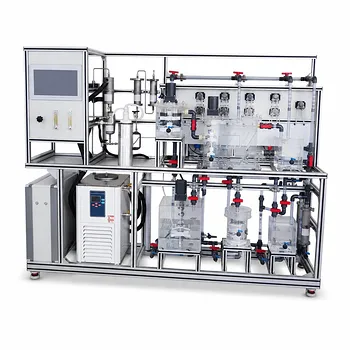
The secret to making titration data meaningful in a wet scrubber pilot plant is conditional mass balance.
Instructor-led sessions can walk students through the measurement of three equivalent values—total alkalinity (A), sulfide-plus-mercaptan alkalinity (B), and sulfide-only concentration (C)—then apply a clear set of algebraic rules. When total alkalinity exceeds the sulfide/mercaptan contribution, free sodium hydroxide appears; when it falls short, the distribution shifts toward sodium hydrosulfide and even dissolved H₂S. This exercise transforms abstract equilibrium concepts into a practical, hands-on skill tied directly to scrubber performance and safety.
Central insight: Treat the titration results not as isolated numbers but as three puzzle pieces that, when fitted together via mass‑balance conditions, reveal the exact chemical portrait of the spent alkaline solution—NaOH, Na₂S, and NaHS. This conditional logic teaches students to move beyond raw lab data into actionable process understanding.
Translating Titrations into Equivalent Values
Before any calculation, students must grasp what each titration actually measures in the spent scrubber sample.
Total Alkalinity (A) – The Acid‑Neutralizing Power
Titrating with a strong acid (usually HCl) to the methyl orange endpoint (pH ~4.5) captures every base that can consume protons: hydroxides, carbonates, sulfides, and hydrosulfides.
The result, expressed as equivalents per litre (meq L⁻¹), is the total alkalinity (A).
This single number sums the contributions of NaOH, Na₂S, NaHS, and carbonates or mercaptides that may be present.
Sulfide‑Plus‑Mercaptan Equivalent (B) – The Silver Nitrate Snapshot
A potentiometric or indicator‑based titration with silver nitrate (AgNO₃) precipitates sulfide as Ag₂S and mercaptides as AgSR.
With the correct stoichiometric conversion, the titre yields a value (B) that represents the alkalinity that would be consumed if all the measured sulfide and mercaptan sulfur were fully converted to H₂S or thiols.
(B) therefore gives the acid‑neutralizing capacity attributable solely to the sulfur‑containing species.
Sulfide‑Only Content (C) – Isolating the Inorganic Sulfur
An additional analytical step (such as a selective sulfide electrode, a cadmium‑based precipitation, or a separate iodometric back‑titration) quantifies only the inorganic sulfide, excluding the organic mercaptans.
The result is the equivalent concentration of total dissolved sulfide, expressed either as meq L⁻¹ or as mg L⁻¹ of S²⁻.
This value (C) becomes the pivot for assigning Na₂S concentration when the alkalinity balance allows.
The Conditional Logic That Unlocks the Species Distribution
Once (A), (B), and (C) are in hand, the instructor can reveal a simple decision tree rooted in the principle of electroneutrality: the total positive charge (Na⁺) must equal the sum of the negative charges from the various anions.
Condition I: (A > B) – Excess Caustic Holds Sulfide as Na₂S
When total alkalinity exceeds the sulfide‑plus‑mercaptan base contribution, the only explanation is free sodium hydroxide.
The high pH forces all dissolved sulfide into the fully deprotonated S²⁻ form—there is no NaHS.
The calculation becomes straightforward:
- Free NaOH = (A - B)
- Na₂S = (C) (the entire sulfide‑only content appears as Na₂S)
- NaHS = 0
This scenario often signals a fresh, highly‑alkaline scrubber liquor that still has abundant hydroxide.
Condition II: (A = B) – Hydroxide Is Gone, Sulfide Remains Fully Deprotonated
When the alkalinity and the sulfide‑mercaptan contribution match exactly, there is no free NaOH, yet the pH is still high enough to keep all sulfur as S²⁻.
Consequently, the distribution is equally clean:
- NaOH = 0
- Na₂S = (C)
- NaHS = 0
This represents the “breakpoint” where the caustic is exhausted but the sulfide has not yet started to protonate.
Condition III: (A < B) – The Rise of Hydrosulfide and Possible H₂S
A deficit in total alkalinity means that some of the sulfur‑bearing species are only partially neutralized. The key assumption is that no free NaOH exists, and the difference (B - A) corresponds to the number of equivalents that must be supplied by NaHS (each mole of HS⁻ contributes only one equivalent to the alkalinity instead of the two that S²⁻ would).
Solving the mass balances gives:
- NaOH = 0
- NaHS = (B - A)
- Na₂S = (C - (B - A)) = (C + A - B)
If (A) becomes substantially lower than (B), the calculated Na₂S may fall to zero, and the remaining sulfide can be assigned as dissolved H₂S.
This condition warns of an almost‑spent scrubber where toxic H₂S could begin to escape.
Extending the Method to Real Scrubber Matrices
The three‑value framework is deliberately simplified for teaching, but pilot‑plant instructors can use it to introduce real‑world complexities as advanced extensions.
Accounting for Carbonates
In many scrubbing applications, atmospheric CO₂ dissolves to form carbonate and bicarbonate.
Once students master the basic sulfide distribution, instructors can introduce a fourth titration—total carbonate alkalinity—and extend the conditional rules to partition alkalinity among NaOH, Na₂CO₃, NaHCO₃, Na₂S, and NaHS.
Handling Mercaptans and Other Reduced Sulfur Species
While (B) includes mercaptans, the simple conditions treat them as an inert alkalinity‑equivalent block that does not interchange with sulfide.
Advanced sessions can challenge students to separate mercaptan‑derived alkalinity from the sulfide‑specific contributions and to explore how mercaptan oxidation changes the overall balance.
Understanding the Trade‑offs
Even the best‑constructed titration exercise has limitations. Being transparent about them builds trust and deepens learning.
Endpoint Ambiguity and Interferences
The methyl orange endpoint for total alkalinity may be fuzzy in dark, sulfide‑laden solutions, and residual oxidants can partially convert sulfide before the analysis.
Instructors should demonstrate the use of buffered reference solutions and, where possible, corroborate with pH‑electrode titrations.
Assumption of Complete Dissociation
Condition I assumes that all sulfide exists as Na₂S, ignoring the tiny equilibrium concentration of HS⁻ that persists even at high pH.
This simplification is pedagogically sound but must be flagged when transitioning to rigorous thermodynamic calculations.
Unaccounted Cations or Complexing Agents
The mass‑balance equations assume sodium is the sole cation and that no metal‑sulfide complexes form.
In pilot plants treating real flue gas, iron or zinc can sequester sulfide, causing the calculated distribution to deviate from the true ionic picture.
Unit Confusion
A common student error is mixing meq L⁻¹ with mg L⁻¹ or molarity.
Require students to convert all titration values to the same equivalent unit before applying the conditional rules, and to label their results unambiguously.
Making the Right Choice for Your Teaching Goal
The path you emphasize will depend on whether your course focuses on fundamental chemistry, operator skills, or troubleshooting.
- If your primary focus is fundamental mass balances: Lead with the derivation of the three equivalent values and the algebraic conditions, ensuring students see the electroneutrality principle behind each equation.
- If your primary focus is pilot‑plant operation: Frame the exercise around interpreting the output—e.g., “A NaOH = 0 reading means it is time to replenish the caustic feed,” turning titration data into a live process‑control signal.
- If your primary focus is environmental compliance or safety: Highlight the H₂S‑release risk when condition III appears, and use the calculated NaHS concentration to estimate the stripping potential in the foul‑water stripper.
- If your primary focus is analytical method development: Challenge students to improve the endpoint detection, add a carbonate titration, and compare their calculation with independent ion‑chromatography results.
A structured titration exercise turns the pilot plant from a black‑box absorption column into a transparent chemical reactor, empowering students to see the invisible chemistry that governs scrubber performance.
Summary Table:
| Condition | Alkalinity Relationship | NaOH Concentration | Na2S Concentration | NaHS Concentration | Process Interpretation |
|---|---|---|---|---|---|
| Condition I | A > B | A - B | C | 0 | Excess caustic; fresh alkaline liquor |
| Condition II | A = B | 0 | C | 0 | Breakpoint; caustic fully exhausted |
| Condition III | A < B | 0 | C + A - B | B - A | Spent scrubber; risk of toxic H2S release |
Elevate Your Environmental Engineering Lab with LABPARK
Ready to transform abstract equilibrium chemistry into hands-on student mastery? LABPARK provides state-of-the-art Educational and Vocational Unit Operations Pilot Plants in chemical engineering, bioprocess & biotech, and environmental & water treatment.
Designed specifically for universities, research institutes, and enterprises, our pilot plants offer a realistic platform to perform complex titrations, analyze mass balances, and manage process safety parameters in real time.
Contact us today to discover how LABPARK pilot plants can enhance your engineering curriculum and research capabilities!
Related Products
- Alkaline Membrane Water Electrolysis Educational Pilot Plant Unit Operations Training System
- Fixed-Bed Chemical Reaction and Gas Dust Tar Removal Unit Operations Pilot Plant
- Natural Product Extraction Unit Operations Training Pilot Plant
- Green Anhydrous Ethanol Refining Practical Training Pilot Plant
- Ethyl Acetate Synthesis Unit Operations Pilot Plant for Practical Training
People Also Ask
- How do chemical engineering pilot plants demonstrate electrolysis? Bridge Theory & Industrial Scale
- How do alkaline and PEM electrolysis technologies differ in pilot plant operations?
- Why is the selection of electrode materials critical when configuring or operating educational electrolysis pilot plants?
- Bipolar vs Monopolar Electrolysis: Key Configuration Details to Analyze in Pilot Plants
- Which Electrolysis Pilot Plant Parameters Ensure Safety & Efficiency? Key Controls Explained