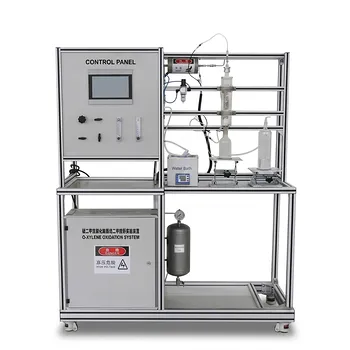
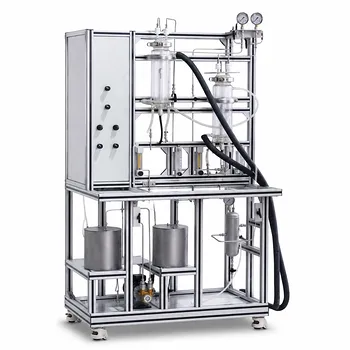
By using a selective platinum-rhodium gauze catalyst, maintaining a high reaction temperature, and enforcing extremely short gas residence times—typically between 10⁻⁴ and 10⁻³ seconds—a chemical engineering unit operations pilot plant can demonstrate that rapid kinetic rates for nitric oxide formation readily outrun the thermodynamically preferred path to nitrogen. When the pilot plant’s flow control is adjusted to minimize the time ammonia and oxygen spend in the hot reaction zone, the kinetically fast but thermodynamically less favorable NO-producing pathway dominates, providing a clear, data-backed lesson in reactor design.
Ammonia oxidation is the classic example of a reaction where thermodynamics and kinetics pull in opposite directions: N₂ formation is favored at equilibrium, but the desired NO can be produced with high selectivity by exploiting a highly active catalyst, an optimal temperature window, and contact times short enough to “freeze” the kinetic product before equilibrium is reached. A well‑instrumented pilot plant lets students and researchers systematically manipulate these variables to see exactly how kinetic control is achieved.
Why Thermodynamics Favors Nitrogen While Industry Wants Nitric Oxide
The ammonia oxidation reaction can proceed along two main paths. The first yields nitric oxide and water, while the second leads to nitrogen and water. From a purely equilibrium standpoint, the formation of N₂ is overwhelmingly preferred because it releases more free energy and leads to a lower, more stable energy state.
The Competing Pathways
When ammonia and oxygen mix over a hot catalyst, multiple reaction networks compete. The direct oxidation to NO is endothermic and equilibrium‑limited, whereas the path to N₂ is highly exothermic and thermodynamically downhill. In a conventional reactor given enough time, the system would drift toward the equilibrium‑favored N₂ product, ruining selectivity.
Why Kinetics Override the Destination
Happily, chemistry is not governed by thermodynamics alone. The NO‑forming reaction has a much lower activation energy on the right catalyst, making it intrinsically faster. If the reaction mixture spends only microseconds in the catalyst zone, the fast NO‑producing step has time to occur while the slower, thermodynamically favored side reactions are starved of contact time. The pilot plant is the ideal environment to visualize this race between speed and stability.
How the Pilot Plant Puts Kinetic Control Into Practice
A dedicated unit‑operations pilot plant for ammonia oxidation strips the problem down to its essentials: a precise gas feed system, a short‑contact‑time reactor housing a Pt‑Rh gauze, and a suite of sensors. By giving operators direct control over flow, temperature, and feed composition, the plant becomes a demonstration stage where the principles of kinetic selectivity come to life.
The Selective Pt‑Rh Gauze Catalyst
The catalyst is not simply an accelerator; it is the selectivity agent. Platinum‑rhodium gauzes are the industrial standard because they dramatically lower the activation energy for NO formation while leaving the N₂ pathway largely unaffected. In the pilot plant, the gauze is typically a thin, woven mesh placed across the reactor tube so that gases pass through it with minimal pressure drop. Users can observe how even subtle changes in catalyst surface condition—such as activation or poisoning—instantly shift the selectivity.
Temperature as a Kinetic Lever
High temperature (usually 800–950 °C) is essential for two reasons. First, it ensures the catalyst is active enough to make the reaction almost instantaneous. Second, because the NO‑forming reaction has a lower activation energy than the decomposition routes that lead to N₂, a rapid temperature increase accelerates the desired reaction more than the undesired ones. The pilot plant’s integrated heaters and embedded thermocouples let operators sweep temperature while monitoring how selectivity rises and then plateaus—creating a vivid picture of the kinetic window.
Extremely Short Residence Times (10⁻⁴ to 10⁻³ Seconds)
This is the make‑or‑break variable. If gas molecules linger in the hot, catalytically active zone for more than a few milliseconds, the initially formed NO has time to decompose or react with unconverted ammonia to produce N₂. The pilot plant’s high‑precision mass flow controllers and a reactor geometry designed for minimal volume allow users to dial in residence times on the order of 0.1 to 1 millisecond. By varying the feed flow rate while holding temperature constant, operators directly visualize the inverse relationship between contact time and NO yield—the very definition of kinetic control.
Real‑Time Data That Reveals the Kinetic–Thermodynamic Tug‑of‑War
The pilot plant is instrumented to capture temperature profiles, pressure drops, and often online gas analysis (e.g., via FTIR or mass spectrometry). When students plot NO concentration against residence time at a fixed temperature, they see a peak that represents the kinetic optimum—the point where NO formation has gone as far as possible before the thermodynamically driven decay kicks in. This instant feedback transforms abstract reactor theory into a tangible, data‑driven experience.
Understanding the Trade‑offs and Practical Limits
No demonstration is without its constraints, and the ammonia oxidation pilot plant is no exception. The very short contact times that make kinetic control possible also demand extremely fast, accurate measurement and control systems—small drifts in flow or temperature dramatically shift the results. Moreover, operating at 900 °C with a precious‑metal gauze carries inherent safety and material challenges that must be carefully managed.
Catalyst Deactivation and Cost
Pt‑Rh gauzes slowly lose active surface area through metal volatilization, grain growth, and contamination. A pilot plant running repeated experiments must account for catalyst aging, as selectivity will drift downward if the gauze is not regularly reactivated or replaced. This is an excellent teachable moment about industrial practice but also a practical headache.
Safety and Scale‑Up Gaps
The millisecond‑scale residence times are straightforward to achieve in a small pilot plant but are far harder to maintain uniformly in a large industrial converter. The pilot plant represents an idealized, well‑mixed or plug‑flow micro‑environment; real reactors suffer from bypassing, channeling, and heat‑distribution challenges that erode kinetic control. Educators use this gap to discuss the complications of scaling up kinetic‑controlled processes.
The Analytical Bottleneck
Measuring NO selectivity reliably requires either a fast online analyzer or grab‑sample quenching. Poor sampling can give the misleading impression that the reaction has reached equilibrium, obscuring the very kinetic effect one aims to demonstrate. A well‑designed pilot plants trains operators in both reaction engineering and analytical rigor.
Making the Right Choice for Your Goal
Whether you are designing a pilot‑plant experiment, teaching a class, or assessing a technology, the way you use the ammonia oxidation setup should align with your specific objective. The same hardware can illuminate different facets of kinetic control.
- If your primary focus is teaching reaction engineering principles: Set up a structured lab where students alter flow rate (residence time) at a fixed temperature to plot selectivity versus contact time, directly illustrating how kinetics can “outrun” thermodynamics.
- If your primary focus is catalyst screening or process research: Use the pilot plant’s precise control to maintain identical residence time and temperature while swapping catalyst forms—active gauze, aged gauze, different alloys—to isolate the kinetic contribution of the catalyst.
- If your primary focus is safety and scale‑up studies: Deliberately increase residence time beyond the optimum while monitoring heat release and NO decomposition, demonstrating how thermal runaway and nitrogen formation are linked and underscoring the need for rapid heat removal in larger reactors.
- If your primary focus is data modeling and kinetic parameter estimation: Run a matrix of temperature and contact time conditions, collect concentration‑versus‑time profiles, and fit the data to a microkinetic model that separates the rate constants for NO formation and N₂ formation—cementing the concept that it is the magnitude of k₁ versus k₂ that dictates selectivity, not equilibrium constants.
A unit‑operations pilot plant turns the ammonia oxidation reaction into a live‑action lesson: when you understand and control the interplay of catalyst, temperature, and residence time, you can reliably steer a process toward the product that kinetics dictate, even when thermodynamics insists on a different destination.
Summary Table:
| Parameter | Role in Kinetic Control | Target Value / Range |
|---|---|---|
| Catalyst | Lowers activation energy for NO path over N₂ | Platinum-Rhodium (Pt-Rh) Gauze |
| Temperature | Accelerates desired reaction rate and selectivity | 800–950 °C |
| Residence Time | Prevents NO decay by freezing the kinetic product | 10⁻⁴ to 10⁻³ seconds (0.1–1 ms) |
| Monitoring | Tracks concentration vs. time profiles | Online Gas Analysis (FTIR/MS) |
Elevate Your Chemical Engineering Lab with LABPARK
Bridge the gap between thermodynamic theory and kinetic reality. LABPARK provides state-of-the-art Educational and Vocational Unit Operations Pilot Plants in chemical engineering, bioprocess & biotech, and environmental & water treatment.
Designed specifically for universities, research institutes, and enterprises, our pilot plants enable students and researchers to safely master reactor design, control residence times, and optimize reaction kinetics with real-time, high-precision data.
Ready to enhance your department's research and teaching capabilities? Contact us today to request a quote or custom configuration!
Related Products
- O-Xylene Oxidation to Phthalic Anhydride Educational Unit Operations Pilot Plant
- Photocatalytic Membrane Separation and Degradation Unit Operations Pilot Plant
- Methane Cracking Educational Unit Operations Pilot Plant
- Multi-Stage Stirred Tanks in Series Residence Time Distribution and Mixing Performance Determination Educational Pilot Plant
- Fixed-Bed Chemical Reaction and Gas Dust Tar Removal Unit Operations Pilot Plant
People Also Ask
- Why determine reaction order & activation energy in pilot plants? Key to safe scale-up.
- What materials fit high-temp oxidation pilot plants? Key Hastelloy & Titanium Requirements
- Under what conditions can axial diffusion be neglected? Reactor Simulation Guide
- What limitations exist in high-temp pilot reactor design? Key Material & Safety Rules
- How are sensitivity functions applied to parameter estimation in chemical reactor pilot plants? Guide