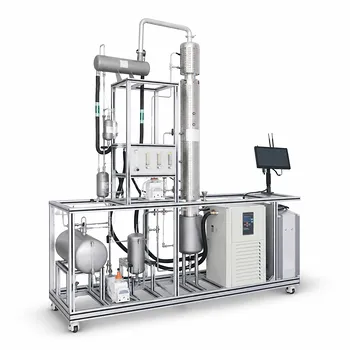
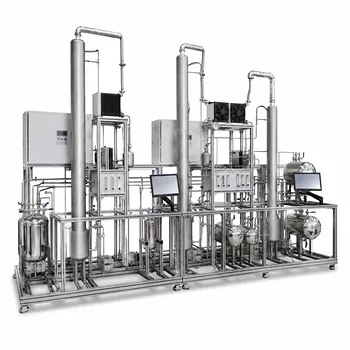
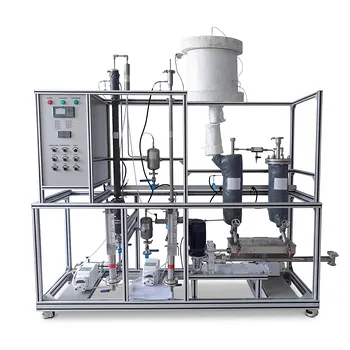
Optimizing a reactive distillation pilot plant for series reactions depends entirely on which product is your target. For a consecutive scheme A → S → R, the pilot column must be reconfigured to either preserve the intermediate S or drive the reaction all the way to R. This means pairing dynamic temperature/pressure profiling with deliberate choices about feed locations, liquid holdup, and side-stream withdrawals—all while the integrated separation continuously removes key species from the reaction zones.
The central insight: Control of the intermediate’s residence time and its exposure to reactive conditions is everything. A pilot plant optimized for series reactions must be able to dynamically adjust where and how fast the intermediate forms and departs, so you either instantly quench the second step (for S) or rapidly isolate S to complete the transformation elsewhere in the column (for R).
The Unique Challenge of Consecutive Reactions in Reactive Distillation
A reactive distillation column merges reaction and separation in one vessel, but series reactions add a layer of complexity. The intermediate S is both a product of the first reaction and a reactant for the second. Without deliberate design, the column can over-react S into unwanted R, wasting yield.
Traditional reactive distillation excels at overcoming equilibrium limits for single-step reactions. For consecutive kinetics, however, selectivity becomes the dominant concern. You must engineer the pilot-scale hardware and operating strategy to dominate the time- and space-dependent competition between the two reactions.
Two Divergent Optimization Strategies
The entire optimization roadmap changes based on whether S or R is your desired molecule.
Targeting the Intermediate S: Preventing Over-Reaction
When S is the product, every second it lingers in a reactive zone risks conversion to R. The pilot column must therefore suppress the second reaction. This calls for precise temperature and pressure profiling across multiple reaction zones to keep the kinetic conditions unfavorable for the R-forming step. For example, you might run the middle section cooler or at a pressure that slows the secondary kinetics.
Continuous removal of volatile by-products—such as water in esterifications—also plays a key role. Stripping out a coproduct reduces the liquid residence time and drives the first reaction forward without giving S enough time to degrade. In practice, this means configuring a side-draw or an overhead take-off that pulls S-rich vapor away from the high-hold-up reactive trays.
Finally, the pilot plant’s control system must enforce a short, uniform residence time in the reactive section. This can be achieved by restricting the liquid holdup on the catalyst packing or by using a higher boil-up rate to reduce the liquid phase volume.
Targeting the Final Product R: Driving the Reaction to Completion
When R is the goal, you cannot allow S to escape the column before it has been fully converted. The pilot column must become a “reactor-in-series” that rapidly separates the intermediate product from the initial reaction zone and delivers it to a second reactive zone.
The most effective lever is flexible feeding points. Introducing the primary reactant at multiple column heights gives you independent control over where S forms and where it reacts. You can feed fresh A lower in the column to generate S, then rely on the vapor rising from the stripping section to carry S into an upper rectifying section packed with catalyst, where it is converted to R.
This configuration demands adjustable liquid holdup on the reactive trays or structured packing. A higher holdup in the rectifying section gives S more time to react, while a lower holdup lower down prevents back-mixing. Real-time monitoring of the temperature profile in both the stripping and rectifying sections becomes non-negotiable; a subtle shift in the temperature bulge can signal that S is accumulating in the wrong place and selectivity is dropping.
Practical Pilot-Plant Engineering: Integrating Reaction and Separation
A successful pilot scheme for series reactions goes beyond the core strategy—it requires attention to hardware and operational windows.
Aligning the Operating Window
The temperature and pressure inside the column must simultaneously satisfy two masters: the kinetics of both reactions and the vapor–liquid equilibrium needed for separation. If the boiling point of S is too close to A or R, the operating window collapses. In such cases, the pilot plant may need to operate under vacuum to lower temperatures and widen the relative volatility, all while keeping the reaction rates viable.
Catalyst Packing and Hydrodynamics
In a catalytic distillation setup, the two-phase countercurrent flow—liquid trickling down, vapor rising—can easily flood the column if the catalyst packing is too dense. The catalyst must have an open, structured morphology that provides sufficient reaction surface area without choking the hydraulics. Pilot plants intended for education and research often use modular packing cartridges so you can swap out catalyst beds and study how packing type affects residence time distribution.
Leveraging In-Situ Separation to Boost Yield
Even for series reactions, many key steps are equilibrium-limited (esterifications, transesterifications). By continuously stripping a volatile product—such as an azeotropic ester–water–alcohol mixture—the column shifts equilibrium forward according to Le Chatelier’s principle. This in-situ removal is a powerful advantage that raises both the conversion of A and the yield of S or R, while the exothermic heat of reaction is directly reused to vaporize liquid, cutting energy demands.
Understanding the Trade-offs
Optimizing for one product inevitably creates tensions. A column fine-tuned to preserve S will likely leave a portion of A unreacted or require an uneconomically tall rectifying section to recover S in high purity. Conversely, a column configured to drive the reaction to R may suffer from thermal degradation of S if the intermediate is heat-sensitive, because the extra holdup and heat needed to complete the second step raise the thermal stress.
Real-time control complexity also escalates. Multiple reaction zones mean that a single temperature sensor is inadequate; you must install an array of thermocouples and inferential sensors to track composition profiles. For a pilot-scale educational unit, this adds cost and operator training burden. Moreover, if the desired product is a saddle point in the residue curve map, standard reactive distillation cannot isolate it. In those rare cases, the plant would need a more complex Batch Reactive Extractive Distillation configuration with a heavy entrainer, which goes beyond the simple column modifications described here.
Making the Right Choice for Your Pilot Plant Goal
Your target molecule and the reaction kinetics will dictate the best pilot-plant configuration.
- If your primary focus is isolating the intermediate S: Design the column with a short, low-holdup reactive zone and a side-stream withdrawal that rapidly removes S-rich vapor. Use tight temperature control to keep the secondary reaction kinetically frozen, and strip away volatile coproducts to shorten residence time.
- If your primary focus is obtaining the final product R: Implement multiple feed points and a split-reactor concept—a lower zone to generate S, an upper rectifying zone with high catalyst holdup to convert it. Rely on continuous temperature-profile monitoring across both sections to hold selectivity steady.
- If your pilot plant must teach or compare both objectives: Invest in a modular system with adjustable tray spacing, interchangeable catalyst cartridges, and a flexible control architecture. This design lets you reconfigure the column from an “S-preserving” mode to an “R-driving” mode in a single lab session, demonstrating the full trade-off space.
By aligning the pilot column’s hardware and control philosophy with the fate you intend for the intermediate, you turn the inherent tension of consecutive reactions into a tunable advantage.
Summary Table:
| Target Product | Key Objective | Column Configuration | Key Operating Lever |
|---|---|---|---|
| Intermediate (S) | Prevent over-reaction to R | Side-stream withdrawal, short reactive zones | Low liquid holdup, precise temperature/pressure profiling |
| Final Product (R) | Drive reaction to completion | Multiple flexible feed points, split-reactor setup | High liquid holdup in rectifying section, strict temperature monitoring |
Optimize Your Chemical Engineering Lab with LABPARK
Are you looking to scale up complex reaction processes or train the next generation of engineers? LABPARK provides advanced Educational and Vocational Unit Operations Pilot Plants in chemical engineering, bioprocess & biotech, and environmental & water treatment. Designed specifically for universities, research institutes, and enterprises, our modular pilot systems allow you to easily reconfigure feed points, adjust catalyst holdups, and master complex kinetics like consecutive reactive distillation.
Ready to elevate your research and teaching capabilities? Contact our experts today to find the perfect pilot plant solution for your institution!
Related Products
- Multi-Functional Special Distillation Educational Pilot Plant
- Continuous Sieve-Plate Distillation Pilot Plant for Unit Operations Laboratory Education
- Electrolyte Distillation Purification and Formulation Educational Pilot Plant
- Green Anhydrous Ethanol Purification Extractive Distillation Unit Operations Training Pilot Plant
- Dual-Mode Rectification Pilot Plant for Practical Training Unit Operations
People Also Ask
- Why does simple distillation yield higher efficiency than flash distillation? Key thermodynamic differences.
- How does double temperature difference control improve distillation pilot plants? Stabilize purity.
- Why is the acentric factor important in pilot plants? Fluid property prediction.
- How to Integrate Spectroscopy in Distillation Pilot Plants for Advanced Process Control
- How to Verify Distillation Boundary Lines & Composition Regions with Pilot Plants