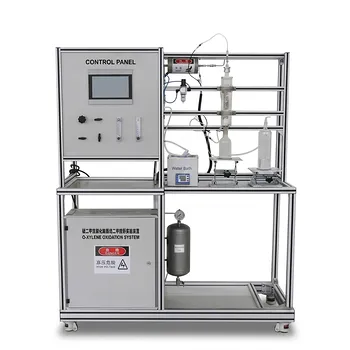
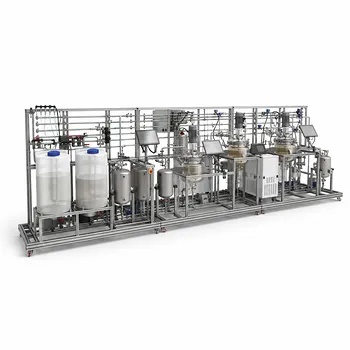
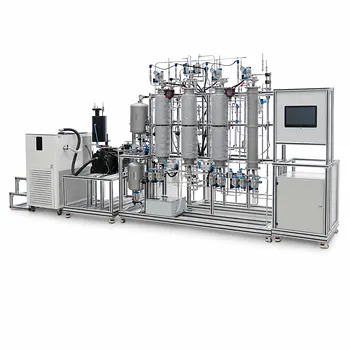
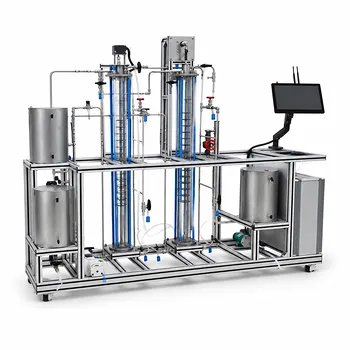
Adapting a pilot plant for phthalate plasticizer production boils down to two core modifications: enabling flexible raw material inputs and installing precise, wide-range process controls. A pilot plant that can produce DOP, DINP, and DIDP interchangeably must first allow the alcohol reactant to be switched easily—from 2-ethylhexanol for DOP to isononanol for DINP or isodecanol for DIDP. Simultaneously, the system’s control architecture must let operators dial in different reaction temperatures, neutralization protocols, washing intensities, and drying profiles to meet the distinct specifications of general-grade, electrical-grade, food-grade, or medical-grade plasticizers. This dual focus on feedstock flexibility and parameter tunability transforms a fixed single-product line into a versatile development tool.
A truly adaptable pilot plant doesn’t just accommodate different recipes—it gives you the control resolution to replicate every nuance of each plasticizer grade, from crude esterification down to the final vacuum drying step. The engineering challenge lies in designing systems that handle the broader physical property ranges of higher alcohols while maintaining the cleanliness and speed required for rapid product changeovers.
The Core Levers of Flexibility: Alcohol and Process Control
Why the Alcohol Chain Defines the Plasticizer
Phthalate plasticizers are diesters of phthalic anhydride and two molecules of an alcohol. DOP uses 2-ethylhexanol (C8), DINP uses isononanol (C9 branched), and DIDP uses isodecanol (C10 branched). Each alcohol carries different molecular weights, boiling points, solubilities, and reaction kinetics, directly impacting the final plasticizer’s volatility, plasticizing efficiency, and low-temperature performance.
How Raw Material Substitution Works in Practice
Adaptation starts at the feed system. Storage tanks, transfer lines, and metering pumps must be compatible with multiple alcohols, some of which are more viscous or have higher melting points. Quick-connect manifolds or dedicated, purged lines prevent cross-contamination between grades. The reactor itself must handle the different exothermic profiles and equilibrium limits of each esterification—what works for the fast-reacting 2-ethylhexanol may require longer residence times or higher temperatures for the bulkier isononanol and isodecanol.
Tuning Process Parameters for Different Plasticizer Grades
Temperature: The Primary Quality Dial
Process temperature is the most powerful lever for shifting a plasticizer from general- to food-grade. Higher esterification temperatures can drive conversion but also promote side reactions that create color bodies and acidic impurities. Grade-specific targets—often validated on pilot scale—include overhead and bottom temperatures in the esterification column, neutralization temperature (typically around 130°C for DOP), and the temperature ramp during vacuum stripping. For DINP and DIDP, the entire thermal profile shifts upward: reaction temperatures may need to rise by 10–30°C to achieve equivalent conversion while avoiding thermal degradation.
Neutralization and Washing: The Gateway to Purity
The neutralization step, typically using a 10% sodium carbonate solution at elevated temperature, removes residual catalyst and monoester acidity. For medical-grade plasticizers, the washing sequence is often extended, with multiple water washes and precise pH endpoints. A pilot plant must provide flexible dosing for alkaline solutions, adjustable mixing intensity, and rapid phase separation—all while allowing variation in wash water temperature and ratio. Subtle changes here can dramatically lower conductivity and acid number, meeting the most stringent electrical-grade requirements.
Vacuum Drying and Final Polishing
After washing, the crude ester is dried under vacuum. The drying profile—temperature ramp rate, final vacuum level, and hold time—must be tunable to strip residual moisture and light ends without thermally stressing the ester. Higher molecular weight plasticizers like DIDP require deeper vacuum or longer residence times because their lower volatility makes moisture removal more difficult. A pilot plant’s falling-film or wiped-film evaporator must handle this range without hardware changes.
The Underlying Process: A Continuous DOP Case Study
What a Baseline Recipe Looks Like
To adapt efficiently, it helps to start with a well-characterized reference process. A proven continuous DOP route using sulfuric acid catalyst illustrates the core steps:
- Monoesterification: React phthalic anhydride with 2-ethylhexanol at a 1:2.3 molar ratio, around 130°C, without catalyst.
- Esterification column: Add sulfuric acid catalyst and cyclohexane entrainer; maintain overhead at 115°C and bottom at 132°C to drive water removal.
- Neutralization: Treat the ester at 130°C with 10% Na₂CO₃ solution.
- Thermal decomposition and distillation: Heat to 180°C to destroy sulfate diesters, then distill overhead at 100°C to recover unreacted octanol.
Extending the Framework to DINP and DIDP
With this baseline, adaptation involves three practical adjustments:
- Raise the esterification temperature band to match the higher boiling points of isononanol and isodecanol.
- Re-optimize the entrainer ratio and reflux because water solubility and azeotrope behavior differ.
- Extend or retune the alcohol recovery distillation—isodecanol recovery often demands a lower overhead pressure or a higher bottom temperature to avoid product carry-over.
Understanding the Trade-offs and Common Pitfalls
The Cleaning and Cross-Contamination Burden
Switching between plasticizer types leaves trace residues that can fail a high-purity grade specification. Cleaning protocols for reactors, heat exchangers, and distillation columns must be aggressive yet non-damaging. Pilot plants often add dedicated pre-rinse circuits and spectrometric verification steps, which raise downtime and operational cost. Underestimating this leads to off-spec batches that erode the very flexibility you designed for.
Control Complexity and Operator Skill
A plant with a wide parameter window is only as good as the protocols that guide it. Excessive flexibility without standardized, grade-specific recipes can lead to inconsistent product properties. The control system must store and enforce multiple recipe profiles, while operators require training to recognize the visual cues (viscosity changes, color shifts) that signal a successful transition.
Catalyst and Material Compatibility
Higher reaction temperatures for DIDP can accelerate equipment corrosion, especially with acidic catalysts. The choice of construction materials (e.g., 316L stainless versus higher alloys) must balance capital cost against longevity across the entire operating envelope. Additionally, the different solubility and viscosity of higher alcohols may necessitate upgrades to agitation and pumping systems, adding hidden retrofit costs.
Making the Right Choice for Your Development Goals
Whether you are building a new pilot plant or retrofitting an existing one, your adaptation strategy must align with your primary mission. Use these goal-driven recommendations to guide your design.
- If your primary focus is academic training and process fundamentals: Prioritize modular, glass-lined or small-scale stainless equipment with easily swappable feed vessels. Focus on visual process monitoring and manual control points so students can directly observe the impact of changing alcohol and temperature on reaction rate, phase separation, and color.
- If your primary focus is rapid new grade development and scale-up validation: Invest in a highly automated platform with recipe-driven controls, inline analytics (near-infrared, pH, conductivity), and full clean-in-place capability. The initial cost pays for itself in reduced turnaround time between grades and the generation of high-fidelity scale-up data.
- If your primary focus is producing small commercial quantities of multiple specialized plasticizers: Design for dedicated or semi-dedicated lines for each alcohol family, even within a pilot setting. Accept the higher capital expenditure to minimize cleaning validation and maximize batch-to-batch consistency, turning your plant into a reliable revenue stream rather than a pure R&D tool.
Your pilot plant’s true value is measured not by the number of grades it can theoretically make, but by how quickly and reliably it can transition between them while delivering actionable process understanding. Anchor every design choice in that metric, and you’ll create a platform that genuinely accelerates innovation in phthalate plasticizer technology.
Summary Table:
| Plasticizer | Alcohol Raw Material | Reaction Temperature | Key Purification Adjustments |
|---|---|---|---|
| DOP | 2-ethylhexanol (C8) | Baseline (Esterification ~130°C) | Standard washing & neutralization |
| DINP | Isononanol (C9) | Elevated (+10°C to +30°C) | Re-optimized entrainer & distillation |
| DIDP | Isodecanol (C10) | Highest profile | Deeper vacuum drying & longer stripping |
Scale Up Your Chemical Engineering Innovation with LABPARK
Are you looking to build or upgrade your process systems? LABPARK provides state-of-the-art Educational and Vocational Unit Operations Pilot Plants in chemical engineering, bioprocess & biotech, and environmental & water treatment for universities, research institutes, and enterprises.
By partnering with LABPARK, you gain:
- Flexible System Architecture: Easily transition between different chemical processes and raw materials.
- Precision Controls: Advanced automation and monitoring to replicate industrial-scale quality (like medical or electrical-grade specifications).
- Vocational & Research Excellence: Robust, industry-standard equipment designed to accelerate R&D and enhance student learning.
Ready to design a versatile pilot plant? Contact LABPARK today to consult with our engineering experts!
Related Products
- O-Xylene Oxidation to Phthalic Anhydride Educational Unit Operations Pilot Plant
- Polymerization Granulation and Pellet Processing Educational Unit Operations Pilot Plant
- Ethyl Acetate Synthesis Unit Operations Pilot Plant for Practical Training
- Methanol Synthesis and Catalyst Performance Evaluation Educational Unit Operations Pilot Plant
- General Purpose Cosmetics Production Unit Operations Training Pilot Plant
People Also Ask
- What materials fit high-temp oxidation pilot plants? Key Hastelloy & Titanium Requirements
- Under what conditions can axial diffusion be neglected? Reactor Simulation Guide
- What limitations exist in high-temp pilot reactor design? Key Material & Safety Rules
- What pressure parameters ensure pilot plant safety? Analyze reactor profiles & gas evolution.
- How are sensitivity functions applied to parameter estimation in chemical reactor pilot plants? Guide