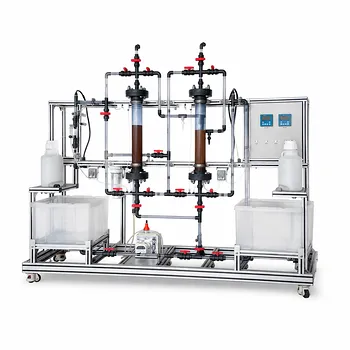
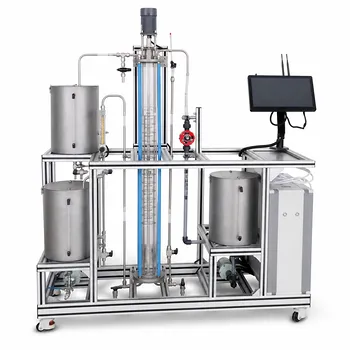
Cation exchange columns strip interfering metal cations from a solution by binding them to the resin, while target anions pass straight through. In practice, a sample containing both anions (like chromate, phosphate, or sulfate) and troublesome metal cations (such as iron, aluminum, nickel, or zinc) is flowed through a hydrogen‑form resin bed. The effluent that emerges contains only the anions, enabling a direct, interference‑free titration or gravimetric measurement of those species. Once the column is loaded, the retained cations can be separately eluted with hydrochloric acid for further analysis or recovery.
The core insight is that a cation exchange column functions as a charge‑selective gate: it physically removes polyvalent metal contaminants that would otherwise co‑precipitate, consume titrants, or skew analytical results. This unit operation solves the deep problem of achieving accurate anion quantification in complex wastewater or deposit matrices, and it directly informs pilot‑plant scale‑up through measurable design parameters like capacity, breakthrough, and regenerant dose.
The Underlying Challenge: Why Metal Cations Interfere with Anion Analysis
The Co‑Precipitation Trap in Gravimetric Methods
In gravimetric sulfate determination, for example, iron and other metal ions readily co‑precipitate with barium sulfate. This contaminates the precipitate, leading to falsely high masses and completely unreliable results.
Masking Errors During Titration
When chromatography or titrimetry is used to quantitate anions like phosphate or chromate, high levels of aluminium, magnesium, or transition metals can complex with the indicator or partially precipitate the analyte. The result is a shifting endpoint or a low bias in the measurement.
The Engineer’s Need for a Clean Sample Stream
In both wastewater surveillance and deposit analysis, the real goal is often to measure a regulated pollutant anion, such as phosphate or chromate, while the sample is loaded with industrial-metal interferences. A separation step that does not destroy or alter the anions is essential.
How Cation Exchange Columns Solve This Problem
The Ion Exchange Mechanism in Practice
A strong‑acid cation exchange resin (typically containing sulfonic acid groups) is first converted to its hydrogen form. When the mixed‑ion sample passes through, the resin’s active sites exhibit a strong preference for polyvalent metal cations:
- Cations like Al³⁺, Ni²⁺, Zn²⁺, Ca²⁺, and Mg²⁺ displace H⁺ ions and bind irreversibly to the resin matrix.
- The displaced hydrogen ions exit the column, slightly lowering the pH of the effluent but not interfering with subsequent anion detection.
Anions Flow Through Unhindered
Because the resin’s polymer backbone bears negatively charged sulfonate groups, anions are repelled and simply travel through the void volume without being retained. The collected effluent contains only the original anions—chromate, phosphate, sulfate—ready for direct titration or measurement.
Controlled Flow Rate Ensures a Clean Cut
To achieve a single‑pass clean separation, the sample must be loaded at a slow, controlled rate—approximately one drop per second. Faster flow rates risk partial breakthrough of weakly retained cations, contaminating the anion fraction and defeating the purpose of the column.
Elution and Recovery of the Captured Metals
After the anion fraction has been collected, the bound metal cations can be recovered for separate estimation. Alternating treatments of hydrochloric acid (1:1 HCl) and water displace the metals in a concentrated plug. This sequential elution not only regenerates the column for the next cycle but also prepares a clean metal stream for techniques like precipitation of aluminium as a basic succinate.
From Lab Analysis to Pilot‑Plant Scale‑Up
Bridging Analytical Chemistry and Process Design
In a chemical engineering curriculum, the same separation is scaled up in an ion‑exchange pilot plant. Students load a synthetic wash liquor—a mix of anions and interfering metal cations—and then calculate the total exchange capacity of the resin bed by monitoring effluent composition over time.
Designing the Resin Bed for a Specific Load
Industrial columns are typically sized so that the breakthrough point occurs at around 80% of the total capacity. This safety margin ensures that no detectable metals leak into the treated effluent before the column is taken off‑line for regeneration.
Regeneration and Cycle‑Time Economics
The pilot plant directly yields the required dosage and flow rate of regenerant (e.g., sodium hydroxide for a hydroxide‑form resin) to restore the bed within a specified cycle time. This exercise translates textbook stoichiometry into the real‑world constraints of chemical plant operation and wastewater system design.
Understanding the Trade‑offs and Pitfalls
pH Control Is Non‑Negotiable
If the feed solution’s acidity is too high, the equilibrium shifts and metals may not be fully retained. Conversely, if the pH is too alkaline, some metals may precipitate inside the column, causing clogging and flow restriction.
Capacity Limits and Breakthrough
Every resin bed has a finite number of exchange sites. Exceeding the column’s capacity, even momentarily, will allow metal cations to slip into the anion fraction, instantly ruining the analysis or causing a compliance breach in a treatment stream.
Regeneration Chemicals and Waste Streams
Eluting the metals with concentrated HCl generates a secondary waste stream that must be neutralized or further processed. In an industrial setting, the cost and environmental burden of this regeneration step can dominate the operational economics.
Not a Stand‑Alone Anion Removal Tool
A cation exchange column only targets positively charged species. It does not remove anions themselves from wastewater—it is a pretreatment or analytical separation step, not a final treatment for pollutant anions unless paired with an anion exchange unit downstream.
Making the Right Choice for Your Analysis or Process Design
Your design decisions hinge on whether the priority is analytical precision, metal recovery, or scalable treatment capacity.
- If your primary focus is accurate anion quantification in a heavily contaminated sample: Pre‑load the column with a known standard to calibrate recovery, maintain a flow of roughly one drop per second, and use the first‑collected effluent directly for titration or gravimetry without additional treatment.
- If your primary focus is recovering valuable or regulated metals for separate characterization: Follow the anion collection with an alternating HCl‑and‑water elution protocol, and design the regeneration sequence to concentrate the metals into the smallest possible volume for subsequent precipitation or spectroscopic measurement.
- If your primary focus is scaling this unit operation for an industrial wastewater pilot plant: Run a breakthrough curve experiment to determine the resin bed’s total exchange capacity, size the vessel for an 80‑% load before regeneration, and calculate the exact regenerant (NaOH or HCl) dose and flow rate needed to meet your target cycle time.
- If your primary focus is optimizing long‑term operational costs: Model the trade‑off between bed depth and regenerant consumption, and always factor in the cost of neutralizing the spent eluate before discharge.
Mastering this one unit operation gives you a versatile, predictable method to isolate anions from a mess of metal interferences—whether you are pursuing a sub‑milligram measurement in the lab or designing a cubic‑meter‑per‑hour treatment system in a plant.
Summary Table:
| Process Aspect | Key Details & Parameters |
|---|---|
| Mechanism | Strong-acid resin ($H^+$ form) binds metal cations; target anions pass through. |
| Interferences Solved | Prevents metal co-precipitation in gravimetry and endpoint masking in titrations. |
| Process Controls | Requires strict pH control, flow rate of ~1 drop/sec, and loading limit of 80% capacity. |
| Regeneration | Alternating hydrochloric acid (HCl) and water washes elute metals and restore resin. |
Bring Practical Unit Operations to Your Institution
Mastering ion exchange separations is critical for future chemical and environmental engineers. LABPARK provides state-of-the-art Educational and Vocational Unit Operations Pilot Plants in chemical engineering, bioprocess & biotech, and environmental & water treatment for universities, research institutes, and enterprises.
Our pilot systems enable hands-on learning of breakthrough curves, regeneration kinetics, and system scale-up. Contact LABPARK today to equip your facility with industry-grade laboratory and pilot-scale training equipment!
Related Products
- Ion Exchange Water Purification Educational Pilot Plant for Engineering Unit Operations
- Educational Rotary Disc Liquid-Liquid Extraction Pilot Plant
People Also Ask
- How to Prevent Ion Exchange Channeling? Expert Solutions for Pilot Plants
- What operational precautions should lab operators take for resin volume changes and air pockets? Key Guide
- How does ion exchange work in water treatment pilot plants? Cost & process guide.
- How to use ion exchange pilot plants to verify alkalinity? A hands-on guide for engineering students.
- Why does iron degrade cation resin & how to demonstrate capacity recovery? Step-by-Step Lab Guide