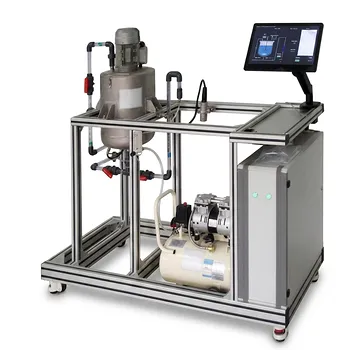
Scaling up mixing isn’t just about making it bigger—it’s about switching the physics. In high-throughput chemical engineering pilot plants, 3D alternating cross-injection mixers fundamentally change the mixing game compared to planar micro devices. They inject streams cross-wise along the long axis of a larger-diameter channel, deliberately inducing turbulent flow rather than relying on diffusion-limited laminar multi-lamination. This design enables simple stacking of internal plates (internal numbering-up) to handle volumes up to several cubic meters per hour, making them the bridge from benchtop microreactors to industrial pilot-scale processes.
While planar micromixers achieve fine structuring in the laminar regime, 3D alternating cross-injection mixers trade pure laminar stratification for turbulent dispersion—a trade-off that unlocks practical scale-up through straightforward plate stacking, critical for pilot plants transitioning away from lab microchemistry.
How 3D Alternating Cross-Injection Mixers Actually Operate
The operating mechanism departs radically from the thin, flat channels of planar devices. Instead of micromachined grooves or split-and-recombine loops, the mixer works by injecting fluid streams perpendicularly into the main mixing chamber along its length.
The Cross-Injection Principle
Fluid enters the mixing chamber not from one end, but through multiple inlets spaced along the chamber's long axis. Each inlet injects the secondary stream cross-wise into the primary flow, creating a three-dimensional collision zone. This repeated, spatially distributed injection forces the streams to interpenetrate at angles, generating chaotic advection.
Turbulence by Design
Because the mixing chamber has a significantly larger internal diameter than a typical microchannel (often millimeters, not micrometers), the Reynolds number at pilot-plant flow rates surges well into the turbulent regime. The result isn’t the soft, layered laminae of a planar mixer. Instead, the cross-injection triggers turbulent eddies and vortices that tear apart fluid elements and mix them within milliseconds. This is a volumetric, energy-intensive process rather than a diffusion-driven one.
Internal Numbering-Up Through Stacking
The true scalability secret lies in the construction. Plates with alternating injection patterns are stacked vertically, effectively running many mixing cells in parallel inside a single housing. Because turbulent mixing is robust to geometry variations, this internal numbering-up simply adds more volume capacity without requiring a thousand separate microchannels. A stack of ten or fifty plates can deliver the same mixing quality at linearly higher throughput.
Advantages Over Planar Micro Devices
Planar micromixers excel at creating exquisite mixing precision at laboratory flow rates (microliters to milliliters per minute). In a pilot plant, however, different metrics dominate.
Throughput Without Micro-Parallelism
A planar approach to high flow often means massive external numbering-up: thousands of parallel microchannels, each prone to clogging and flow maldistribution. The 3D cross-injection mixer achieves equivalent total flow by simply making the channel wider and stacking plates, sidestepping the nightmare of maintaining identical pressure drops across parallel microstructures.
Resilience to Particulates and Fouling
Laminar micromixers rely on channels with dimensions below 100 µm, where a single fine particle can block the path. The millimeter-scale chamber of the cross-injection mixer tolerates realistic process streams—small solids, precipitates, or viscous feeds—without catastrophic failure, a non-negotiable for operational pilot plants.
Direct Pathway from Lab to Pilot
The same mixing principle works at both reduced and scaled flow. You can validate the chemistry in a single-channel lab version, then stack plates to increase capacity without re-engineering the entire mixing scheme. This continuity slashes process development time compared to a shift from a planar chip to a completely different pilot-scale stirred tank.
The Spectrum of 3D Mixer Types and Performance
Not all 3D static mixers are identical. Supplementary studies on intersecting and helical structures reveal important nuances that inform the cross-injection approach.
Intersecting-Geometry Mixers (Including Cross-Injection)
Designs that repeatedly split, recombine, and inject streams tangentially (the family into which alternating cross-injection falls) produce a finely dispersed mixture. Manifold-level splitting creates multiple contact zones, yielding a narrow droplet or concentration distribution. The cost is a higher pressure drop—each collision and recombination dissipates energy.
Helical and Folded-Channel Mixers
In contrast, helical 3D mixers stretch and fold the fluid in a continuous channel. They generate a coarser mixture but operate with a significantly lower pressure drop. For pilot plants where pumping energy is a concern but top-tier micro-mixing is not required, helices offer an alternative. However, they lack the straightforward stacking architecture: throughput increases by elongating the helix, which becomes bulky.
Where Cross-Injection Sits
Alternating cross-injection mixers deliberately embrace the finer mixing side of the spectrum. By injecting perpendicular flows along the chamber, they mimic an intersecting geometry's savage chopping of fluid elements, sacrificing some pressure for the benefit of rapid turbulent dispersion. The stacked-plate construction then compensates by allowing the high-pressure pump to serve many plates in parallel, keeping the total energy cost manageable.
Understanding the Trade-offs
Trust requires candor. Switching to a 3D alternating cross-injection mixer is not a universal upgrade; it’s a strategic choice with real downsides.
Higher Pressure Drop than Laminar Planar Devices
Turbulent cross-injection chews through energy. The pressure drop is substantially higher than in a long, smooth planar microchannel mixing the same volume per time. You’ll need a pump capable of delivering several bars of differential pressure, which may not exist in a legacy pilot plant designed for low-shear mixing.
Reduced Mixing Precision at Very Low Reynolds Numbers
If your process must operate at a trickle—say, during catalyst screening—the Reynolds number may dip back into the laminar-transitional zone. Cross-injection mixers lose their characteristic turbulence, and mixing quality can deteriorate below what a dedicated multi-lamination planar mixer guarantees. They are optimized for high-flow, steady-state operation.
Less Control Over Stoichiometric Gradients
Planar laminar mixers can precisely layer reactants, enabling exquisite control over concentration profiles for time-sensitive reactions. The violent turbulence of cross-injection smears this out instantly. For chemistries where a controlled, diffusion-limited encounter is critical (certain nanoparticle syntheses), the aggressive mixing may ruin product quality.
Making the Right Choice for Your Pilot Plant
Your selection hinges on the problem you’re really trying to solve: is it scaling throughput with minimal re-engineering, or maintaining micro-precision at any scale?
- If your primary focus is scaling from a microreactor to pilot production without redesign: Choose a 3D alternating cross-injection mixer with stacked plates. It provides the linear volume scaling you need through internal numbering-up, tolerates real-world process streams, and keeps the mixing mechanism consistent from lab to pilot.
- If your primary focus is absolute mixing time or controlled concentration gradients at low flow rates: Stay with planar micro-lamination or split-and-recombine devices. These deliver unparalleled laminar structuring that turbulent mixers cannot replicate at low Reynolds numbers.
- If your primary focus is minimizing pump energy and pressure drop: Evaluate a helical 3D mixer for a compromise between volume and pressure, though you’ll sacrifice the stacking simplicity and may face a larger spatial footprint.
Ultimately, the 3D alternating cross-injection mixer isn’t a better mixer in every dimension—but for the messy, high-flow reality of a chemical pilot plant bridging the lab and the plant, it’s the tool that makes the transition physically and operationally possible.
Summary Table:
| Feature | 3D Cross-Injection Mixer | Planar Micro Device |
|---|---|---|
| Flow Regime | Turbulent dispersion | Laminar multi-lamination |
| Scale-up Method | Internal plate stacking | External parallel channels |
| Clogging Resistance | High (millimeter-scale) | Low (micrometer-scale) |
| Best Suited For | High-throughput pilot plants | Low-flow lab scale |
Are you scaling up your chemical processes? LABPARK provides premium Educational and Vocational Unit Operations Pilot Plants in chemical engineering, bioprocess & biotech, and environmental & water treatment. Designed specifically for universities, research institutes, and enterprises, our advanced systems bridge the gap between lab-scale discovery and industrial reality.
Optimize your mixing performance and process efficiency today—contact us now to get started!
Related Products
- Agitation and Mixing Educational Unit Operations Pilot Plant
- Multi-Stage Stirred Tanks in Series Residence Time Distribution and Mixing Performance Determination Educational Pilot Plant
People Also Ask
- How do cost-capacity exponents vary across chemical equipment? Scaling insights.
- What are the primary considerations when managing and scaling up shear rates in pilot plant mixing operations? Guide
- What are the differences between set-point, servo, and program control? Master unit operations training.
- Evaluate Tablet Compaction: Force, Density & Porosity in Unit Operations Pilot Plants
- Why Switch Unit Operations Flow Configurations? Impact on Experimental Measurements