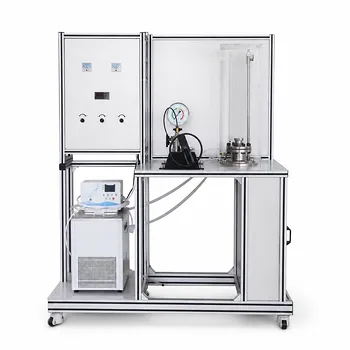
For highly effective CO reduction via selective oxidation in a laboratory pilot plant, three noble-metal formulations stand out: 2.5 wt% Ru/Al₂O₃ at 126°C, 5 wt% Rh/Al₂O₃ at 140°C, and a 2.5 wt% Pt/2.5 wt% Rh/Al₂O₃ mixture at 144°C. These catalysts can slash CO concentrations from 12,000 ppm to below 4 ppm at a flow rate of 500 mL/min, making them exceptional candidates for unit‑operations curricula and hands‑on research.
Core Takeaway
The bimetallic Pt–Rh/Al₂O₃ catalyst offers the best long‑term stability for repeated lab runs, but at the cost of slightly lower hydrogen selectivity (~88 %). If your experiment demands the absolute lowest ignition temperature, Ru/Al₂O₃ at 126°C is the most active; if you need a proven industrial‑type benchmark, nanoscale Pt on a silica sol‑gel support operates optimally near 160°C. The essential trade‑off is always between stability and CO₂ selectivity as temperature rises.
The Top Formulations for Selective CO Oxidation
Ruthenium on Alumina (2.5 wt% Ru/Al₂O₃)
Ru/Al₂O₃ lights off at 126°C, the lowest temperature among the tested catalysts.
This low‑temperature activity helps preserve hydrogen in the stream, a critical advantage when simulating hydrogen‑rich reformate for fuel‑cell research.
Its inherent durability also shines in supplementary long‑run studies, where ruthenium catalysts have maintained activity beyond 16,000 hours.
Rhodium on Alumina (5 wt% Rh/Al₂O₃)
Rh/Al₂O₃ reaches peak CO‑reduction performance at 140°C.
This single‑metal system provides a clean benchmark for studying CO oxidation kinetics and the trade‑off between precious‑metal loading and selectivity.
The slightly higher operating temperature makes it a useful teaching tool to demonstrate how reaction rate changes with thermal input.
Platinum–Rhodium Mixture (2.5 wt% Pt / 2.5 wt% Rh/Al₂O₃)
The Pt–Rh/Al₂O₃ catalyst operates at 144°C and exhibits the highest stability during extended runs.
This makes it the prime choice for multi‑hour lab sessions or pilot‑plant campaigns where constant performance is valued more than raw low‑temperature activity.
However, at 140°C its hydrogen selectivity falls to approximately 88 %, meaning a small but measurable portion of the valuable H₂ is oxidized to water instead of targeting CO.
Aligning Operating Conditions with Catalyst Behaviour
Temperature, Space Velocity, and O₂/CO Ratio
Precision temperature control is non‑negotiable. Even a 10°C overshoot can shift the reaction towards H₂ oxidation and erode CO₂ selectivity.
Supplementary PROX data with a nanoscale Pt/silica sol‑gel catalyst show optimum operation at 160°C, an O₂/CO ratio of 0.5, and a Weight Hourly Space Velocity (WHSV) of 13 h⁻¹, delivering 91 % CO conversion and 90 % CO₂ selectivity.
Those parameters illustrate the tight window designers must hit, and why the Ru‑ and Rh‑based formulations that activate at lower temperatures can offer a selectivity buffer.
Feed Purity and Pilot‑Plant Design
While the noble‑metal catalysts are robust, the wider plant lesson comes from shift‑reaction catalysts.
Copper‑based low‑temperature shift catalysts (180–260°C) can reduce CO to 0.2–0.3 %, but they fail rapidly if exposed to trace sulfur (>0.1 ppm) or chlorine (>0.01 ppm).
A pilot plant design that incorporates upstream guard beds and precise mass‑flow controllers therefore becomes an essential part of the learning experience, even when the primary oxidation bed uses noble metals.
Understanding the Trade‑offs
Activity Stability vs. Hydrogen Selectivity
The Pt–Rh catalyst shines in stability but loses about 12 percentage points of hydrogen selectivity near its operating temperature.
For a hydrogen‑fueled PEM fuel cell experiment, that H₂ loss directly impacts system efficiency; a curriculum could quantify that loss by measuring outlet water content.
Ru/Al₂O₃, by contrast, fires at a lower temperature where H₂ oxidation is slower, often yielding better selectivity in short‑duration tests, though its long‑term stability under thermal cycling must be verified with periodic CO‑slip measurements.
The Wrong Path: High‑Temperature Shift Catalysts for Selective Oxidation
Iron‑chromium and copper‑based shift catalysts are not viable for selective oxidation in H₂‑rich streams.
Their operating windows (300–530°C for Fe–Cr; 180–260°C for Cu) are far too high for PROX, causing runaway H₂ combustion that destroys CO₂ selectivity entirely.
Pilot plants that simulate exhaust‑gas aftertreatment or three‑way‑catalyst reactions may use those catalysts, but they belong to a different unit‑operation module—not a selective‑oxidation lab.
Making the Right Choice for Your Educational or Research Goal
After a brief introductory overview, align your catalyst selection with the learning outcome you want to emphasize.
- If your primary focus is ultra‑low‑temperature ignition: Choose 2.5 wt% Ru/Al₂O₃ at 126°C to show how single‑atom or small‑cluster active sites can trigger CO oxidation with minimal thermal input.
- If your primary focus is long‑duration stability and hands‑on data logging: Use the Pt–Rh/Al₂O₃ mixture at 144°C, and let students track the gradual decline in hydrogen selectivity while CO outlet concentration stays pinned below 4 ppm.
- If your primary focus is mimicking commercial PEM‑fuel‑cell reformers: Adopt the nanoscale Pt/silica sol‑gel catalyst and standard PROX conditions (160°C, O₂/CO = 0.5, WHSV = 13 h⁻¹) to generate data directly comparable with industrial benchmarks.
Whichever path you choose, the most valuable lesson a pilot plant can teach is that optimal performance is never a single number—it’s a deliberate balance between conversion, selectivity, and durability that you control through temperature and feed management.
Summary Table:
| Catalyst Formulation | Optimal Temp (°C) | Key Advantage | Major Trade-off / Note |
|---|---|---|---|
| 2.5 wt% Ru/Al₂O₃ | 126°C | Lowest activation temperature; preserves H₂ stream | Requires thermal cycling stability verification |
| 5 wt% Rh/Al₂O₃ | 140°C | Clean kinetic benchmark for teaching reaction rates | Higher thermal energy required for activation |
| 2.5% Pt / 2.5% Rh/Al₂O₃ | 144°C | Outstanding stability for long-duration runs | Reduced hydrogen selectivity (~88%) |
| Nanoscale Pt/silica sol-gel | 160°C | Matches industrial PROX benchmarks | Tight operating window (requires O₂/CO = 0.5) |
Bring Precision to Your Chemical Engineering Lab with LABPARK
To effectively study selective catalytic oxidation, your students and researchers need highly stable, precise, and reliable equipment. LABPARK designs and manufactures advanced Educational and Vocational Unit Operations Pilot Plants in chemical engineering, bioprocess & biotech, and environmental & water treatment for universities, research institutes, and enterprises worldwide.
Our pilot plants feature precise temperature controls, accurate mass-flow integration, and robust construction to ensure safe and repeatable experiments.
Ready to elevate your engineering curriculum or research capabilities?
Contact LABPARK Today to explore our customizable pilot plant solutions!
Related Products
- O-Xylene Oxidation to Phthalic Anhydride Educational Unit Operations Pilot Plant
- Photocatalytic Membrane Separation and Degradation Unit Operations Pilot Plant
- Methanol Synthesis and Catalyst Performance Evaluation Educational Unit Operations Pilot Plant
- Carbon Dioxide PVT Curve Determination Educational Unit Operations Pilot Plant
- Educational Unit Operations Pilot Plant for Intraparticle Diffusion Effective Factor Measurement
People Also Ask
- Why Is the Peclet Number (Pe) Key in Tubular Reactors? Avoid Critical Modeling Errors
- Why determine reaction order & activation energy in pilot plants? Key to safe scale-up.
- What materials fit high-temp oxidation pilot plants? Key Hastelloy & Titanium Requirements
- Why is the reactor tube-to-catalyst particle diameter ratio (dt/dp) critical? Key to Accurate Kinetic Scale-Up
- Under what conditions can axial diffusion be neglected? Reactor Simulation Guide