The Unseen Variable Ruining Your Mass Balance
Every engineering student learns the theory. Plug in the rate constant, calculate the yield, close the mass balance. But a pilot plant is where theory meets thermodynamics, and thermodynamics can be cruel.
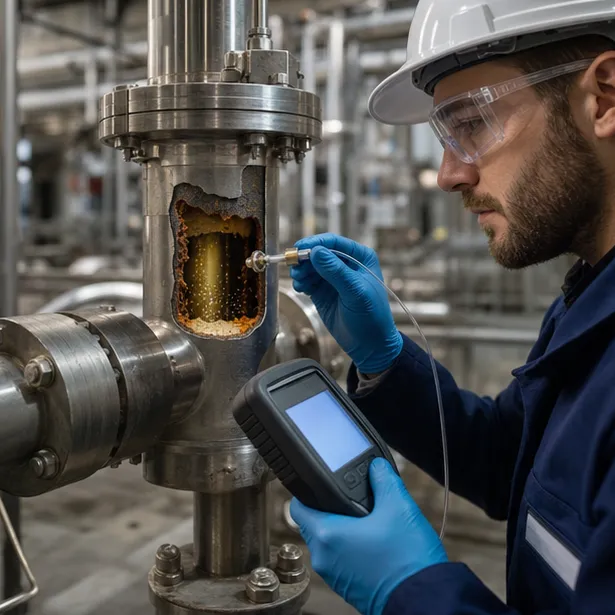
One day, the numbers stop making sense. The level sensor drifts. A pressure drop appears where none should exist. You find the problem not inside a reactor but on the outside of a condensate return line: a smooth-walled groove, carved into the steel like a river channel in limestone.
The culprit isn't exotic. It's carbon dioxide. Dissolved CO₂ in condensate is a silent, systematic destroyer of both metal and data integrity. It doesn't explode. It doesn't announce itself with a color change. It just slowly, electrochemically, steals iron atoms from the places they're needed most.
Understanding this mechanism isn't paranoia. It's the difference between a pilot plant that teaches process engineering and one that teaches expensive plumbing repair.
The Electrochemistry of a Groove
The corrosion path is deceptively simple to describe and devilishly hard to stop once it starts.
How Carbonic Acid Forms
CO₂ from the atmosphere or process off-gassing dissolves into the condensate. It doesn't stay as a dissolved gas. It reacts with water to form carbonic acid (H₂CO₃) .
The acid is weak, but it has a specific talent: it dramatically increases the oxidizing power of hydrogen ions. In plain terms, it makes the water hungry for electrons.
The Atomic Heist
Steel is mostly iron. Iron atoms sit in a crystalline lattice, held there by a shared sea of electrons. Carbonic acid attacks this arrangement directly. Iron goes into solution as Fe²⁺. Electrons flow through the metal to adjacent cathodic sites where hydrogen ions accept them and bubble off as gas.
This is an electrochemical cell, with your pipe as the sacrificial anode.
The result isn't uniform rusting. It's localized grooving—channels of missing metal where the acid concentrates and the stress lines run.
Why the Groove Follows the Stress
The primary literature points to a specific location: bends and threaded connections.
This isn't random. Tensile stress pulls the iron atoms slightly apart in the metal lattice. That microscopic separation makes those sites more electrochemically active. The carbonic acid senses the vulnerability and carves along the stress line, creating a smooth-bottomed groove that follows the mechanical forces like a path of least resistance.
In a pilot plant, these stresses come from everywhere: fluid pressure, thermal cycling between batch runs, pump vibration, residual stresses from fabrication welds that were never stress-relieved.
You can’t see the stress. But the corrosion groove maps it perfectly.
The Two-Pronged Defense: Chemistry and Physics
Stopping this requires fighting on two fronts simultaneously. Chemical neutralization buys you time. Physical design removes the root cause.
The pH Shield: Amine Chemistry
The simplest chemical fix is to raise the pH above 7.4. In basic conditions, the acidic hydrogen ions are neutralized, and the driving force for metal dissolution collapses.
This is done by injecting neutralizing amines into the steam line. The amine travels with the steam, condenses in the pipelines, and provides protection exactly where the acid attacks.
But which amine? The choice matters deeply.
The Amine Selection Matrix
| System Characteristic | Recommended Amine | Why |
|---|---|---|
| Low-pressure (< 15 psi) | Cyclohexylamine | Favorable vapor-liquid distribution keeps it in the condensate phase at low temperatures. |
| High-pressure steam | Morpholine | Remains stable and effective in the condensate phase at elevated temperatures. |
| Contains copper alloys | Non-ammoniacal amine | Ammonia aggressively complexes copper, dissolving it. Cyclohexylamine or filming amines are safer. |
The Ammonia Trap
Ammonia is cheap. It neutralizes acid. It seems like the easy choice.
But if your pilot plant has a copper-alloy preheater, brass instrument tubing, or a copper condenser, ammonia becomes the agent of destruction. It reacts with copper and dissolved oxygen to form soluble cupric complexes. You won't see a groove. You'll see the entire copper surface thinning uniformly until a pinhole leaks.
The rule is absolute: never use ammonia near copper.
Physical Design: The Engineer’s First Responsibility
Chemicals patch a problem. Physical design prevents it from existing in the first place.
Drainage is Destiny
Any pocket of stagnant condensate becomes a carbonic acid reservoir. The acid concentrates as water evaporates. The corrosion rate in that puddle can be orders of magnitude higher than in flowing condensate.
A pilot plant designed for research must be designed to drain completely. No dead legs. No bellies in piping. Every line slopes back to a collection point.
If liquid can pool, it will corrode.
Smooth Surfaces and Butt Welds
Lap joints and threaded connections create natural crevices. Acidic condensate wicks into the crevice and stagnates. The bulk solution outside the crevice remains oxygenated while the interior becomes depleted. This sets up a differential aeration cell—one of the most aggressive localized corrosion mechanisms known.
Smooth butt welds eliminate the crevice entirely. The internal surface is flush. Nothing catches. Nothing concentrates.
The upfront fabrication cost is higher. The lifecycle reliability is immeasurably better.
Stress Relief is Not Optional
A weld is molten metal frozen in place. During cooling, the weld and the surrounding heat-affected zone contract. This locks in residual tensile stress—exactly the kind that makes carbonic acid grooving worse.
Post-Weld Heat Treatment (PWHT) reheats the component to a specific temperature and lets it cool slowly. The locked-in stresses relax. The atomic lattice returns to a neutral state.
Without PWHT, you've built a stress map into your piping. The carbonic acid will read it and follow it.
Flow Velocity: The Goldilocks Zone
Corrosion isn’t only about chemistry. Fluid mechanics plays a role.
Too slow, and solids settle. A layer of debris on the pipe bottom creates an under-deposit corrosion cell—a hidden, concentrated acid attack shielded from chemical treatment.
Too fast, and any protective iron carbonate scale (which can form naturally as corrosion proceeds) is eroded away, exposing fresh metal to attack. This is flow-accelerated corrosion, and it's particularly vicious at elbows and teardrop-shaped obstructions.
Pilot plant designs must keep velocities in a range where neither deposition nor erosion occurs. This requires knowing your turndown ratios and batch cycling patterns.
The Hidden Cost: Data That Lies
Let’s be honest about what’s at stake. It's not just the cost of replacing a pipe section.
A corroding pilot plant generates contaminated data.
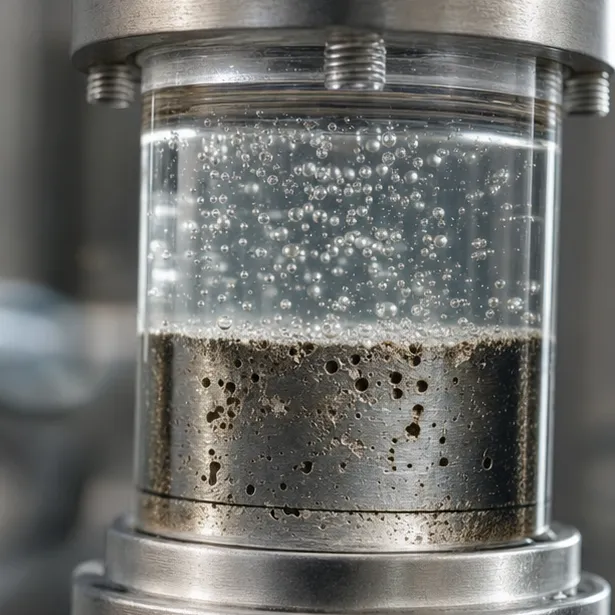
Trace iron ions in the product stream change reaction kinetics. A pinhole leak alters the system pressure and mass balance. Corrosion products foul analytical sensors. An unplanned shutdown to repair a leak destroys a week-long steady-state experiment.
Graduate students lose time. Research sponsors lose confidence. The educational value of the plant—the very reason it was built—erodes one groove at a time.
You built the plant to teach process engineering. If it's teaching corrosion mechanics instead, the mission has drifted.
A Decision Strategy for Your System
Every plant is a compromise between budget, research goals, and physical constraints. The key is making choices consciously.
Match the Strategy to the Priority
-
If your plant is a teaching tool for corrosion studies: Integrate test coupons in removable racks, install variable-speed pumps, and let students explore the boundaries of amine dosing. Design the system to demonstrate failure modes safely. This isn't a cost; it's curriculum.
-
If your plant supports bioprocess or high-purity research: Protect your data. Start with complete drainage design, smooth butt welds, and material isolation. Layer on a robust amine dosing system with online pH monitoring. The goal is zero unplanned variables entering your product stream.
-
If your plant contains copper alloys (preheaters, condensers, instrument lines): Reject ammonia completely. Select cyclohexylamine for low-pressure loops or a non-complexing filming amine. Physically isolate brass components with dielectric unions to eliminate galvanic couples.
-
If your plant is high-pressure, all-ferrous metallurgy: Morpholine is your chemical workhorse. Demand PWHT on all welded joints. The pressure magnifies the stress, which magnifies the corrosion rate. Don't leave residual fabrication stress in your system.
The Trade-Offs at a Glance
| Choice | Wins | Loses |
|---|---|---|
| Ammonia | Cheap, effective in simple steel loops. | Aggressively corrodes copper alloys; interferes with some sensors. |
| Cyclohexylamine | Excellent for low-pressure systems; safer with some copper chemistries. | Higher cost per pound; vapor-liquid distribution less favorable at high pressure. |
| Smooth Butt Welds + Slope | Eliminates crevice and concentration cells; permanent physical solution. | Higher fabrication cost; requires skilled welding. |
| PWHT | Removes residual stress; prevents stress-corrosion cracking. | Adds a process step and cost; must be specified in fabrication order. |
| Over-Neutralization (pH > 9.5) | None intended. | Can induce caustic corrosion or scaling; wastes amine. |
Building a Plant That Outlasts the Research Grant
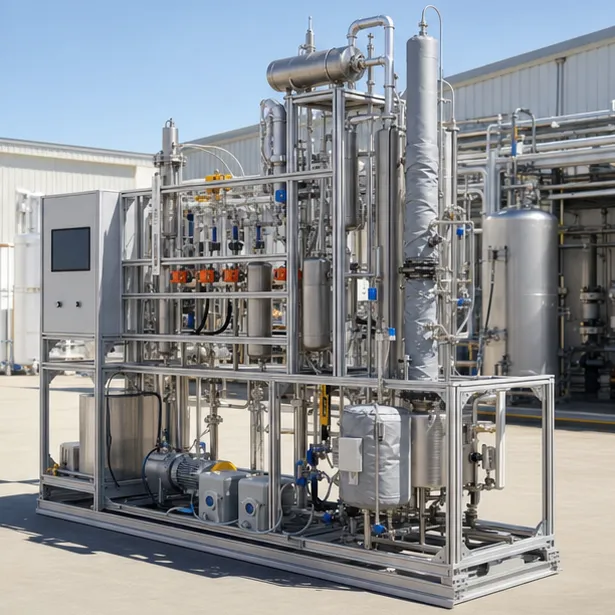
A pilot plant is an infrastructure investment. It should span research projects, student cohorts, and faculty rotations.
The corrosion mechanism of dissolved CO₂ is well understood. The mitigation is well understood. What's rare is the institutional discipline to implement it at the design stage, not the repair stage.
Specify the physical geometry correctly—sloped, smooth, stress-relieved, crevice-free. Select the amine chemistry that matches your metallurgy and operating pressure. Monitor the pH online and treat it as a process variable, not an afterthought.
A well-designed plant produces data you can trust for a decade. A poorly designed one produces corrosion case studies for your own graduate students to debug.
Don't let dissolved gas determine the research output of your facility.
Engineer the problem out from the start. If you are designing a new pilot plant or upgrading an existing system to achieve the operational reliability your research demands, specialized expertise in unit operations design makes the difference between a system that teaches corrosion control and one that simply suffers from it. Contact Our Experts to design a pilot plant where corrosion is an intended learning objective—not a recurring emergency.
Related Products
Related Articles
- The Invisible Constraint: How First-Principles dCO₂ Modeling Turns Your Pilot Plant into a Predictive Engine
- The Ideal-Selectivity Trap: How Pilot Plants Expose the Real Story of Membrane CO₂ Capture
- The Intuition You Can’t Simulate: Why the Best Bioprocess Education Still Lives on a Thin-Layer Plate
- The Machine That Teaches Green Chemistry by Making Pressure Visible
- The Invisible Thread: How Supercritical CO₂ Weaves a Future Without Water