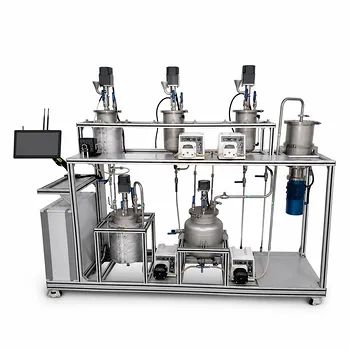
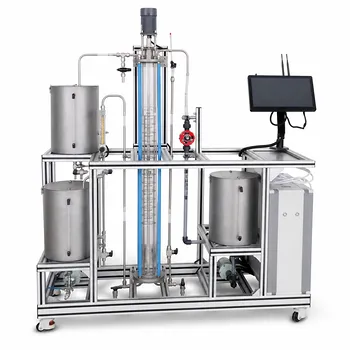
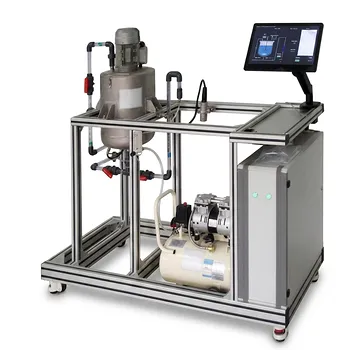
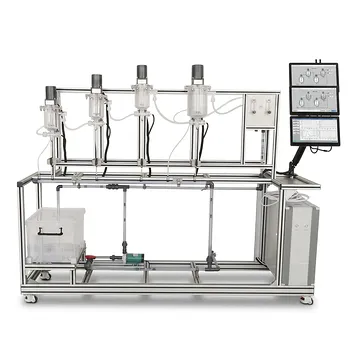
Pilot plant reliability isn't just about immediate safety—it's about surviving the slow, relentless assault of every pump stroke, agitator rotation, and pressure cycle. Rotating machinery like agitators, mixers, and pumps subjects shafts, housings, and connected piping to fluctuating stresses that, over thousands of runs, can initiate microscopic cracks. Evaluating a material's fatigue strength and its endurance limit is the only way to guarantee these components won't fail suddenly during repetitive educational or research experiments, protecting both personnel and the integrity of long-term studies.
A pilot plant filled with rotating equipment is a fatigue-generating machine. The endurance limit isn't just a material property—it's the dividing line between a facility that can run safely for decades of experiments and one that hides a growing risk of brittle fracture, seal blowouts, and unpredictable downtime. Ignore it, and you're designing a failure that only needs time.
Why Rotating Machinery Makes Fatigue a First‑Order Concern
The Cycle Count Reality in Pilot Plants
Pilot plants aren’t one-off demonstrations. They run the same purification or reaction sequence dozens—sometimes hundreds—of times. Every startup, speed adjustment, and shutdown cycles stress on agitator shafts, pump impellers, and connecting nozzles.
Over weeks and months, these load reversals accumulate far beyond what a static pressure vessel would ever see. A standard bending or torsional stress that looks harmless in a single test can turn destructive when repeated thousands of times.
Vibration, Pressure Pulses, and Mixed Loading
Rotating equipment doesn’t just create a single, neat sine wave of stress. Agitators churn viscous fluids, generating bending moments that reverse with every rotation. Pumps deliver pressure pulses that hammer into pipe walls and flanges. Thermal cycling adds its own expansion‑contraction pattern, especially in jacketed vessels and hot‑oil systems.
These combined loads create multiaxial fatigue conditions where cracks can start in directions that simple stress calculations miss. In a pilot plant teaching environment, operators may also run equipment at off‑design speeds or with unsettled fluids, amplifying vibration and accelerating fatigue damage.
The Endurance Limit: Your Material’s Survival Threshold
The Science of Crack Initiation
Fatigue isn’t about gross yielding. It begins at stress concentrators—keyways, threads, weld toes, corrosion pits—with a tiny slip band that grows into a micro‑crack with each load reversal. Once a crack reaches a critical size, the remaining cross‑section snaps in a fast, brittle manner, often with no visible warning.
The endurance limit tells you the stress amplitude below which this process won’t progress, regardless of how many cycles are applied. In steels, that limit can be a clear plateau; in other alloys, it’s a fatigue strength at a defined life. Piloting with materials that operate consistently below their endurance limit is the surest way to prevent fatigue‑driven failures.
Why Educational Pilot Plants Can’t Afford to Ignore This
In academic or industrial‑research settings, pilot plants must combine flexibility with longevity. Students and trainee operators may start and stop equipment frequently, sometimes pushing buttons without fully anticipating the cumulative damage. If a shaft material’s endurance limit has been overlooked, a simple experiment running a few extra hours can become the final cycle that snaps a component—turning a learning opportunity into a safety incident.
Fatigue failures in a pilot plant also undermine data integrity. A sudden leak or mechanical seizure mid‑batch can destroy months of experimental culture or catalyst performance data, making reproducibility impossible.
Understanding the Trade‑offs and Pitfalls
The Corrosion–Fatigue Double Threat
Chemical pilot plants seldom run with pristine, inert fluids. Seepage at seals, acidic process streams, and cleaning solutions create a corrosive environment that drastically lowers effective fatigue strength. A material that easily passes a dry endurance test can fail in a tenth the cycles when exposed to even mild chemical attack.
This is why evaluating fatigue limits must always happen in the context of the operational environment. The primary reference’s emphasis on seal failures becomes critical here—leaking seal flush can accelerate pitting, which becomes a fatigue nucleation site.
Low‑Temperature Embrittlement and Cyclic Stress
Supplementary hazard standards highlight the danger of operating at low temperatures that cause carbon steel to become brittle. This risk compounds with fatigue: a crack that would remain stable in a ductile material can trigger a sudden fracture when the metal’s toughness drops. A pilot plant running cryogenic reactions or cold solvent loops must ensure that materials not only possess a fatigue limit above working stresses but also retain sufficient notch toughness at the minimum design metal temperature.
Misjudging Operational Duty Cycles
Even a well‑intentioned design can fail if the real‑world duty cycle exceeds assumptions. A pilot plant originally planned for 5,000 cycles might end up running 30,000 mini‑batches during optimization studies. If the material selection accounted only for a finite life or a marginal safety factor, the plant silently transitions into a zone where failure is statistically likely. The pitfall is treating fatigue analysis as a one‑time gate rather than a living requirement that respects actual usage.
Making the Right Choice for Your Pilot Plant Reliability
Your selection criteria must connect the deep need for long‑term safety with practical, everyday operation. Align your material and design choices with the real stress landscape:
- If your primary focus is maximizing long‑term safety and repeatability across countless student experiments: Choose components with a clear endurance limit at least 30% above the highest stress amplitude measured during any transient, and pair this with a mandatory vibration monitoring program.
- If your primary focus is avoiding brittle fracture in extreme‑temperature cycles: Require impact‑tested materials that maintain high fracture toughness at both low and elevated temperatures, and never depend on fatigue strength alone when thermal shock is present.
- If your primary focus is preventing seal and leak‑driven hazards in corrosive service: Overlay the fatigue endurance limit with a corrosion allowance and specify seal designs that fail visibly (weep holes, drain ports) before a fatigue crack can propagate into a pressure boundary.
- If your primary focus is protecting valuable experimental data and uptime: Perform a detailed cycle‑count audit of all rotating equipment before operation and re‑evaluate whenever the pilot plant mission expands beyond its original scope.
Embedding fatigue and endurance limits into your pilot plant evaluation isn’t a theoretical exercise—it’s the deliberate act of turning a collection of pumps and agitators into a trustworthy tool for discovery and learning.
Summary Table:
| Key Factor | Impact on Pilot Plants | Mitigation Strategy |
|---|---|---|
| Cyclic Loading | Micro-cracks from pump/agitator rotations | Use materials with endurance limits 30%+ above peak stress |
| Corrosion-Fatigue | Drastically reduced fatigue life in chemical streams | Specify corrosion-resistant alloys & visible leak seals |
| Thermal Cycling | Increased risk of low-temp embrittlement | Use impact-tested materials with high fracture toughness |
| Vibration & Pulses | Unpredicted multiaxial stress propagation | Implement continuous vibration monitoring & cycle-count audits |
Ensure the safety, longevity, and experimental accuracy of your training and research facilities. LABPARK provides premium Educational and Vocational Unit Operations Pilot Plants in chemical engineering, bioprocess & biotech, and environmental & water treatment, specifically engineered to withstand rigorous cyclic stresses and operational demands.
Whether you are upgrading a university lab, a research institute, or an industrial enterprise, our robust designs prioritize fatigue resistance and reliable performance. Contact LABPARK today to consult with our engineering experts and find the perfect, reliable pilot plant solution for your institution!
Related Products
- High-Gravity Emulsification and Mass Transfer Educational Pilot Plant
- Educational Rotary Disc Liquid-Liquid Extraction Pilot Plant
- Rising and Falling Film Evaporation Educational Unit Operations Pilot Plant
- Agitation and Mixing Educational Unit Operations Pilot Plant
- Multi-Stage Stirred Tanks in Series Residence Time Distribution and Mixing Performance Determination Educational Pilot Plant
People Also Ask
- How to update chemometric calibration models in pilot plants? Best practices for process engineers.
- How does column packing affect absorption intensification, and how is it evaluated experimentally?
- Why Compare Membrane-Reservoir Models with Pilot Plant Data? Ensure Successful Process Scale-Up
- How should OSBL investments be estimated? Key Steps to Avoid Budget Overruns in Pilot Plant Projects
- What are the limitations of acentric factor models? Avoid pilot plant errors with polar fluids.