Knowledge Chemical Engineering Education Why is the study of three-phase fluidization crucial in chemical engineering education? Elevate Lab Training
Author avatar

Tech Team · LABPARK

Updated 1 month ago

Why is the study of three-phase fluidization crucial in chemical engineering education? Elevate Lab Training


The study of three-phase fluidization is absolutely foundational to chemical engineering education because it transforms abstract multiphase theory into a hands-on investigation of real industrial complexity. Using laboratory pilot plants, students and researchers directly measure and observe critical parameters like bed expansion, minimum fluidization velocity, and bubble dynamics, which definitively bridges the gap between idealized equations and the operational challenges of gas‑liquid‑solid catalytic reactors.

While lecture halls can explain the governing equations, a three‑phase fluidized bed pilot plant turns theory into tangible insight. It is the only way to truly internalize how gas, liquid, and solid phases interact—a skill essential for designing and scaling up processes like coal liquefaction, slurry catalysis, and biological wastewater treatment.

The Educational Imperative of Three‑Phase Fluidization

Bridging Theory and Industrial Reality

Classroom models for multiphase flow are necessary, but they are idealized.

Pilot plant experiments force students to confront non‑idealities head‑on. Channeling, slugging, and bubble coalescence directly impact reactor efficiency and safety, and these phenomena cannot be predicted by equations alone.

This practical exposure creates engineers who can diagnose operational problems rather than just calculate numbers.

Understanding Complex Interfacial Phenomena

A three‑phase system involves simultaneous gas‑liquid, liquid‑solid, and gas‑solid interactions.

In a pilot column, students observe how catalyst particles are suspended by both gas and liquid streams. They see firsthand how bed porosity and phase holdup dictate mass transfer rates and catalyst wetting efficiency.

These are not just academic concepts; they determine whether a reactor will achieve its design conversion or suffer from by‑product formation.

Preparing for Key Industrial Processes

The primary reference highlights coal liquefaction and catalytic slurry reactions as prime examples. Other vital applications include hydrocracking, Fischer‑Tropsch synthesis, and aerobic wastewater treatment.

Mastering the hydrodynamics of lab‑scale three‑phase beds gives graduates an immediate advantage when they step into roles involving these large‑scale, high‑value processes.

Investigating Three‑Phase Fluidization with Laboratory Pilot Plants

Measuring Minimum Fluidization Velocity ($U_{mf}$)

The pilot plant allows a controlled increase of gas and liquid flow rates through a bed of solid particles.

Students monitor the pressure drop across the bed in real time. The $U_{mf}$ is identified at the transition point where the drag forces fully support the effective weight of the solids—a fundamental threshold that defines all subsequent reactor behavior.

Observing Bed Expansion and Bubble Behavior

As flows increase beyond $U_{mf}$, the bed height expands visibly in a transparent column.

Students quantify this expansion and directly relate it to the increase in bed porosity. They observe bubble size, rise velocity, and coalescence patterns, which are the primary drivers of gas‑liquid mass transfer and backmixing.

This visual data makes abstract concepts like “bubble‑to‑emulsion phase transport” instantly concrete.

Analyzing Phase Holdup and Axial Mixing

Beyond simple expansion, pilot plants configured with tracer injection ports and sample points reveal the true hydrodynamics.

Students can determine the gas holdup, liquid holdup, and solid concentration along the column height. Measuring axial mixing profiles teaches why a perfectly mixed assumption can fail and how catalyst entrainment becomes a real risk in industrial units.

This level of investigation directly validates multiphase reactor models and builds competence in using computational fluid dynamics (CFD) with confidence.

Understanding the Trade‑offs

No educational tool is without limitations, and three‑phase pilot plants are no exception. It is critical to acknowledge these downsides to build genuine expertise.

  • Wall effects and scale distortion: Small‑diameter laboratory columns exhibit higher wall friction, which can alter bubble paths and mixing patterns compared to industrial vessels.
  • Distributor sensitivity: Uniform introduction of gas and liquid is notoriously difficult. A poorly designed distributor can create dead zones or accelerate catalyst attrition, skewing all hydrodynamic data.
  • Simplified chemistry vs. real reactions: Many teaching pilot plants operate with air‑water‑glass bead systems. While excellent for hydrodynamic study, they do not capture the complex heat effects and surface tension changes present in real reactive flows, so results must be extrapolated with care.

Making the Right Choice for Your Educational Goal

Your specific learning objective will set the focus for how you use a three‑phase pilot plant.

  • If your primary focus is building foundational intuition: Prioritize a transparent column with air‑water‑solid beads. Focus on visual observation of fluidized states, simple bed expansion measurements, and $U_{mf}$ determination to ground the Ergun equation in physical reality.
  • If your primary focus is advanced reactor engineering: Equip the pilot plant with differential pressure transmitters, phase holdup measurement ports, and tracer analysis capabilities. Stress the quantitative link between bubble behavior and mass transfer coefficients.
  • If your primary focus is industrial scale‑up validation: Operate the pilot plant with the intended catalyst and liquid‑phase chemistry (at ambient conditions where possible). Compare the experimentally derived $U_{mf}$ and phase holdups against literature correlations, and use the data to challenge the assumptions in your scale‑up model.

A three‑phase fluidized bed pilot plant is the most effective tool for turning multiphase flow theory into a deployable engineering skillset, provided its limitations are acknowledged and the investigation is tailored to the learning outcome you need.

Summary Table:

Parameter / Phenomenon Experimental Method in Pilot Plants Industrial Relevance
Minimum Fluidization Velocity ($U_{mf}$) Monitor bed pressure drop against gas/liquid flow rates Defines the fundamental operating boundary of the reactor
Bed Expansion & Porosity Visual column observation and height measurement Direct indicator of gas-liquid mass transfer and contact efficiency
Phase Holdup & Mixing Tracer injection and axial concentration sampling Key to validating CFD multiphase models and avoiding catalyst bypass
Bubble Behavior Direct visual recording of coalescence and rise velocity Governs interfacial mass transfer and thermal distribution

Bring Industrial-Scale Realism to Your Lab

Bridge the gap between complex multiphase theory and physical reality. LABPARK provides premium Educational and Vocational Unit Operations Pilot Plants in chemical engineering, bioprocess & biotech, and environmental & water treatment. Specifically tailored for universities, research institutes, and enterprises, our advanced pilot plants empower students and researchers to master fluidization dynamics, scale-up modeling, and real-world process troubleshooting.

Ready to upgrade your department's educational capabilities? Contact LABPARK today to discuss your laboratory's needs!

Related Products

People Also Ask

Related Products

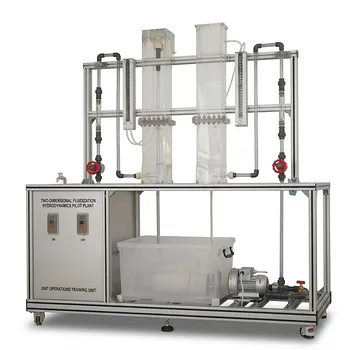
Two-Dimensional Fluidization Hydrodynamics Educational Pilot Plant for Unit Operations Training

Two-Dimensional Fluidization Hydrodynamics Educational Pilot Plant for Unit Operations Training

Explore gas-solid and liquid-solid fluidization hydrodynamics with our transparent 2D educational pilot plant. Ideal for chemical engineering unit operations labs, it demonstrates fixed to fluidized bed regimes, measures pressure drop, and integrates QR-code digital learning for enhanced student training.

Fluidized Bed Gas Solid Catalytic Reaction Educational Pilot Plant

Fluidized Bed Gas Solid Catalytic Reaction Educational Pilot Plant

Our educational fluidized bed gas-solid catalytic reaction pilot plant is ideal for chemical engineering labs. Students study fluidization dynamics, catalyst evaluation, and process control hands-on. Features include a customizable reactor, touchscreen HMI, and safety interlocks for safe, curriculum-aligned experiments.

Multi Pump Fluid Transport Process Piping Unit Operations Training Pilot Plant

Multi Pump Fluid Transport Process Piping Unit Operations Training Pilot Plant

Industrial-scale multi-pump pilot plant for unit operations training in fluid transport and process piping, featuring real-material and semi-physical simulation modes, comprehensive pump and flowmeter calibration, and safety-enhanced two-tier platform, bridging academic theory and industrial practice for chemical engineering education.

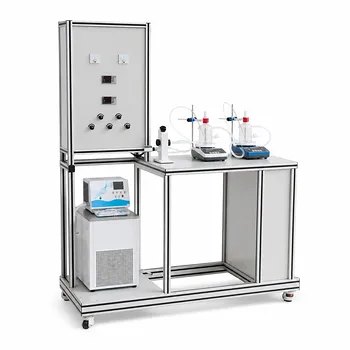
Ternary Liquid-Liquid Equilibrium Educational Pilot Plant

Ternary Liquid-Liquid Equilibrium Educational Pilot Plant

An integrated laboratory training system for engineering students to determine ternary liquid-liquid equilibrium data, construct phase diagrams, and gain hands-on experience with industrial instrumentation, including Abbe refractometer and magnetic stirrers, for precise data acquisition and curriculum-aligned experiments.

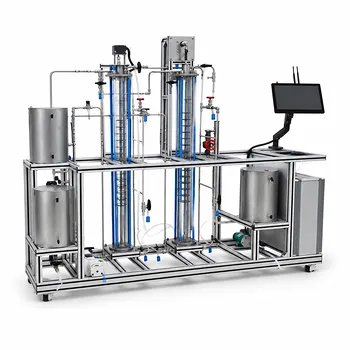
Multi-Reactor Educational Pilot Plant for Reaction Engineering Unit Operations

Multi-Reactor Educational Pilot Plant for Reaction Engineering Unit Operations

Integrated bench-scale educational pilot plant for chemical engineering teaching featuring fixed bed fluidized bed and stirred tank reactors with web-based digital twin controls and safety interlocks for hands-on unit operations and reaction engineering comparative studies in one compact system.

Comprehensive Liquid-Liquid Extraction Pilot Plant for Engineering Education

Comprehensive Liquid-Liquid Extraction Pilot Plant for Engineering Education

Comprehensive liquid-liquid extraction pilot plant for engineering education, integrating rotary and vibratory columns for hands-on observation of phase behavior, flooding limits, and mass transfer efficiency, enabling precise HTU and mass transfer coefficient calculations.

Comprehensive Fluid Mechanics Educational Unit Operations Pilot Plant

Comprehensive Fluid Mechanics Educational Unit Operations Pilot Plant

Hands-on fluid mechanics pilot plant for engineering education covering over 13 principles including pipe flow, minor losses, flowmeter calibration, and pump performance with industrial-grade components, smooth and rough piping, venturi and orifice flowmeters, and centrifugal pump testing and analysis.

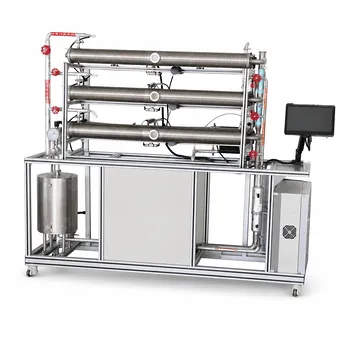
Three-Tube Heat Transfer Educational Pilot Plant for Unit Operations Training

Three-Tube Heat Transfer Educational Pilot Plant for Unit Operations Training

Three-tube heat transfer pilot plant for studying convective heat transfer enhancement and condensation. Allows comparison of smooth, corrugated, turbulent tubes, verifying empirical correlations. Ideal for chemical engineering education with safety and closed-loop steam recovery.

Multi-Functional Drying Educational Unit Operations Pilot Plant

Multi-Functional Drying Educational Unit Operations Pilot Plant

Versatile multi-functional drying educational unit operations pilot plant integrating tunnel, fluidized bed, and spray drying. Enables hands-on study of drying curves, psychrometry, and gas-solid separation for chemical engineering curriculum in higher education labs.

Multi Functional Catalytic Reaction and Reactor Evaluation Educational Unit Operations Pilot Plant

Multi Functional Catalytic Reaction and Reactor Evaluation Educational Unit Operations Pilot Plant

Bench-scale educational pilot plant for catalytic reaction and reactor evaluation, integrating fixed bed, fluidized bed, and stirred tank reactors. Students compare reactor designs, evaluate catalysts, and study reaction kinetics and hydrodynamics. Perfect for unit operations labs in chemical engineering curricula.

High-Gravity Emulsification and Mass Transfer Educational Pilot Plant

High-Gravity Emulsification and Mass Transfer Educational Pilot Plant

This integrated educational pilot plant utilizes rotating packed bed technology to demonstrate high-gravity emulsification and mass transfer, providing engineering students with hands-on experience in process intensification and unit operations through a modular, customizable design with digital monitoring.

100L Continuous Loop Hydrogenation Educational Unit Operations Pilot Plant

100L Continuous Loop Hydrogenation Educational Unit Operations Pilot Plant

This 100L continuous loop hydrogenation pilot plant is designed for chemical engineering education, featuring 316 stainless steel construction, advanced gas-liquid mass transfer components, explosion-proof safety systems, and a 15.6-inch touchscreen with 5G connectivity, cloud data logging, bridging theory and industry.

Multi-Functional Special Distillation Educational Pilot Plant

Multi-Functional Special Distillation Educational Pilot Plant

Versatile multi-functional special distillation pilot plant for chemical engineering education. Supports continuous, vacuum, azeotropic, reactive, extractive distillation. Transparent glass columns enable real-time visual observation of hydrodynamics and separation processes.

Thermal Desorption Exhaust Gas and Tail Water Treatment Educational Pilot Plant

Thermal Desorption Exhaust Gas and Tail Water Treatment Educational Pilot Plant

Bench-scale educational pilot plant for treating thermal desorption exhaust gas and tail water integrates condensation, Fenton oxidation, precipitation, filtration, and carbon adsorption. Ideal for chemical engineering and environmental labs, teaching unit operations, process control, and real-time data analysis.

Electrolyte Distillation Purification and Formulation Educational Pilot Plant

Electrolyte Distillation Purification and Formulation Educational Pilot Plant

Integrated bench-to-pilot scale educational pilot plant for electrolyte distillation, purification, and formulation with borosilicate glass construction, PLC automation, touchscreen HMI, and advanced industrial safety features for hands-on chemical process training, ideal for chemical engineering and materials science curricula.

Continuous Batch Extractive Distillation Educational Pilot Plant

Continuous Batch Extractive Distillation Educational Pilot Plant

Versatile pilot plant for continuous, batch, and extractive distillation training. High-borosilicate glass column for visualizing hydraulics, 15.6-inch touchscreen with data logging, precise reflux ratio control 1-99, and durable corrosion-resistant frame. Ideal for chemical engineering education and process research.

Fixed-Bed Chemical Reaction and Gas Dust Tar Removal Unit Operations Pilot Plant

Fixed-Bed Chemical Reaction and Gas Dust Tar Removal Unit Operations Pilot Plant

Integrated educational pilot plant for studying catalytic gas-solid reactions and downstream gas purification. Features dual fixed-bed reactor, three-stage heating, and touchscreen control for hands-on engineering training. Ideal for chemical and environmental engineering curricula.

Constant Pressure Filtration Educational Unit Operations Pilot Plant

Constant Pressure Filtration Educational Unit Operations Pilot Plant

Hands-on educational pilot plant for constant pressure filtration. Classic plate and frame filter press allows students to study kinetics, determine specific cake resistance, perform cake washing and evaluate washing rates. Ideal for chemical engineering curriculum. Mobile, customizable, safety-compliant design.

Hot Filtration Educational Unit Operations Pilot Plant Laboratory System

Hot Filtration Educational Unit Operations Pilot Plant Laboratory System

This integrated laboratory bench-scale hot filtration pilot plant enables students to study solid-liquid separation under thermal conditions, featuring a stainless steel vessel, removable heating jacket, and multi-layer filter plates for unit operations education, ideal for chemical engineering laboratory curriculum.

Natural Product Extraction Unit Operations Training Pilot Plant

Natural Product Extraction Unit Operations Training Pilot Plant

Integrated natural product extraction pilot plant for chemical engineering training bridges theory and industrial practice with modular extraction and evaporation/concentration units, hybrid touchscreen and manual control, realistic process simulation, and self-contained softened water and vacuum utilities.


Leave Your Message