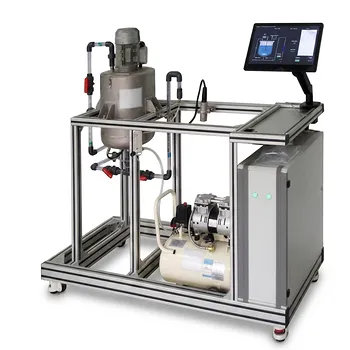
Static mixers integrated with fluid diagnostics turn a pilot plant from an opaque blending vessel into a transparent, data-rich learning environment. This pairing is critical because it lets you directly observe and quantify the mixing kinetics of complex, non-Newtonian fluids—the very materials that dominate the chemical, food, and pharmaceutical industries. By combining chaotic advection elements like SMX mixers with real-time sensors such as electrical resistance tomography (ERT), you transform an abstract transport phenomenon into a measured, scaled-up engineering parameter.
The deep need is not just better mixing—it’s the ability to generate trustworthy scale-up data while teaching low-energy process intensification. Without this integration, the chaotic, diffusion-driven dance inside a static mixer remains a black box, leaving engineers to guess at radial dispersion, component uniformity, and the true efficiency of a continuous process. The right diagnostics make that process visible, measurable, and optimizable in ways that batch trials alone can never achieve.
The Core Challenge of Modern Mixing Unit Operations
Traditional mixing education often stops at the impeller. But industry has already moved on. The real challenge is bridging the gap between textbook fluid mechanics and the shear-thinning, non-Newtonian behavior that governs real product quality and process economics.
The Shift from Batch to Continuous
Continuous manufacturing is no longer just a lean manufacturing trend. It is a direct response to the wastes of batch processing: bloated inventory, long cycle times, and excessive downtown for cleaning.
Pilot plants equipped with both batch and continuous modules let students compare these worlds side by side. They see firsthand how static mixers eliminate moving parts and reduce equipment footprint while maintaining tight control over residence time distribution.
The Complexity of Non-Newtonian Fluids
Most real fluids—polymer melts, fermentation broths, emulsions—do not mix like water. Their viscosity changes with shear rate, creating stubborn unmixed zones that stretch and fold unpredictably.
A pilot plant that cannot capture this complexity teaches a sanitized version of reality. You need to see how a shear-thinning fluid behaves when it hits a split-and-recombine element, not just how a tracer dye looks in a water tank.
Why Simple Visual Observation Fails
The human eye can spot gross maldistribution, but it cannot quantify radial concentration gradients or detect micro-mixing deficits in a multiple-reaction system. Fluidic phenomena like lamination feed segment widths directly control reactant conversion and product yield, yet they are invisible without spectral or tomographic diagnostics. If you cannot measure the mixing quality, you can never truly optimize it.
How Static Mixers and Diagnostics Unlock Process Understanding
The integration of smart hardware (chaotic mixers) and smart sensing (fluid diagnostics) turns a pilot plant into a kinetics laboratory. You move from asking “Is it mixed?” to “How fast, and by what mechanism?”
Visualizing Chaotic Advection in Real Time
Chaotic advection inside an SMX mixer relies on exponential stretching and folding of fluid elements. When you connect electrical resistance tomography or a visualization sensor to the flow path, students watch this chaos unfold.
They can manipulate flow rates and velocity ratios and immediately see how a change in the Reynolds number alters the scattered islands of unmixed fluid. The abstract concept becomes a repeatable, photographed event—a perfect teaching tool for transport phenomena.
Quantifying Radial Dispersion and Component Uniformity
Diagnostics provide the hard numbers. Instead of guessing at the time needed to reach a target coefficient of variation, you measure it directly at multiple radial positions.
This is the data that scale-up decisions are built on. A pilot plant that can prove a static mixer achieves 99% component uniformity at a given energy input gives process engineers the confidence to design the industrial unit without excessive safety factors. It replaces faith with fact.
Building Scale-Up Confidence through Data
Scaling mixing is notoriously difficult because the energy dissipation rate varies wildly between a benchtop and a plant. By generating a complete kinetic map of mixing time vs. flow rate in a pilot plant, you create a scale-agnostic performance curve.
That curve translates directly to larger pipes, because chaotic mixing in SMX elements is geometrically similar across scales. The diagnostics ensure the curve is based on measured fluid behavior, not just computational assumptions.
Bridging the Gap Between Theory and Practical Skill
The integration of these tools is not just research—it is the most effective form of engineering pedagogy. It connects the abstract mathematics of fluid dynamics to the very tangible reality of a product’s color, taste, or purity.
Mastering Transport Phenomena Hands-On
Fluid mechanics is a discipline of gradients. Lamination feed segment widths, micro-mixing designs, and split-and-recombine geometries all influence the local concentration field.
In a diagnostic-equipped pilot plant, students can deliberately alter these variables and then measure the impact on product distribution in a multiple-reaction system. They learn that a small change in feed configuration can shift yield from 85% to 95%—a lesson no textbook can deliver with equal force.
Preparing for Industry’s Green and Lean Future
Modern chemical industries are mandated to treat their exhaust gases, wastewater, and residues. That same diagnostic and mixing technology applies directly to environmental unit operations.
When a pilot plant integrates static mixers for neutralization or precipitation, and then uses sensors to verify effluent quality, it trains operators in emissions control and green chemistry protocols simultaneously. The same low-energy mixing principle that intensifies a reaction also reduces the energy burden of downstream water treatment. The value chain becomes clear.
Understanding the Trade-offs
Nothing comes for free. Static mixers and advanced diagnostics are powerful, but they bring their own engineering costs and complexities that must be managed honestly.
Pressure Drop and Energy Cost
Static mixers achieve chaos by forcing fluid through a series of restrictive elements. That creates a substantial pressure drop compared to an empty pipe.
In a pilot plant, you must weigh the mixing quality against the pumping energy. The diagnostics become essential here: they tell you the point of diminishing returns where extra pressure drop no longer yields better uniformity. Teaching this energy trade-off is itself a core lesson in process intensification.
Diagnostic Integration Complexity
Tomography and advanced visualization sensors are not plug-and-play. They require careful calibration, signal processing, and an understanding of measurement uncertainty.
If a pilot plant obscures this complexity with a slick interface, it can give a false sense of ease. A good instructional plant makes the diagnostic setup a deliberate part of the learning—electrode placement, conductivity drift, and all—so that engineers graduate knowing both the power and the pitfalls of these tools.
When Simplified Setups May Suffice
For low-viscosity, Newtonian fluids in a single-phase flow, a simple tracer injection and a spectrophotometer may be entirely adequate. Not every pilot plant needs a full tomographic array.
The integration of static mixers and diagnostics must be purpose-driven. If the objective is solely to train operators on a standard batch recipe, the added complexity may distract rather than educate. Reserve the full integration for when non-Newtonian behavior, low-energy intensification, or scale-up data is the true goal.
Making the Right Choice for Your Pilot Plant
Your decision to integrate these tools should align with what you are trying to learn or teach. The following recommendations can guide that choice.
- If your primary focus is teaching process intensification: Prioritize an SMX-type static mixer with a transparent housing and a camera-based visualization system. Let students see chaotic advection and measure mixing time directly. The visual feedback accelerates understanding faster than any numerical simulation.
- If your primary focus is generating reliable scale-up data for non-Newtonian fluids: Invest in electrical resistance tomography or a similar tomographic modality. The ability to produce radial concentration maps at different flow rates will give you the kinetic curve you need to confidently design the full-scale unit.
- If your primary focus is preparing students for modern continuous manufacturing: Combine the static mixer diagnostics with a direct comparison to a batch vessel. Show how residence time distribution and energy consumption differ, and how the same diagnostic tool can be used to validate both modes. This builds the cross-functional skill set industry demands.
Ultimately, the integration of static mixers and fluid diagnostics transforms a mixing pilot plant from a simple demonstration unit into a truth-telling instrument. It reveals the physics you cannot see, measures the uniformity you could only assume, and builds the engineering judgment that separates a textbook answer from a plant-floor success.
Summary Table:
| Focus Area | Key Technology | Primary Value | Key Challenge |
|---|---|---|---|
| Teaching Intensification | SMX Mixers & Cameras | Visualizes chaotic advection in real time | Managing pressure drop vs. mixing quality |
| Non-Newtonian Scale-Up | Tomography (e.g., ERT) | Provides quantifiable radial dispersion data | Diagnostic calibration and complexity |
| Continuous Manufacturing | Batch vs. Continuous Modules | Compares equipment footprint and residence time | Higher initial setup and integration costs |
Bring Advanced Mixing and Process Intensification to Your Lab
Are you looking to equip your students, researchers, or engineers with industry-ready process engineering skills?
LABPARK provides state-of-the-art Educational and Vocational Unit Operations Pilot Plants in chemical engineering, bioprocess & biotech, and environmental & water treatment. Designed specifically for universities, research institutes, and enterprises, our advanced pilot plants integrate static mixing and diagnostic technologies to deliver reliable scale-up data, green chemistry protocols, and hands-on learning.
Contact LABPARK today to design your custom pilot plant solution!
Related Products
People Also Ask
- Why is the Reynolds number ($Re_M$) critical in mixing? Master N_P for pilot plants.
- What are the four guiding principles of process intensification? Educational Equipment Guide
- How do educational unit operations pilot plants support process analysis? Connect theory with real data
- How does the pseudobinary diffusion approximation simplify mass transport equations in educational pilot plants?
- Why is post-implementation performance evaluation and gap analysis critical when deploying educational unit operations pilot plants?