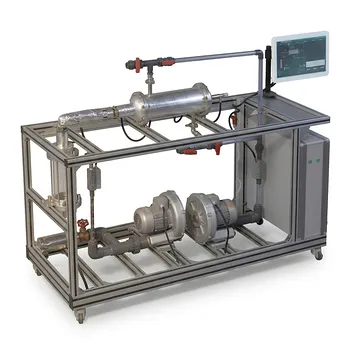
In commercial chemical production, utility costs are not a minor overhead—they directly determine a process's economic viability. Including heat integration and energy recovery systems in vocational unit operations pilot plants is essential because it teaches future engineers to manage these costs firsthand. These systems transform abstract thermodynamic concepts into measurable, hands-on experiments that reveal how minimizing external steam, cooling water, and electricity consumption can slash operating expenses by 5% to 15% or more. Without this integrated training, graduates miss the critical skill of designing processes where every unit of energy is recovered and reused.
Heat integration in pilot plants is the bridge between theoretical energy balances and real-world economic performance. It trains operators and researchers to see waste heat not as a byproduct, but as a recoverable asset—directly lowering production costs, enhancing sustainability, and shaping the instinct to design inherently efficient plants.
The Economic Reality of Chemical Production
In large-scale facilities, utility expenses are a relentless drain on profitability, often ranking among the top cash cost components.
The true weight of utility costs
Utilities—steam, cooling water, and electricity—typically account for 5% to 15% of the total cash cost of production. This is not a static figure; it fluctuates with energy market prices, making it a principal risk factor. Vocational pilot plants must replicate this economic pressure so learners feel the financial consequence of poor thermal design.
Why classroom theory alone fails
Calculating a heat exchanger network on paper does not convey the operational discipline needed to maintain pinch points, respond to fouling, or sequence batch operations. A pilot plant with integrated heat recovery forces users to confront the practical gap between ideal simulation and actual plant performance, where flow maldistribution or startup dynamics can erase anticipated savings.
Hands-On Learning of Thermodynamic Principles
Energy recovery systems in a pilot plant turn thermodynamics into a tangible, economic language.
Demonstrating real-world energy balances
When a waste heat boiler captures thermal energy from hot furnace off-gases to produce steam for other unit operations, students directly measure the conversion of sensible heat into useful work. This experimental setup models processes like steam methane reforming and makes the abstract concept of exergy efficiency concrete.
Teaching the pinch technique experimentally
A pilot plant configured with multiple hot and cold streams—preheaters, condensers, reboilers—allows users to experimentally determine the pinch temperature and minimum utility requirements. They manipulate stream targeting, observe the temperature driving forces, and see instantly how a 5°C approach temperature penalty rises or falls with exchanger area. This cements a skill that is nearly impossible to learn from a simulator alone.
Decoupling reaction from utility dependence
Heat-integrated reactors demonstrate how high-temperature catalytic steps can be driven entirely by internal heat recovery, not by external fuel. Users learn that decoupling a reaction route from plant utilities makes a process more robust and economically independent—a key insight for evaluating process intensification options.
Bridging Theory and Practical Process Design
Beyond single-unit experiments, integrated pilot plants reveal the system-level trade-offs encountered during scale-up.
Configuring heat exchanger networks
Trainees physically connect streams to form a complete heat recovery loop, learning that the sequence of heat exchange dictates the achievable energy savings. They see how an incorrectly placed cooler can destroy a carefully designed preheat cascade, embedding the logic of network synthesis.
Handling batch and scheduling challenges
Not all plants operate continuously. Integrated systems that can simulate indirect heat recovery—using thermal storage or intermediate utility loops—show how to overcome the thermodynamic barriers in batch processes where hot and cold streams do not align in time. This teaches the real art of scheduling for maximum energy recapture without compromising product quality.
Generating utilities from waste
A pilot-scale waste heat boiler does more than recover heat; it generates utility-grade steam that can drive other unit operations within the pilot plant. This closes the loop, mimicking industrial sites where a single waste stream supports reboilers, evaporators, or even chillers, and underscores the multiplier effect of energy integration.
Understanding the Trade-offs
No technology comes without compromises, and heat integration is no exception. Recognizing these limitations is part of the essential training.
Capital cost versus operating cost
Every additional heat exchanger increases capital expenditure. In a pilot plant, students can test whether the additional equipment cost is justified by the long-term utility savings, learning to use metrics like payback time without being blinkered by a single objective.
Complexity and operability
Highly integrated plants are harder to control. A process upset in one stream cascades into the entire network. Pilots with full integration force users to manage this dynamic coupling, teaching that sometimes a simpler design with slightly higher utility use is more robust.
Minimum temperature driving forces
Thermodynamics imposes a hard limit: heat can only flow from a hotter to a colder source. Users encounter the minimum approach temperature constraint and learn that pushing for 99% recovery often demands impractical heat transfer area or leads to control instability. This instills an intuition for where to draw the line.
Flexibility for future changes
An over-integrated plant can become a straightjacket, resisting any modification to throughput or product mix. Training with integrated pilots helps researchers evaluate the long-term adaptability of a heat recovery scheme, balancing immediate efficiency against the need for future capacity creep.
How to Apply This to Your Facility or Curriculum
To gain the full educational and practical benefit, match your pilot plant’s integration level to your core objective.
- If your primary focus is rapid skill-building for plant operators: Choose a configuration with a compact heat exchanger network that reveals pinch analysis in a single session. Keep the control loops simple so operators can focus on energy targeting without being overwhelmed.
- If your primary focus is R&D for new process concepts: Include flexible modules with interchangeable reactors and the ability to compare conventional and micro-reactor setups. This allows direct benchmarking of energy efficiency and helps identify where process intensification truly pays off.
- If your primary focus is simulating real factory economics: Integrate a waste heat boiler and a utility distribution grid. Require students to track steam and electricity costs during runs, turning every experiment into a profit-and-loss lesson that mirrors industrial cash flow.
- If your primary focus is tackling batch or multiproduct flexibility: Use a pilot plant with thermal storage tanks and configurable scheduling logic. The emphasis should be on demonstrating indirect heat recovery and the trade-offs between storage size and energy recapture rate.
Ultimately, a pilot plant without heat integration teaches unit operations; with it, it teaches process engineering that safeguards a plant’s financial and environmental future.
Summary Table:
| Key Dimension | Core Benefit / Concept | Practical Application in Pilot Plants |
|---|---|---|
| Economic Reality | Utilities represent 5% to 15% of production cash costs. | Teaches cost management and risk mitigation against volatile energy markets. |
| Thermodynamics | Pinch analysis and real-world energy balances. | Hands-on optimization of heat exchanger networks and temperature approach constraints. |
| System Trade-offs | Capital cost vs. operating savings & complexity. | Prepares students to manage process dynamic coupling and system operability. |
| Educational Value | Connects abstract formulas to industrial operations. | Develops instincts for designing inherently sustainable and financially viable plants. |
Elevate Your Engineering Curriculum & Research with LABPARK
At LABPARK, we provide premium Educational and Vocational Unit Operations Pilot Plants in chemical engineering, bioprocess & biotech, and environmental & water treatment tailored for universities, research institutes, and enterprises. Our plants feature advanced heat integration and energy recovery configurations to prepare the next generation of engineers for real-world economic challenges.
Ready to enhance your lab's training capabilities with hands-on thermodynamic systems? Contact LABPARK today to discuss your customized pilot plant solution!
Related Products
- Comprehensive Multi-Modal Heat Transfer Unit Operations Pilot Plant for Engineering Training
- Comprehensive Heat Transfer Coefficient Determination Educational Unit Operations Pilot Plant
- Dual Mode Heat Transfer Pilot Plant for Unit Operations Training
- Solid Spherical Heat Transfer Coefficient Determination Educational Chemical Engineering Pilot Plant
- Three-Tube Heat Transfer Educational Pilot Plant for Unit Operations Training
People Also Ask
- When is ε-NTU preferred over LMTD in pilot plants? Predict heat exchanger performance without iteration.
- How to configure heat transfer pilot plants for pinch analysis? Teach energy recovery.
- How does transitioning to a multi-shell heat exchanger affect required area? Optimize pilot plant design.
- How does thermal conductivity affect pilot plant performance? Optimize heat transfer & accuracy
- How to Verify Air-Side Heat Transfer Coefficient with a Pilot Plant? Practical Lab Guide