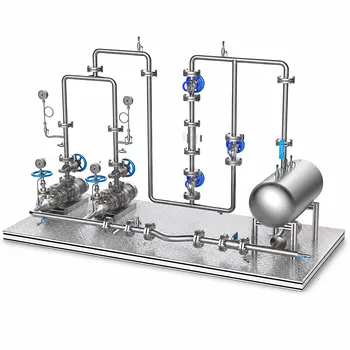
It’s the difference between a controlled safety release and a catastrophic liquid spill. The 15% vapor space rule is a critical engineering control designed to manage two-phase flow during emergency scenarios. In student training, it transforms an abstract design code into a visceral lesson on how a liquid’s incompressibility can defeat a safety relief system, preventing a minor overpressure from escalating into a major loss of containment.
The "15% rule" isn't just a tank-filling guideline; it’s a fundamental safeguard. Mastering this concept teaches students that safety systems are only effective when the physical state of the process material inside the vessel allows them to function as designed. The vapor space acts as a compressible buffer, protecting the relief path from being choked by non-compressible liquid.
Why Liquid Demands a Safety Buffer
The primary hazard with storing pressurized, liquefied gas is its behavior under heat. Unlike a true gas, a saturated liquid expands with almost relentless hydraulic force.
The Problem of Hydraulic Expansion
When a liquid like propane is heated—by a fire or even direct sunlight—it expands in volume. Because liquids are nearly incompressible, this tiny expansion creates a massive, rapid pressure surge.
In a completely full tank, even a one-degree temperature rise can exceed the vessel’s design pressure. The relief valve would then be forced open by an incompressible column of liquid, a scenario it wasn't fully designed to handle efficiently.
The Critical Role of the Vapor Cushion
The top 15% of the tank contains vapor, not liquid. Vapor is highly compressible and acts like a giant spring or shock absorber. This cushion absorbs the initial volume change from thermal expansion without an immediate pressure spike, giving operators and safety systems precious time to react before reaching the relief set pressure.
The Deadly Intersection of Pumps and Vapor Space
The 15% rule also protects against a more dynamic and operator-induced danger: the overfill scenario during product transfer.
When Pump Discharge Overpowers Design
Transfer pumps are often capable of generating discharge pressures that can exceed the set pressure of a tank’s safety relief valve. If students are trained to simply fill a tank until it’s "full," they risk creating a hydraulic lock.
Should the pump continue running against a liquid-full tank, it can instantly spike the pressure beyond the valve’s relief set point. Without a vapor space to compress, the safety valve will open, but it will discharge a dense, hazardous liquid into the relief header or atmosphere—potentially collapsing the flare system or creating a massive fire hazard directly at the vent point.
Training Operational Discipline
Teaching students to stop a transfer at the 85% liquid-full mark instills a non-negotiable safety boundary. It hardwires the concept that the "fill limit" is a safety function, not a commercial capacity metric, directly linking their pump controls to the physics inside the pressure vessel.
Understanding the Trade-offs and Limitations
While the 15% rule is a robust operational standard, it is not a magical solution to all hazards. A holistic safety analysis requires students to consider its limitations.
- Boiling-Liquid Expanding Vapor Explosions (BLEVEs): A 15% vapor space does not prevent a BLEVE. If a fire impinges on the tank’s metal wall above the liquid level, it can weaken the steel, leading to catastrophic rupture. The vapor space prevents small overpressure valve releases but not large-scale structural failure.
- Rapid Transient Events: The rule is designed for relatively steady-state overpressure. In a runaway reaction or an extremely fast-chain deflagration, the relief system’s ability to vent flow—even vapor—might still be overwhelmed.
- Operational Discipline is Still Required: The 15% buffer only works if safety interlocks and operator attention prevent the liquid level from exceeding the limit in the first place. The training must therefore integrate automation with this physical principle.
Making the Right Choice for Your Training Goal
This 15% rule is a versatile teaching tool. How you frame it depends on the core lesson you want your students to learn.
- If your primary focus is fundamental pressure relief design: Use the 15% rule to illustrate the difference between a relieving gas and a relieving liquid, and why API standards mandate this buffer for sizing.
- If your primary focus is operational safety and interlocks: Frame the 15% level as the crucial set point for high-level alarms and automatic pump shutdowns, teaching students that an interlock is the last line of defense upholding a physical safety boundary.
- If your primary focus is emergency response: Explain that knowing a tank is filled to the 85% rule provides responders with a predictable timeline. They understand the relief valve will initially vent vapor, not liquid, during the critical first minutes of a fire.
This single specification teaches students that safety is a system of interdependent parts, where material properties, equipment design, and human operation must all align to prevent a release.
Summary Table:
| Key Aspect | Physical Behavior / Risk | Safety Function in Training |
|---|---|---|
| Hydraulic Expansion | Heated liquids expand with massive force | Highlighting why incompressible fluids cause rapid pressure spikes |
| Vapor Cushion (15%) | Compressible gas space at tank top | Acts as a shock absorber to delay overpressure relief |
| Overfill Scenario | Pump pressure exceeds design limit | Teaches operational discipline to avoid liquid venting and hydraulic lock |
| BLEVE Limitation | Fire weakens tank steel above liquid | Illustrates that vapor buffers cannot prevent structural thermal failure |
Enhance Your Process Safety Training with LABPARK Pilot Plants
To effectively teach critical safety rules like vapor space buffer dynamics, students need hands-on experience with realistic systems.
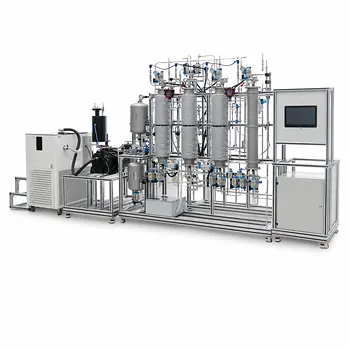
LABPARK provides premium Educational and Vocational Unit Operations Pilot Plants in chemical engineering, bioprocess & biotech, and environmental & water treatment. Specifically designed for universities, research institutes, and enterprises, our pilot plants bridge the gap between theoretical safety codes and real-world operational discipline.
Help your students master pressure relief, flow dynamics, and system interlocks safely—contact us today to discover how we can customize a solution for your lab!
Related Products
- Multi Pump Fluid Transport Process Piping Unit Operations Training Pilot Plant
- Multimodal Absorption and Desorption Pilot Plant for Unit Operations Training
- Multi-Functional Drying Educational Unit Operations Pilot Plant
- Chemical Pipeline Assembly and Fluid Transport Practical Training Unit Operations Pilot Plant
- Educational Pressure Swing Adsorption Ethylene Capture Unit Operations Pilot Plant
People Also Ask
- Why distinguish Newtonian & non-Newtonian fluids in pilot plants? Prevent design errors.
- How do steady-state and dynamic simulations complement pilot plants? Validate scale-up and controllability
- How can unit operations pilot plants demonstrate simultaneous removal of light and heavy impurities? Configure a modular setup
- Why Does a Pilot Plant Solver Return a Singular Matrix Error, and How Can You Resolve It?
- Why is the chemical plant startup schedule crucial? De-risk scale-up with pilot plants.