Knowledge Chemical Engineering Education Why is precise temperature monitoring essential in compressible flow pilot plants? Key to Mach Calculations
Author avatar

Tech Team · LABPARK

Updated 1 month ago

Why is precise temperature monitoring essential in compressible flow pilot plants? Key to Mach Calculations


Precise temperature monitoring is not a minor detail—it is the physical backbone of your compressible flow calculations. In any pilot plant handling compressible fluids, the speed of sound is a dynamic, local property that changes dramatically as the gas expands and cools. A seemingly small error in temperature measurement can propagate into significant miscalculations of Mach number and, consequently, the nozzle discharge coefficient, undermining the entire purpose of your flow experiments.

At its core, acoustic velocity in a perfect gas depends on the square root of the absolute temperature. When a gas accelerates through a nozzle, its temperature drops sharply; you must measure the local temperature at the very point where speed of sound is needed. Failing to do so makes your computed Mach number unreliable, corrupting both flow characterization and equipment calibration.

The Physics Linking Temperature to the Speed of Sound

The Fundamental Relationship

For a perfect gas, the acoustic velocity ($c$) is given by the relation $c = (gkRT)^{1/2}$. This relationship highlights a critical fact: $c$ is independent of pressure and varies exclusively with the absolute temperature ($T$). In a pilot plant, this means that any temperature error directly distorts the calculated local speed of sound.

Why Mach Number is a Moving Target

The Mach number ($M$) is simply the ratio of the local flow velocity ($V$) to the local speed of sound ($M = V/c$). If you measure $V$ correctly but use a temperature taken from a distant, warmer upstream point, you will overestimate $c$ and underestimate the true Mach number. For a compressible flow study, this mischaracterization defeats any effort to analyze shock formation, choking conditions, or similarity parameters.

Nozzle Discharge Coefficient Hinges on This Accuracy

In many educational and research pilot plants, the goal is to calibrate flow nozzles by determining the discharge coefficient ($C$). Calculating $C$ requires knowing the theoretical mass flow, which in turn depends on the throat Mach number. If your throat temperature—and therefore the correct local $c$—is off, the resulting $C$ value becomes a meaningless artifact rather than a true performance metric.

The Real Challenge in a Pilot Plant: Temperature Gradients

Expansion Cooling in Nozzles and Venturi Throats

When a gas accelerates through a converging-diverging nozzle or a Venturi meter, pressure energy converts to kinetic energy. This process is not isothermal; the gas temperature can drop by tens of degrees across the throat. A single temperature probe at the inlet can be 30–80°C warmer than the gas in the high-velocity region, depending on the pressure ratio and gas properties.

The Need for Local, Not Inlet, Measurement

Because $c$ is a point function of temperature, you cannot use an upstream reservoir temperature to calculate the speed of sound at the throat. Accurate calculation of local acoustic velocity demands that your temperature sensor be immersed directly in the flow at the measurement plane—typically the nozzle exit or Venturi throat—where the gas is coolest and flow velocity is highest.

Small Errors, Large Consequences

Suppose your throat gas is at 250 K, but a sensor error of just 5 K leads you to use 255 K. The speed of sound is proportional to $\sqrt{T}$, so your $c$ will be off by about 1%. While that sounds modest, Mach number and discharge coefficient calculations often involve pressure ratios and density corrections that amplify small temperature errors into unacceptable uncertainties for performance mapping or educational validation of thermodynamic models.

Understanding the Trade-offs and Practical Pitfalls

Sensor Interference with the Flow Field

Placing a physical probe in a miniature nozzle throat is intrusive. Even a fine thermocouple can create flow blockage, shock reflections, or heat conduction along the stem, distorting the very temperature you aim to measure. The sensor itself can act as a thermal mass that fails to track rapid start-up transients or pulsating flows.

Thermal Lag and Response Time

High-speed compressible flows can exhibit rapid temperature fluctuations. A slow-responding probe averages these dynamics, giving a false steady-state value. This lag introduces a systematic bias in the calculated Mach number, particularly during transient studies such as nozzle surge or critical flow onset.

The “Stagnation vs. Static” Temperature Confusion

A sensor exposed to a high-velocity stream may partially recover the stagnation temperature due to adiabatic compression, yielding a reading between the static and stagnation values. If you mistakenly use this reading as the static temperature without applying a recovery factor, you will overestimate $c$ and underestimate $M$, defeating the precision you need.

Making the Right Choice for Your Pilot Plant Experiment

Your sensor strategy must match the experimental objective. Here are goal-oriented recommendations:

  • If your primary focus is calibrating a critical flow nozzle: Install a miniature, fast-response thermocouple directly at the throat wall, and apply a well-characterized recovery factor. Combine this with an upstream total temperature measurement to cross-validate the thermal boundary layer influence.
  • If your primary focus is measuring mass flow rate using a Venturi meter: Use a thermowell or a flush-mounted sensor at the throat to minimize flow disturbance. Account for the thermal mass of the well when interpreting readings from start-up or varying flow conditions.
  • If your primary focus is visualizing Mach number contours or shock patterns: Prioritize non-intrusive optical temperature techniques (e.g., laser-induced fluorescence) to eliminate probe interference, or use a rake of micro-thermocouples downstream and numerically back-calculate throat static temperature with a validated compressible flow model.
  • If your primary focus is demonstrating the temperature–speed of sound dependency for students: Deliberately place sensors at the inlet and throat to showcase the magnitude of expansion cooling. Emphasize that the correct local temperature is the only path to a physically meaningful Mach number.

The integrity of your compressible flow data rests on a simple, inescapable truth: you cannot separate the measurement of speed from the measurement of temperature. Secure the temperature, and you secure the physics.

Summary Table:

Key Parameter Impact of Temp Error Practical Mitigation
Acoustic Velocity Directly distorts calculated sound speed. Place sensors locally at the high-velocity throat.
Mach Number Mischaracterizes shock waves and choking. Use recovery factors for static vs. stagnation temp.
Discharge Coeff. Invalidates theoretical mass flow calculations. Install fast-response, miniature thermocouples.

Elevate Your Engineering Research & Education with LABPARK

Accurate fluid dynamics data starts with premium-grade experimental setups. LABPARK provides advanced Educational and Vocational Unit Operations Pilot Plants in chemical engineering, bioprocess & biotech, and environmental & water treatment tailored specifically for universities, research institutes, and enterprises.

Ensure precise measurement and robust training on compressible flow systems. Contact us today to find the ideal pilot plant configuration for your laboratory!

Related Products

People Also Ask

Related Products

Comprehensive Fluid Mechanics Educational Unit Operations Pilot Plant

Comprehensive Fluid Mechanics Educational Unit Operations Pilot Plant

Hands-on fluid mechanics pilot plant for engineering education covering over 13 principles including pipe flow, minor losses, flowmeter calibration, and pump performance with industrial-grade components, smooth and rough piping, venturi and orifice flowmeters, and centrifugal pump testing and analysis.

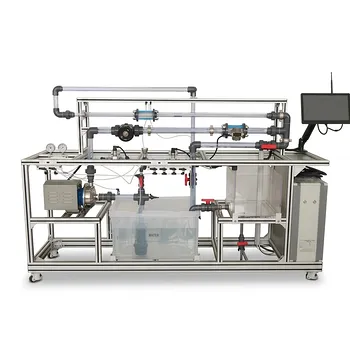
Orifice and Venturi Flowmeter Calibration Educational Pilot Plant for Fluid Mechanics Laboratory

Orifice and Venturi Flowmeter Calibration Educational Pilot Plant for Fluid Mechanics Laboratory

Enhance fluid dynamics education with the Orifice and Venturi Flowmeter Calibration Educational Unit Operations Pilot Plant, featuring transparent orifice and Venturi meters, industrial sensors, touchscreen interface for real-time data analysis and automatic coefficient calculations in engineering student laboratories.

Quantitative Dosing and Liquid Flow Control Educational Unit Operations Pilot Plant

Quantitative Dosing and Liquid Flow Control Educational Unit Operations Pilot Plant

Explore industrial fluid transport and automated process control with this quantitative dosing and liquid flow control educational pilot plant, featuring local and remote control cabinets, variable speed metering pump, high-precision flow sensors, and PLC-based SCADA integration for engineering students.

Fluid Transport and Piping Dynamics Practical Training Unit Operations Pilot Plant

Fluid Transport and Piping Dynamics Practical Training Unit Operations Pilot Plant

This industrial-scale fluid transport and piping dynamics training pilot plant provides essential hands-on experience with pump operations, cavitation, piping resistance, flow metering, and process control. Customizable to fit specific academic engineering curricula.

Multi Pump Fluid Transport Process Piping Unit Operations Training Pilot Plant

Multi Pump Fluid Transport Process Piping Unit Operations Training Pilot Plant

Industrial-scale multi-pump pilot plant for unit operations training in fluid transport and process piping, featuring real-material and semi-physical simulation modes, comprehensive pump and flowmeter calibration, and safety-enhanced two-tier platform, bridging academic theory and industrial practice for chemical engineering education.

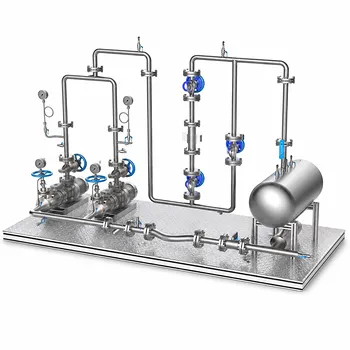
Chemical Pipeline Assembly and Fluid Transport Practical Training Unit Operations Pilot Plant

Chemical Pipeline Assembly and Fluid Transport Practical Training Unit Operations Pilot Plant

Integrated skid-mounted engineering training pilot plant for university labs offers hands-on experience in chemical pipeline assembly, fluid transport, centrifugal pump operation, and pressure testing. Customizable system bridges academic theory and industrial practice with digital pre-lab resources and comprehensive tools.

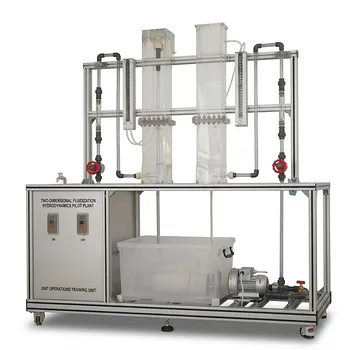
Two-Dimensional Fluidization Hydrodynamics Educational Pilot Plant for Unit Operations Training

Two-Dimensional Fluidization Hydrodynamics Educational Pilot Plant for Unit Operations Training

Explore gas-solid and liquid-solid fluidization hydrodynamics with our transparent 2D educational pilot plant. Ideal for chemical engineering unit operations labs, it demonstrates fixed to fluidized bed regimes, measures pressure drop, and integrates QR-code digital learning for enhanced student training.

Two Phase Flow Pattern Velocity Resistance Measurement Educational Pilot Plant

Two Phase Flow Pattern Velocity Resistance Measurement Educational Pilot Plant

Benchtop educational pilot plant for university labs studying gas-liquid two-phase flow patterns, velocity, and resistance across circular, square, and rectangular conduits. Features 15.6-inch touchscreen, 5G connectivity, differential pressure sensors, safe water-air operation. Supports chemical engineering curricula.

Centrifugal Pump Performance and Orifice Flowmeter Calibration Educational Pilot Plant

Centrifugal Pump Performance and Orifice Flowmeter Calibration Educational Pilot Plant

This versatile educational pilot plant enables engineering students to conduct centrifugal pump performance tests, orifice flowmeter calibration, and fluid mechanics experiments using a transparent flow loop, industrial HMI, and 3D virtual simulation for a comprehensive hands-on learning experience.

Fluidized Bed Gas Solid Catalytic Reaction Educational Pilot Plant

Fluidized Bed Gas Solid Catalytic Reaction Educational Pilot Plant

Our educational fluidized bed gas-solid catalytic reaction pilot plant is ideal for chemical engineering labs. Students study fluidization dynamics, catalyst evaluation, and process control hands-on. Features include a customizable reactor, touchscreen HMI, and safety interlocks for safe, curriculum-aligned experiments.

Tubular Reactor Flow Characteristics Determination Educational Unit Operations Pilot Plant

Tubular Reactor Flow Characteristics Determination Educational Unit Operations Pilot Plant

Educational pilot plant for investigating tubular reactor flow characteristics and residence time distribution Features adjustable recycle for plug flow and backmixing studies industrial touchscreen interface and real-time data acquisition Ideal for chemical engineering unit operations laboratory training and education

Residence Time Distribution and Reactor Flow Characteristics Determination Educational Pilot Plant

Residence Time Distribution and Reactor Flow Characteristics Determination Educational Pilot Plant

This versatile educational pilot plant is designed for comprehensive study of residence time distribution and reactor flow characteristics, featuring multiple CSTRs in series, a tubular reactor, variable recycle loop, and automated real-time data acquisition, perfect for hands-on chemical engineering education.

Multi-Reactor Educational Pilot Plant for Reaction Engineering Unit Operations

Multi-Reactor Educational Pilot Plant for Reaction Engineering Unit Operations

Integrated bench-scale educational pilot plant for chemical engineering teaching featuring fixed bed fluidized bed and stirred tank reactors with web-based digital twin controls and safety interlocks for hands-on unit operations and reaction engineering comparative studies in one compact system.

Packed Bed Absorption Educational Unit Operations Pilot Plant

Packed Bed Absorption Educational Unit Operations Pilot Plant

Study gas-liquid absorption, pressure drop, flooding, and mass transfer coefficients with this pilot plant. Transparent packed column, industrial touchscreen, real-time sensor data, automated analysis. Investigate two-phase flow, loading points, column efficiency. Comprehensive data logging and assessment software included.

Bernoulli Equation Demonstration Unit Operations Pilot Plant

Bernoulli Equation Demonstration Unit Operations Pilot Plant

Laboratory pilot plant for Bernoulli's equation demonstration with transparent PVC pipes, 23 piezometer tubes for pressure measurement, and hands-on experiments. Designed for engineering education to study energy conservation, hydraulic grade line, and localized losses in fluid steady-flow systems.

Constant Pressure Filtration Educational Unit Operations Pilot Plant

Constant Pressure Filtration Educational Unit Operations Pilot Plant

Hands-on educational pilot plant for constant pressure filtration. Classic plate and frame filter press allows students to study kinetics, determine specific cake resistance, perform cake washing and evaluate washing rates. Ideal for chemical engineering curriculum. Mobile, customizable, safety-compliant design.

Multi-Functional Drying Educational Unit Operations Pilot Plant

Multi-Functional Drying Educational Unit Operations Pilot Plant

Versatile multi-functional drying educational unit operations pilot plant integrating tunnel, fluidized bed, and spray drying. Enables hands-on study of drying curves, psychrometry, and gas-solid separation for chemical engineering curriculum in higher education labs.

100L Continuous Loop Hydrogenation Educational Unit Operations Pilot Plant

100L Continuous Loop Hydrogenation Educational Unit Operations Pilot Plant

This 100L continuous loop hydrogenation pilot plant is designed for chemical engineering education, featuring 316 stainless steel construction, advanced gas-liquid mass transfer components, explosion-proof safety systems, and a 15.6-inch touchscreen with 5G connectivity, cloud data logging, bridging theory and industry.

Multi-Functional Special Distillation Educational Pilot Plant

Multi-Functional Special Distillation Educational Pilot Plant

Versatile multi-functional special distillation pilot plant for chemical engineering education. Supports continuous, vacuum, azeotropic, reactive, extractive distillation. Transparent glass columns enable real-time visual observation of hydrodynamics and separation processes.

Electrolytic Hydrogen Production Educational Unit Operations Pilot Plant

Electrolytic Hydrogen Production Educational Unit Operations Pilot Plant

Bench-scale electrolytic hydrogen production pilot plant designed for university engineering labs. Provides hands-on training in water electrolysis, gas-liquid separation, and process safety. Fully customizable system with digital PID control, corrosion-resistant components, and hydrogen gas detector. Ideal for chemical engineering curricula.


Leave Your Message