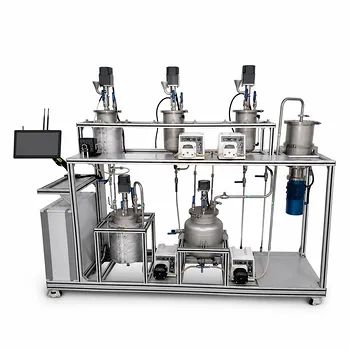
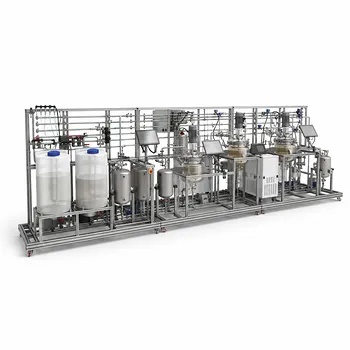
Without precise environmental control, a bioreactor pilot plant becomes a black box, not a learning tool.
In educational and research fermentations, temperature and pH are the two master dials that govern microbial growth and product formation. Their tight regulation is critical because enzymatic reaction rates are exponentially dependent on temperature, and even a shift of 0.5 pH units can move an organism outside its optimal metabolic window, causing growth to stall or undesirable by-products to form. Pilot plants must therefore embed automated heating/cooling jackets and precision pH dosing—not simply to maintain a setpoint, but to give students and researchers the power to explore, model, and replicate industrial‑scale behavior under controlled conditions.
The singular goal of a bioprocess pilot plant is to turn biological variability into reproducible data. Precise temperature and pH control is the non‑negotiable foundation for that; without it, growth kinetics become uninterpretable, teaching objectives are undermined, and scale‑up predictions lose all credibility.
The Biological Imperative: Why Cells Demand No Excuses
Living catalysts—enzymes and whole microbial cells—are structurally and functionally fragile. Every educational fermentation exercise hinges on understanding that fragility.
Enzymes Denature at the Extremes
Proteins maintain their catalytic three‑dimensional shape only within narrow thermal and pH boundaries.
Extreme heat disrupts hydrogen bonds and hydrophobic interactions; extreme acidity or alkalinity alters ionic charges that hold the active site together. Once denatured, an enzyme loses its biological activity permanently, halting the entire metabolic pathway.
Temperature Dictates Growth Rate—Exponentially
Below an organism’s optimum, the maximum specific growth rate ($\mu_{max}$) follows an Arrhenius‑type relationship—a small temperature rise produces a disproportionately large jump in metabolism.
Above that optimum, however, growth collapses just as quickly as thermal damage outpaces repair mechanisms. In a pilot plant, controlling temperature to ±0.5 °C is the difference between a robust exponential phase and a crashed culture.
pH Operates a Narrow Metabolic Window
Different microbes have distinct pH optima: bacteria often near neutral, yeast thrive at acidic pH 4–5, and molds can push lower.
Outside these narrow bands, membrane transport proteins lose efficiency, internal pH homeostasis fails, and substrate uptake plummets. Precise dosing of acid or base is the only way to keep the organism inside its productive zone.
Fermentations Are Self‑Heating
Most microbial processes are exothermic—especially yeast and bacterial cultivations that consume sugars rapidly.
Without active cooling jackets or internal coils, metabolic heat accumulates, pushing the culture beyond its thermal optimum and causing a runaway failure. Temperature control therefore doubles as a heat‑removal strategy, not just a setpoint keeper.
Bridging Theory and Practice: How Precision Enables Learning and Research
A bioprocess pilot plant exists to turn kinetic theory into tangible data. Loose control eliminates that bridge entirely.
From Batch Curves to Kinetic Models
Students and researchers use precisely controlled batch fermentations to determine intrinsic parameters like $\mu_{max}$, substrate saturation constants, and yield coefficients.
By running identical cultures at systematically varied temperatures or pH levels, they can build and validate kinetic models—exactly the skill required to optimize industrial processes such as penicillin or bioethanol production.
Optimization Gains That Matter
Literature‑validated profiles show that operating near the true biological optimum can lift product yields by about 15 % while cutting batch cycle times by up to 60 %.
These gains are only accessible when temperature and pH are held within tolerances tight enough to reveal the shape of the response surface. A pilot plant without that precision cannot teach students how to extract such value.
Simulating Industrial Reality
Commercial‑scale bioreactors use cascaded PID loops for jacket temperature, cooling water flow, and ammonia‑assisted pH control.
An educational pilot plant must replicate this hierarchy so students experience the lag times, dead bands, and alarm thresholds they will encounter in practice. That realism depends entirely on the presence of rapid, responsive control hardware.
The Measurement Challenge: Why pH Sensor Compensation Is Part of the Story
Precise pH control is impossible without precise pH measurement—and that measurement is surprisingly temperature‑dependent.
The Nernst Equation Sets the Rules
A pH electrode’s output slope is proportional to absolute temperature: $S = 2.303RT/nF$.
At 25 °C this slope is 59.2 mV/pH, but it shrinks at lower temperatures and grows at higher ones. A pilot plant meter must automatically compensate for the actual process temperature, or the displayed pH will drift even when the solution is stable.
Buffers Shift With Temperature
Even the standard calibration buffers used to set up the probe change pH as they warm or cool.
A phosphate buffer that reads 6.951 at 5 °C drops to 6.833 at 50 °C. Operators must perform two‑point calibration at the working temperature, typically starting with pH 6.86 buffer and selecting a second point (4.00 or 9.18) that brackets the process setpoint.
Neutral pH Is a Moving Target
The self‑ionization of water is endothermic, so $K_w$ rises with temperature. The neutral point shifts from pH 7.47 at 0 °C down to pH 6.14 at 100 °C.
Bioreactor pH control loops that ignore this shift will misinterpret true neutrality and over‑ or under‑dose neutralizing agents. Temperature‑compensated probes are therefore non‑negotiable in a research‑grade plant.
Understanding the Trade‑offs: Where Precision Can Bite Back
Even essential controls come with practical pitfalls that educators and researchers must manage.
Calibration Overhead
High‑accuracy pH loops require frequent two‑point calibrations against certified buffers.
If a student neglects this routine, the “precise” control system will faithfully hold the wrong setpoint, leading to data that looks repeatable but is systematically wrong.
Control‑Loop Dynamics
Fast‑acting heaters and pumps can cause overshoot and oscillation if PID parameters are poorly tuned.
In a teaching setting, overly aggressive control can obscure the biological response, making it harder for students to distinguish instrument artifacts from true metabolic shifts.
Cooling Capacity Constraints
Exothermic yeast or E. coli cultures can generate heat faster than a small‑scale jacket can remove it.
A pilot plant must be sized with sufficient thermal mass exchange area to handle the peak metabolic load, or precision will degrade exactly when it matters most.
The Automation Trap
Fully automated systems can tempt students to view the bioreactor as a “set‑and‑forget” appliance.
The educational value lies in forcing learners to predict, measure, and manually adjust—using automation as a scaffold, not a crutch. A well‑designed plant balances precision with pedagogical visibility.
Making the Right Choice for Your Educational or Research Goal
Your specific objective determines how much control precision you genuinely need—and where to invest.
- If your primary focus is teaching fundamental kinetics: Emphasize a plant that allows deliberate, step‑wise deviations so students can observe the collapse of growth rate outside the optimum zone.
- If your primary focus is process optimization and scale‑up modelling: Invest in high‑resolution temperature and pH loops with data‑logging that captures the full dynamic response, enabling accurate kinetic‑parameter extraction.
- If your primary focus is maintaining stable long‑duration cultures (e.g., continuous chemostats): Prioritize sensor robustness, automatic temperature‑compensated pH probes, and a cooling system sized for steady‑state heat removal with minimal deadband.
Precise temperature and pH control are not luxury features—they are the instruments that transform a stainless‑steel vessel into a true bioprocess pilot plant, one that turns curious students into competent bioprocess engineers.
Summary Table:
| Control Parameter | Biological Impact | Practical & Educational Significance |
|---|---|---|
| Temperature | Dictates exponential growth rates; prevents enzyme denaturation & metabolic heat runoff. | Enables kinetic parameter modeling ($\mu_{max}$) and teaches industrial heat removal. |
| pH Level | Maintains the narrow metabolic window required for efficient membrane transport & substrate uptake. | Teaches automated acid/base dosing and temperature-compensated sensor calibration (Nernst equation). |
Bring Industrial Realism to Your Lab with LABPARK
Empower your students and researchers with industry-standard control. LABPARK provides state-of-the-art Educational and Vocational Unit Operations Pilot Plants in chemical engineering, bioprocess & biotech, and environmental & water treatment.
Designed specifically for universities, research institutes, and enterprises, our pilot plants deliver the precise automation, PID tuning capability, and sensor compensation needed to turn biological variability into predictable, scale-up data.
Ready to upgrade your laboratory? Contact our team today to discuss your custom project specifications!
Related Products
- Bio-fermentation Ethanol Production Practical Training Unit Operations Pilot Plant
- Natural Product Extraction Unit Operations Training Pilot Plant
- Continuous Batch Extractive Distillation Educational Pilot Plant
- Electrolyte Distillation Purification and Formulation Educational Pilot Plant
- High-Gravity Emulsification and Mass Transfer Educational Pilot Plant
People Also Ask
- Why Use PTFE & Hastelloy in Chemical Pilot Plants? Prevent Corrosion & Ensure Safety
- Why Compare Predicted and Experimental Excess Enthalpy? Key to Accurate Pilot Plant Scale-up
- Why is the chemical plant startup schedule crucial? De-risk scale-up with pilot plants.
- When to transition from PID to adaptive control in pilot plants? Key process indicators.
- Why must batch and fed-batch fermentation pilot plants be designed to accommodate changing rheological conditions?