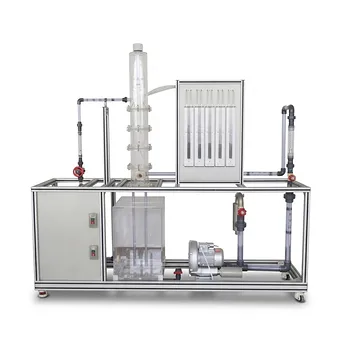
Convergence is the single biggest hurdle in rigorous distillation simulation. Running a shortcut column model first eliminates this hurdle by generating the highly accurate initial estimates that complex tray-by-tray solvers demand. Without these, the rigorous simulation will almost certainly fail to find a stable mathematical solution, wasting hours of your time.
A shortcut model is not just a quick approximation; it’s an essential, reliability-building first step. It transforms a chaotic, trial-and-error guessing game into a predictable, convergent workflow by providing the rigorous solver with a physically plausible starting point—critical for both robust simulation and meaningful comparison with real-world pilot plant data.
The Convergence Trap: Why Rigorous Models Fail
Rigorous distillation models don’t just calculate a result—they solve a massive system of non-linear MESH (Material, Equilibrium, Summation, and Enthalpy) equations for every single tray simultaneously. This numerical challenge demands a starting guess that is already very close to the true solution.
The Solver's Dependency on Initial Values
The algorithms powering these simulations, often based on the SRK equation of state with inside-out convergence methods, are iterative. They refine guesses step after step. If you feed a rigorous model random or highly inaccurate guesses for the number of stages, reflux ratio, or temperature profile, the solver diverges, oscillates wildly, or crashes outright.
The Result of Poor Initialization
The consequence is simulation failure. You get no useful data, no stage profiles, and no understanding of the column's behavior. For a student or an engineer, this is a dead end. The only fix is to go back and create a rational starting point—precisely what the shortcut model provides.
The Shortcut Model as a Solution Bootstrapper
Shortcut methods like Fenske-Underwood-Gilliland give you exactly what the rigorous solver needs in minutes. They act as an intelligent initialization engine.
Delivering the Three Critical Estimates
The shortcut model calculates the three most influential parameters for convergence:
- The minimum reflux ratio, which you can scale to a practical operating reflux ratio.
- The minimum number of theoretical stages for your specified light and heavy key recoveries.
- The optimal feed tray location, balancing rectifying and stripping section sizes.
Why These Estimates Ensure Convergence
By importing these values, you anchor the rigorous solver in physical reality. The algorithm no longer needs to blindly search for a feasible solution; it just refines an already plausible one. This is the difference between a process that converges in seconds and one that never does.
Bridging the Gap Between Ideal and Real Systems
The pedagogical and practical value goes far beyond just getting a simulation to run. The shortcut-to-rigorous workflow is the most effective way to understand how thermodynamic non-idealities alter real column performance.
Exposing the Limits of Constant Molal Overflow
Shortcut methods assume constant molal overflow and constant relative volatility—simplifications that work for many ideal, two-product systems. A rigorous model abandons these assumptions, performing an enthalpy balance on each tray. Comparing the two results teaches you precisely where heat of mixing, heat loss, or varying latent heats cause real internal flow rates to deviate from the shortcut prediction.
Validating Design Software Against Physical Reality
When you run a pilot plant distillation, you collect physical data: temperature profiles, distillate purity, and reboiler duty. You can now overlay three sets of data: shortcut predictions, rigorous simulation output, and physical measurements. This triangulation lets you evaluate thermodynamic model accuracy, identify heat losses from the physical column, and gain confidence in using computer-aided design tools to model real processes.
Understanding the Trade-offs and Pitfalls
While indispensable, the shortcut-to-rigorous workflow has limitations you must respect to avoid building false confidence.
Shortcut Methods Are Not Sufficient for Final Design
Relying solely on shortcut results for a non-ideal, azeotropic, or multicomponent system is dangerous. The constant-alpha assumption can drastically mispredict stage counts and reflux ratios. The primary reference’s value is purely as an initialization tool; the rigorous simulation is the design basis.
The Garbage-In, Garbage-Out Principle Still Applies
If your shortcut model is based on incorrect light/heavy key splits or badly estimated relative volatilities, the “good” initial estimates it produces will actually be systematically wrong. The rigorous solver may converge smoothly to an incorrect, non-physical solution that satisfies the math but not the real process. Always validate inputs carefully.
False Convergence Risk
A rigorous model can converge mathematically to a stable solution that is not the physically correct steady-state (e.g., a dry tray artifact). By comparing the converged rigorous profile against your shortcut baseline, you gain a sanity check. If the temperature profile or composition splits look fundamentally different than what the shortcut predicted in principle, you know to investigate.
Making the Right Choice for Your Goal
The way you leverage the shortcut model depends entirely on your primary objective.
- If your primary focus is avoiding simulation frustration and saving time: Always run a shortcut model first. Import its stage, feed, and reflux ratio estimates directly into the rigorous model’s input forms to guarantee convergence on the first attempt.
- If your primary focus is learning the foundations of separation theory: Run both models and actively compare the internal traffic, temperature profiles, and product purities. Focus on quantifying how the rigorous MESH equations correct the shortcut’s idealized assumptions for a real mixture.
- If your primary focus is safely operating a physical pilot plant: Use the shortcut model to quickly calculate a safe starting reflux ratio and an estimated reboiler heat duty before you energize any equipment. This prevents thermal overload and establishes a benchmark for detecting instrument errors or column fouling once physical data starts flowing.
This linear, shortcut-first workflow transforms process simulation from a frustrating black-box guessing game into a logical, hypothesis-driven experiment where every deviation teaches you something real about thermodynamics, not just about numerical tricks.
Summary Table:
| Feature | Shortcut Model (FUG) | Rigorous Model (MESH) |
|---|---|---|
| Primary Purpose | Quick estimation & initialization | Detailed design & physical simulation |
| Key Assumptions | Constant molal overflow & relative volatility | Real thermodynamic non-idealities & enthalpy balances |
| Key Outputs | Min. stages, feed location, min. reflux | Stage profiles, actual duties, precise compositions |
| Convergence Risk | Extremely low | High (demands accurate initial values) |
Bridge the Gap Between Simulation and Physical Reality
Validating distillation models requires accurate physical data. LABPARK provides premium Educational and Vocational Unit Operations Pilot Plants in chemical engineering, bioprocess & biotech, and environmental & water treatment.
Specifically engineered for universities, research institutes, and enterprises, our pilot plants allow you to match simulation data with real-world operations, ensuring students and researchers gain practical thermodynamic insights.
Ready to elevate your laboratory capabilities? Contact LABPARK today to request a quote or custom consultation.
Related Products
- Plate Column Hydrodynamics Tray Demonstration Educational Pilot Plant
- Absorption and Desorption Educational Unit Operations Pilot Plant
People Also Ask
- How to update chemometric calibration models in pilot plants? Best practices for process engineers.
- How can educational pilot plants be used to teach process safety and risk assessment in chemical engineering curricula?
- How does nuclear yield inefficiency translate to chemical engineering education? Optimize kinetics with pilot plants.
- Why Correct Sig Figs & Rounding Matter in Educational Pilot Plants: Ensure Data Accuracy
- Why Calculate Sieve Tray Pressure Drop? Optimize Distillation Pilot Plant Performance