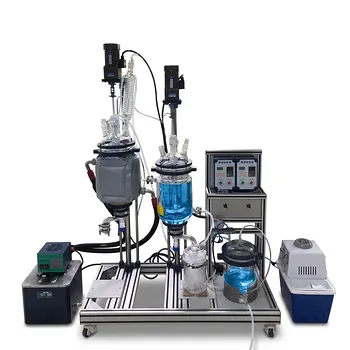
The true key to scaling up a drying process lies in finding the point where physics changes—the critical moisture content. Running experimental drying tests on a chemical engineering pilot plant is essential because the critical moisture content (Xc) cannot be reliably calculated from theory. It depends heavily on material-specific factors like particle size, bed depth, agitation, and dryer type. Pilot-plant experiments provide the only accurate way to measure Xc under real-world conditions, giving engineers the data needed to calculate residence time, control energy costs, and scale up with confidence.
The critical moisture content is the hidden hand that governs a dryer’s economics: it marks the transition from fast, surface‑limited drying to slow, diffusion‑limited drying. Because Xc is impossible to predict theoretically and varies dramatically with how you dry, pilot‑plant experiments are non‑negotiable for designing a process that is both efficient and scalable.
Why the Critical Moisture Content Defines Drying Economics
Xc is not just an academic concept. It directly controls how long a material must stay in the dryer and how much energy the process consumes.
The Two Drying Regimes and Their Consequences
In the constant‑rate drying period, moisture evaporates from the material’s surface as if from an open pool. The drying rate is fast, steady, and limited only by external heat and mass transfer. The material surface remains at the air’s wet‑bulb temperature, preventing thermal damage.
Below Xc, the process enters the falling‑rate period. Here, internal diffusion limits moisture movement to the surface. The drying rate drops continuously, and the surface temperature rises toward the incoming air temperature. This stage is slow, energy‑intensive, and can overheat sensitive products.
Why a Higher Xc Is a Costly Problem
A higher critical moisture content means the material leaves the efficient constant‑rate period earlier. The dryer must then spend more time—and significantly more energy—in the falling‑rate zone to reach the target moisture. Even small shifts in Xc can dramatically change the required residence time and operating cost.
The Fallacy of Purely Theoretical Prediction
You cannot simply look up Xc in a handbook or derive it from first principles. The number you get from a desk calculation will almost certainly be wrong.
Xc Is a System Property, Not a Material Constant
The critical moisture content is not an intrinsic material property. It changes with particle size, material layer thickness, and the type of dryer used. For example, a thick bed in a static tray dryer yields a much higher Xc than the same material agitated in a fluidized bed dryer.
This happens because agitation reduces internal diffusion resistance, mechanically bringing wetter interior material to the surface. Without pilot‑plant data, you cannot know how your specific combination of material, bed depth, and dryer dynamics will shift Xc.
Static vs. Dynamic Equipment and the Role of Agitation
Static drying equipment, such as tray dryers, inherently produces a higher Xc because moisture must travel through a stagnant bed. In contrast, dynamic dryers like fluidized bed or flash dryers suspend particles, drastically reducing Xc and keeping the process in the highly efficient constant‑rate stage for longer. Only pilot‑plant trials can quantify this advantage for your exact material.
What Pilot‑Plant Experiments Unlock
A unit‑operations pilot plant gives you the controlled environment needed to transform an elusive variable into an engineering parameter.
Measuring the Drying Curve Under Controlled Conditions
By maintaining a constant air temperature, humidity, and velocity, researchers can run a batch drying experiment and periodically measure the material’s weight loss. Plotting dry‑basis moisture content (X) against time reveals the drying curve. Using the drying rate equation
$$U = -\frac{G'}{S} \frac{dX}{d\tau}$$
(where G’ is the bone‑dry mass and S is the drying area) you can then plot the drying rate curve (U vs. X). The clear transition from a flat, constant‑rate plateau to a declining line pinpoints Xc with precision.
Translating Data to Accurate Residence Times and Scale‑Up
That single experimentally determined Xc value becomes the anchor for all subsequent design calculations. It lets you accurately compute the required total residence time in the full‑scale dryer. Starting with a theoretical guess would over‑ or under‑design the equipment, leading to either product that fails quality specifications or massive capital and energy waste.
Understanding the Trade‑offs and Limitations
Pilot‑plant experiments are essential, but they are not a magic wand. They demand time, resources, and careful interpretation.
The Cost and Time of Experimental Campaigns
Running a pilot‑plant trial requires dedicated equipment, material, and skilled operators. You must test at the specific layer thicknesses, air velocities, and agitation levels that mirror your commercial design. Each variation adds to the project timeline and cost, making it critical to design the experimental matrix wisely.
Dangers of Oversimplifying with Lab‑Scale Static Tests
A simple vacuum‑oven‑balance setup can give drying curves, but it ignores the effect of agitation. What you measure in a completely static bed will overestimate Xc—sometimes dramatically—leading you to specify an unnecessarily large dryer or excessive energy demand. Pilot‑plant tests with realistic mixing (e.g., a pan dryer with an impeller or a fluidized bed) capture the true dynamic behavior and give you a trustworthy Xc for scale‑up.
Making the Right Choice for Your Drying Process
Deciding how and why to run pilot‑plant tests must be tied directly to your development goal.
- If your primary focus is reliable scale‑up and equipment sizing: Run pilot‑plant experiments that replicate your intended commercial dryer’s operating principle, measuring Xc across the full range of expected bed depths and agitation intensities to validate residence time.
- If your primary focus is energy efficiency and cost minimization: Use pilot data to compare static and dynamic configurations. Choose the dryer type and agitation strategy that keeps Xc as low as possible, maximizing the energy‑efficient constant‑rate period.
- If your primary focus is product quality and avoiding thermal damage: The pilot plant’s measured Xc tells you exactly when surface drying starts and surface temperature begins to rise, allowing you to program a precise heat‑input profile that protects heat‑sensitive materials.
Ultimately, a pilot‑plant experiment turns an unpredictable process boundary into a precise design specification, ensuring your commercial dryer does exactly what it is supposed to do—no more, no less.
Summary Table:
| Feature / Phase | Constant-Rate Period | Falling-Rate Period |
|---|---|---|
| Drying Rate | Fast and constant | Slow and declining |
| Limiting Factor | External heat & mass transfer | Internal moisture diffusion |
| Material Temp | Stays at wet-bulb temp (cooler) | Rises toward air temp (hotter) |
| Energy Demand | Highly efficient | Energy-intensive |
Master Chemical Engineering Scale-Up with LABPARK
Accurately determining critical moisture content ($X_c$) is vital for efficient process design. LABPARK provides advanced Educational and Vocational Unit Operations Pilot Plants in chemical engineering, bioprocess & biotech, and environmental & water treatment. Designed specifically for universities, research institutes, and enterprises, our pilot plants enable students and engineers to conduct precise drying tests, optimize residence times, and reduce energy costs.
Bring real-world scaling capabilities to your lab—contact our experts today to find the ideal pilot plant configuration!
Related Products
- Multi-Functional Drying Educational Unit Operations Pilot Plant
- Natural Product Extraction Unit Operations Training Pilot Plant
- Ethyl Acetate Synthesis Unit Operations Pilot Plant for Practical Training
- Multi-Modal Distillation Unit Operations Training Pilot Plant
- Green Anhydrous Ethanol Refining Practical Training Pilot Plant
People Also Ask
- Vacuum vs. Atmospheric Drying: How to Choose the Right Pilot Plant Configuration for Your Lab
- Why is dry-basis moisture content preferred over wet-basis? Simplify your drying pilot plant balances.
- How do seasonal changes affect drying pilot plant blower requirements? Key sizing tips.
- Why are particle density, bulk density & voidage critical in pilot plants? Master Bed Fluid Dynamics
- How can unit operations pilot plants demonstrate simultaneous removal of light and heavy impurities? Configure a modular setup