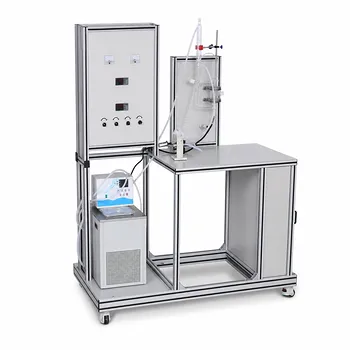
A split-second transition from efficient boiling to a vapor blanket can destroy a pilot plant’s heat exchanger. Exceeding the critical heat flux (CHF) in vaporizers or reboilers triggers a boiling crisis: the heat transfer mechanism instantly shifts from nucleate boiling to film boiling. A continuous vapor film blankets the hot surface, and because vapor has extremely low thermal conductivity, the heat transfer coefficient plummets. If the heat source is not self-limiting—such as an electric heater or a direct-fired burner—the wall temperature rockets upward to catastrophic levels, causing immediate equipment damage or "burnout." Mitigating this risk in pilot plants demands deliberately controlling the driving temperature difference below critical limits and, wherever possible, using heating media that inherently cap the wall temperature.
Every boiling surface has a physical ceiling on how much energy it can safely transfer before the liquid loses contact with the wall. The critical heat flux marks that ceiling. The aftermath is not just a performance loss but a potential rupture, fire, or total loss of an expensive pilot run. Safe operation is about staying well below this threshold through predictive margins, hardware choices, and disciplined thermal design.
The Physics of a Boiling Crisis
The Two Boiling Regimes: Nucleate vs. Film Boiling
Under normal operation, a vaporizer operates in the nucleate boiling regime. Bubbles nucleate at active sites on the hot surface, vigorously mixing the liquid and carrying away heat with remarkable efficiency. Heat transfer coefficients are high and the wall temperature remains only moderately above the liquid saturation temperature.
When the heat flux exceeds the critical value, the bubble formation becomes so intense that the bubbles merge into a continuous vapor film that isolates the surface from the liquid. This is film boiling. The vapor film acts like an insulating blanket because vapor thermal conductivity is an order of magnitude lower than that of liquid. The heat that can be transferred collapses, but the heating source continues to deliver the same power.
Why Burnout Happens So Fast
In a pilot plant, the heat source—whether electric resistance elements, cartridge heaters, or a direct-fired burner—often operates at constant power. When film boiling sets in and heat transfer plummets, the surface cannot shed its thermal load. The temperature of the metal wall surges rapidly, within seconds or fractions of a second, until it reaches a new, often destructive equilibrium.
A typical safe wall temperature for nucleate boiling of water is just 20–30 °C above saturation. Once CHF is exceeded, wall temperatures can jump hundreds of degrees, easily surpassing the maximum allowable working temperature of the material. Steel strength drops significantly above 300 °C, and ASME code pressure vessel limits are quickly violated. The result is physical burnout—a melted electric element, a shattered glass heat exchanger, or a ruptured reboiler tube.
Why Pilot Plants Are Especially Vulnerable
Small-Scale Equipment, Big Consequences
Pilot plants often pack high thermal duty into compact surfaces, which pushes inherent heat flux levels closer to the physical limits. Combined with smaller liquid inventories and thinner walls, the thermal inertia is low. There is little buffering capacity—the system can transition from stable boiling to burnout faster than a human operator can react.
Moreover, pilot units commonly use electric heating or direct gas firing for simplicity, precisely the kind of non-self-limiting sources that drive the runaway wall temperature during a boiling crisis. In contrast, a large industrial unit may have enough thermal mass or recirculation to attenuate the spike, but a pilot rig has no such luxury.
The Domino Effect on Safety and Data
The consequences go far beyond replacing a broken part. A burnout event can rupture the process side and release flammable or toxic fluids into the lab, often right next to the hot surface that ignited the failure. In a sealed pilot environment designed for kinetic studies, such an event destroys weeks of experimental data and, worse, compromises personnel safety. Beyond the physical damage, the loss of precise data integrity from a failed experiment can set development projects back months.
Mitigation Strategies: Designing Against the Boiling Crisis
Maintain a Safe Driving Temperature Difference
The single most direct operational control is to limit the temperature difference between the heating medium and the boiling liquid. For water, the critical delta-T that triggers CHF is typically around 20–30 °C; for light organic solvents, it ranges from 20–50 °C. In a steam-heated system, this means controlling the steam pressure to fix the saturation temperature. In a thermal oil system, the oil temperature setpoint must be locked below the critical delta.
Operating practice should treat this delta-T not as a performance lever to be turned up at will, but as a hard boundary that cannot be crossed. Continuous monitoring of skin temperatures or heat flux sensors provides a direct feedback loop to throttle back if approaching the threshold.
Choose a Self-Limiting Heating Medium
The most robust engineering defense is to use a heating medium whose temperature is inherently limited. Steam condenses at a constant temperature set by its pressure. If the wall temperature tries to shoot up far above the saturation temperature because of a boiling crisis, the steam condensation rate drops, and the heat input is self-regulating. The system passively pushes back against runaway.
Similarly, circulating thermal oil systems with a fixed heater outlet temperature provide a soft ceiling. Even a direct-fired reboiler can be made inherently safer by ensuring that the heating medium (the tube wall via the liquid heating medium) cannot exceed a certain temperature, but pure direct firing without an intermediate fluid offers no such protection. For electric elements, low-watt-density designs plus a fast-acting temperature limit controller are the next best line of defense.
Predict CHF with Engineering Correlations
Pilot plant reboiler tube bundles can be sized using a modified Zuber equation, which accounts for geometry (square vs. triangular pitch, tube diameter, total tube count) as well as fluid properties like surface tension and vapor/liquid densities. The equation calculates the ideal maximum heat flux, but real systems have non-uniformities.
Therefore, a safety factor of 0.7 is applied to the theoretical CHF value to define the design heat flux. This margin of 30 % below the predicted crisis point accounts for variations in flow maldistribution, fouling, and manufacturing tolerances. Incorporating this margin during the engineering phase ensures that the nominal operating flux sits comfortably inside the safe nucleate boiling zone, even before the delta-T control limitation is considered.
Segment the Heat Transfer Design
A subtle but dangerous pitfall emerges during process simulation: treating the entire heat transfer duty as a single exchanger can create internal pinch points. When the hot stream temperature profile crosses inside the boiling zone, the simulation may artificially demand a local heat flux that exceeds CHF to resolve the temperature cross, a thermodynamically impossible condition.
The solution is to segment the duty into three distinct blocks: preheating, boiling, and superheating. Each block is modeled as a separate exchanger with its own temperature-enthalpy relationship. This practice guarantees that the minimum approach temperature is maintained in each zone and that the boiling block never receives a heat flux demand above what the physical surface can sustain. It forces the design to respect the actual boiling curve and eliminates the hidden risk of an internal CHF violation.
Understanding the Trade-offs
Engineering safety around CHF always involves compromises. The most direct trade-off is between maximum achievable throughput and hardware size. Restricting the driving temperature difference to stay far below the CHF threshold means you need a larger heat transfer area for a given duty. In a space-constrained pilot plant, this can clash with mechanical footprint and cost.
Applying a 0.7 safety factor on the Zuber prediction deliberately de-rates the reboiler. You sacrifice some potential capacity to buy operational robustness. For a process development unit where conditions frequently change (different fluids, varying viscosities), this conservatism is wise. But for a dedicated single-product pilot, an over-conservative margin wastes capital and energy.
Self-limiting heating media like low-pressure steam provide an absolute safety net, but they also limit the maximum temperature you can reach, which might be insufficient for high-boiling specialty chemicals. In those cases, a high-temperature thermal oil or a molten salt system must be paired with extremely precise temperature control and fast interlock systems to mimic the inherent safety of steam. The operational discipline and instrumentation cost become the price of pushing the temperature envelope.
Lastly, segmenting the heat transfer design increases model complexity and engineering time. The gain is a system that accurately reflects reality and stays away from the crisis point; the cost is additional simulation effort and a more complicated control narrative. For simple pilot setups with a single boiling medium, a robust delta-T control may be sufficient, but any multi-component or wide-boiling-range application demands segmentation to avoid hidden pinch points that could drive local CHF excursions.
Making the Right Choice for Your Pilot Plant
Your mitigation strategy should mirror your operational priorities. Use the following targeted recommendations to assemble your approach.
- If your primary focus is maximum safety and avoiding any equipment damage: Opt for a saturated steam heating system with a fixed supply pressure that sets the heating temperature well below the critical delta-T, and supplement with independent skin temperature alarms per electrical heater element.
- If your primary focus is process development with frequently changing fluids: Apply the modified Zuber correlation with the 0.7 safety factor to size your reboiler for the worst-case fluid, and install a heat flux sensor to dynamically limit the power input as you explore new boiling chemistries.
- If your primary focus is scaling up a high-performance process to production: Characterize the CHF of your specific fluid mixture under pilot conditions, segment the duty into preheating/boiling/superheating blocks in your process simulator, and design the control system to actively enforce a heat flux ceiling that tracks the real-time process conditions.
- If your primary focus is operation with high-temperature organic fluids where steam cannot reach the required temperature: Use a forced-circulation thermal oil loop with a tight cascade temperature controller on the oil return, and size electric backup heaters with a watt density below 30 % of the predicted CHF to prevent burnout even on control failure.
Safety in boiling systems is not an optimization parameter—it is a hard physical boundary. Recognizing that the critical heat flux is the point where your heat exchanger stops being a process enabler and becomes a hazard is the first step. The second is designing a combination of thermal margins, self-limiting media, and segmented simulation that ensures you never cross it.
Summary Table:
| Strategy | Working Principle | Key Benefit | Trade-off |
|---|---|---|---|
| Limit Delta-T | Control temp difference (20-50°C) | Prevents film boiling transition | Requires larger heat transfer area |
| Self-Limiting Media | Use steam or thermal oil loops | Passive heat regulation | Limits maximum reachable temperature |
| 0.7 Safety Factor | Apply margin to Zuber equation | Protects against flow variations | De-rates maximum reboiler capacity |
| Segmented Design | Split preheat, boil, & superheat | Eliminates simulation pinch points | Increases engineering design complexity |
Build Safer, More Reliable Pilot Plants with LABPARK
Exceeding critical heat flux can derail your research and damage expensive equipment. At LABPARK, we design and provide premium Educational and Vocational Unit Operations Pilot Plants in chemical engineering, bioprocess & biotech, and environmental & water treatment for universities, research institutes, and enterprises. Our systems are engineered with precise thermal controls and safety margins to prevent boiling crises.
Ready to elevate your lab's safety and research capabilities? Contact our engineering experts today to find the perfect pilot plant solution for your facility!
Related Products
- Binary System Vapor Liquid Equilibrium Data Determination Educational Unit Operations Pilot Plant
- Supercritical High-Gravity Flash Evaporation Educational Unit Operations Pilot Plant
People Also Ask
- How can pilot plants assist in validating VLE models? Bridge theory and physical reality.
- Why Collect Isothermal vs. Isobaric VLE Data? Key Pilot Unit Advantages
- How Do Equations of State Predict VLE in Pilot Plants? Optimize Your Separation Design
- How do intermolecular forces and molecular kinetic energy govern gas liquefaction and vaporization? Explore VLE pilot plants
- For VLE Experiments: Fugacity vs. Activity Coefficient Method Selection Criteria