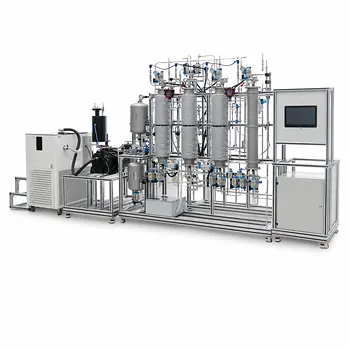
Incorporating assisted extraction technologies is a direct investment in future-proof bioprocess education. Adding microwave-assisted extraction (MAE) and ultrasound-assisted extraction (UAE) units to a bioprocess pilot plant exposes students and researchers to modern process intensification tools that dramatically shorten extraction times and cut solvent use. This hands-on experience teaches them to solve the real industrial puzzle of maximizing yield from delicate biomolecules while maintaining strict thermal and economic constraints.
Assisted extraction units like UAE and MAE are more than just advanced gadgets—they are essential platforms for training engineers to bridge the gap between green chemistry ideals and commercial manufacturing. When paired with conventional methods, they create a complete learning environment where the trade-offs of speed, selectivity, scalability, and sustainability become tangible data points, not just textbook concepts.
The Science Behind UAE and MAE
Both technologies accelerate mass transfer, but they do so through fundamentally different energy delivery mechanisms. Understanding their physical principles is the first layer of the educational value.
How Ultrasound-Assisted Extraction Disrupts Cells
UAE relies on acoustic cavitation. High-frequency sound waves create microscopic bubbles in the solvent that collapse violently near the cell walls of the biomass. This collapse generates localized high temperatures, pressures, and micro-jets that physically rupture cell structures.
The result is a massive increase in mass transfer coefficients because the intracellular target compounds are instantly released into the bulk solvent. And because the cavitation energy is concentrated at the interface, the bulk liquid temperature can remain relatively low, protecting thermolabile biomolecules.
How Microwave-Assisted Extraction Heats Selectively
MAE uses electromagnetic radiation in the microwave frequency range to interact directly with polar molecules in the solvent and the biomass. Instead of heating from the outside in, microwaves generate volumetric, selective heating.
Water inside plant cells absorbs microwave energy rapidly, causing internal superheating and pressure buildup that bursts the cell wall from within. This rapid energy transfer reduces extraction times from hours (as in maceration) to minutes, while often reducing the required solvent volume because the mass transfer is so efficient.
Why These Technologies Are Essential for a Bioprocess Pilot Plant
Including UAE and MAE units transforms a pilot plant from a simple assembly of classic equipment into a true learning factory for process intensification. The benefits extend beyond extraction science into process control, sustainability, and scale-up methodology.
Accelerated Learning of Process Intensification
Process intensification is the discipline of making chemical and biochemical processes dramatically smaller, faster, and more efficient. UAE and MAE are textbook examples.
When a student runs a traditional six-hour Soxhlet extraction alongside a ten-minute UAE run, the concept of intensification ceases to be abstract. They can immediately quantify improvements in yield per unit time, solvent consumption, and energy input. This type of comparative benchmarking is invaluable for training engineers to decide when to deploy intensified technologies and when conventional methods are sufficient.
Minimizing Thermal Degradation of Sensitive Biomolecules
Many high-value bioproducts—antioxidants, enzymes, monoclonal antibodies, and essential oils—denature or oxidize under prolonged heat. Traditional distillation or hot solvent extractions often produce a product with reduced activity.
UAE’s ability to extract at near-ambient temperatures, combined with MAE’s short exposure time, teaches students how to protect thermolabile compounds. They learn to set process parameters that prioritize product quality over brute-force extraction rates, a skill critical for pharmaceutical and nutraceutical manufacturing.
Reducing Solvent Usage and Waste
Sustainability metrics are now central to bioprocess design. Both UAE and MAE are greener alternatives because they require significantly less solvent per gram of extracted product. MAE often uses closed vessels under controlled pressure, which prevents volatile organic compound emissions and enables easy solvent recovery.
Training students on these units instills a habit of optimizing the entire process’s environmental footprint. They learn to calculate solvent waste reduction and energy efficiency, preparing them for industries that must meet strict environmental, social, and governance (ESG) targets.
Benchmarking Against Conventional Extraction Methods
A pilot plant armed only with assisted extraction would be a black box. The true educational power comes when you place UAE and MAE next to maceration, percolation, or Soxhlet systems.
This dual setup allows students to conduct rigorous comparative evaluations of mass transfer kinetics, heat transport, and energy consumption. They can generate evidence-based correlations showing, for example, the exact point at which a longer maceration time matches the yield of a 5-minute ultrasound pulse. Such benchmarking builds the judgment needed to intelligently select processes for specific feedstock and product combinations.
Integrating with Modern Digital Controls and Data Acquisition
UAE and MAE systems can be easily instrumented with industrial-grade sensors for temperature, pressure, power input, and flow rates. Connecting these sensors to a PLC or SCADA system transforms the extraction unit into a process control teaching module.
Students perform real-time data acquisition, learn to convert instrument signals into engineering units, and apply advanced monitoring techniques like multivariate statistical process control on extraction profiles. This experience directly mirrors the automated, data-driven environments found in modern biopharmaceutical and chemical facilities.
Understanding the Trade-offs and Practical Limitations
No technology is a silver bullet, and a trustworthy pilot plant must make the limitations visible. Including UAE and MAE teaches critical problem-solving, not just ideal-case operation.
Capital and Energy Costs Can Be High
Industrial-scale UAE generators and MAE reactors require significant capital investment. Pilot-scale units also consume non-trivial electrical power. By monitoring the specific energy consumption per gram of extract, students learn that intensification can carry a steep energy cost if not optimized—a vital insight for cost-sensitive bulk bioprocessing.
Scale-Up from Laboratory to Industrial Production
What works in a 50 mL lab vessel does not translate linearly to a 50-liter reactor. For UAE, cavitation intensity attenuates with distance from the horn; for MAE, microwave penetration depth limits uniform heating in large volumes.
A well-designed pilot plant allows students to experiment with larger batch or flow configurations and directly observe these scale-up bottlenecks. They learn to use modeling and dimensionless numbers to design larger systems, bridging the gap between academic research and industrial implementation.
Potential for Non-Uniform Processing and Equipment Wear
MAE can suffer from hot spots if the field distribution is uneven, leading to localized charring of the biomass. UAE causes cavitation erosion on probe tips and vessel walls over time, releasing metallic contaminants into the extract in extreme cases.
Teaching students to recognize these failure modes through regular material compatibility checks and post-run analysis trains them to foresee maintenance requirements and select the right construction materials for commercial units.
Safety and Operational Complexity
Closed-vessel MAE operates under elevated pressure and temperature, requiring strict adherence to pressure vessel safety codes. UAE generates intense noise and requires proper shielding. These operational demands are a feature, not a bug, in a pilot plant: they force students to develop rigorous process safety management habits, conduct hazard analyses, and design interlocks—skills directly transferable to any chemical plant floor.
Making the Right Choice for Your Pilot Plant Goals
The decision to include assisted extraction technologies should be driven by the specific competencies you want to build. Allocate your space and budget to create the most impactful learning environment.
- If your primary focus is biopharmaceutical or natural product extraction: Prioritize UAE and MAE units that allow precise temperature and power control. Equip them with closed-loop PLC interfaces so students can validate thermal exposure limits and produce quality analytics on sensitive biomolecules.
- If your primary focus is green process design and sustainability: Invest in both assisted and conventional extraction lines. Use the setup to teach life-cycle thinking—have students measure solvent usage, energy efficiency, and waste generation head-to-head, and then design process alternatives based on real data.
- If your primary focus is comprehensive unit operations education: Ensure that at least one UAE or MAE unit is fully integrated with a digital monitoring system alongside a classic Soxhlet or maceration station. This pairing allows a complete multi-scale educational arc: from fundamental mass transfer principles to advanced process intensification and data-driven operation.
An intelligently equipped bioprocess pilot plant does more than demonstrate science—it creates engineers who instinctively question conventional limits and rewrite the recipe for efficiency.
Summary Table:
| Feature | Ultrasound-Assisted (UAE) | Microwave-Assisted (MAE) | Traditional Extraction |
|---|---|---|---|
| Mechanism | Acoustic cavitation & cell rupture | Volumetric, selective heating | Passive diffusion & thermal dissolution |
| Processing Time | Minutes | Minutes | Hours to days |
| Solvent Usage | Low | Very Low | High |
| Thermal Risk | Low (near-ambient) | Medium (rapid cooling) | High (prolonged heating) |
Bring Modern Process Intensification to Your Lab
At LABPARK, we design and supply advanced Educational and Vocational Unit Operations Pilot Plants specializing in chemical engineering, bioprocess & biotech, and environmental & water treatment. We help universities, research institutes, and enterprises build hands-on learning environments that reflect real-world industrial innovations.
- Industry-Ready Training: Expose students to cutting-edge MAE, UAE, and modern digital control systems.
- Custom Pilot Units: Modular systems built to align with your specific curriculum and research objectives.
- Seamless Integration: Turnkey solutions equipped with industrial-grade PLC/SCADA data acquisition.
Ready to upgrade your training or research facilities? Contact our team today to find the perfect pilot plant solution!
Related Products
- Natural Product Extraction Unit Operations Training Pilot Plant
- Gallium and Indium Selective Extraction Educational Pilot Plant
- Comprehensive Liquid-Liquid Extraction Pilot Plant for Engineering Education
- Educational Rotary Disc Liquid-Liquid Extraction Pilot Plant
- Green Anhydrous Ethanol Refining Practical Training Pilot Plant
People Also Ask
- How to Demo Solubility Sensitivity in SFE Pilot Plants? Practical Thermodynamics
- How do pilot plants differentiate physical vs chemical extraction? Enhance Chemical Engineering Training
- Why do emulsions form during extraction scale-up? Resolve pilot plant phase separation issues.
- What key factors contribute to emulsion formation during liquid-liquid extraction? Scale-up mitigation strategies.
- How are HTU and NTU applied to determine extraction column height? Guide to Pilot Plant Scaling