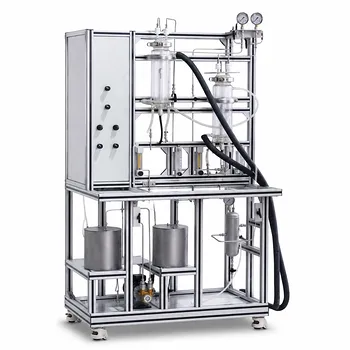
A cylindrical photoreactor with a parabolic reflector solves the inherent conflict between aggressive mixing and reliable, safe light delivery.
In gas-liquid reaction studies, this configuration physically decouples the radiation source from the stirred vessel, eliminating window fouling, complex shaft seals, and corrosion hazards. As a result, you can operate the reactor as a continuously stirred tank reactor (CSTR) with vigorous mechanical agitation—maximizing mass transfer while maintaining a clean, stable optical path. This makes it an unmatched tool for chemical engineering unit operations education and pilot-scale research.
The fundamental challenge of a gas‑liquid photoreactor is bringing light, gas, and liquid together under intense mixing without breaking the reactor. A bottom‑illuminated cylindrical vessel with a parabolic reflector sidesteps that challenge entirely, turning a fragile, messy experiment into a robust platform for studying coupled mass transfer, kinetics, and radiation balances.
The Core Conflict in Gas‑Liquid Photoreactor Design
Why Intensive Mixing is Non‑Negotiable
Gas‑liquid reactions often suffer from mass‑transfer limitations.
To dissolve enough gas into the liquid and keep the catalyst suspended, you need high‑shear agitation or powerful gas sparging.
In a CSTR, this turbulence is created by a centrally mounted impeller—requiring a clear overhead space and a shaft that enters the vessel.
The Pain of Integrating Light into a Stirred Tank
Placing a light source inside the reaction mixture creates a cascade of problems.
Lamp surfaces foul quickly with particles, photocatalyst deposits, or reaction products, cutting off light transmission during the experiment.
Bringing electrical connections through a reactor wall means dynamic seals around a rotating shaft—a reliability nightmare in a corrosive, high‑pressure, or solvent‑laden environment.
Worse, a broken lamp inside a flammable gas mixture or an acidic liquid is a serious safety and corrosion hazard.
The Result: A Model System That Fails to Model Reality
When the optical path is unstable, you cannot collect reproducible kinetic data.
Students and researchers spend more time troubleshooting equipment than analyzing fundamental rate laws.
This undercuts the entire purpose of a unit operations pilot plant: to explore how fluid dynamics, mass transport, and photon flux interact in a controlled, quantitative way.
How the Parabolic Reflector Configuration Breaks the Deadlock
Physical Separation is the Key
A parabolic reflector positioned below a transparent reactor bottom captures light from an external lamp and focuses it upward into the vessel.
The irradiation source never contacts the liquid, never sees the impeller, and never needs a pressure‑tight, chemical‑resistant seal.
This isolation removes the two biggest barriers to reliable operation: window fouling and mechanical complexity.
CSTR Compatibility Without Optical Compromise
With light entering from the base, the entire top of the reactor stays free.
You can mount a standard agitator shaft, gas inlet sparger, baffles, and measurement probes exactly as in an ordinary stirred tank.
The result is a genuine CSTR—perfect backmixing, uniform composition, and precise residence‑time control—that also delivers a stable photon flux.
Eliminating Deposition and Corrosion Risk
In photocatalytic gas‑liquid systems, solid catalyst particles or viscous intermediates tend to adhere to hot lamp surfaces.
When the lamp is outside and the reflector optics are away from the reactor wall, deposition becomes a non‑issue.
Similarly, the most chemically aggressive environment stays inside the vessel, while the electrical components remain outside—radically reducing corrosion and spark hazards.
Light Delivery That Matches Educational Needs
The parabolic reflector collimates the beam, providing a nearly one‑dimensional light gradient along the reactor axis.
This simplification makes it possible to teach radiation‑balance modeling with manageable mathematics while still observing real‑world photon‑attenuation effects.
The predictable light path, combined with CSTR mixing that averages out spatial variations, lets you isolate chemical kinetics from photon transport.
Why This Setup Excels in Unit Operations Education and Research
Decoupling the Three Balances
A pilot‑plant photoreactor must help students and researchers answer three simultaneous questions:
- Is the reaction kinetically controlled or mass‑transfer limited?
- How does gas holdup change with agitation speed?
- What is the local photon absorption rate?
The separated‑source CSTR lets you vary agitation, gas flow, and lamp intensity independently.
You can hold two factors constant while measuring the third—an essential requirement for building robust mass balance, fluid dynamics, and radiation balance models.
Bridging the Hatta Number Gap
In gas‑liquid reaction engineering, the Hatta number (√M) guides reactor choice.
For slow reactions (√M < 0.3), the reaction happens in the bulk liquid, and large liquid holdup with intense mixing is ideal.
The bottom‑irradiated CSTR is perfectly suited for this regime: it provides high liquid volume, excellent macromixing, and the ability to study how enhanced mass transfer shifts the rate‑limiting step. Even for intermediate kinetics, you can use the same platform to demonstrate the transition from film‑control to bulk‑control by altering agitation speed or gas flow.
A Standardized Platform for Quantitative Work
Photoreactor research has long suffered from non‑standard designs, making it difficult to compare kinetic constants or scale‑up correlations.
This configuration offers a repeatable, geometrically simple setup—a fixed lamp‑to‑window distance, a known reflector focal point, and a defined optical path length.
Students can measure photon flux with chemical actinometers or photodiodes and directly compute quantum yields, bridging the gap between lab‑scale curiosity and industrial feasibility.
Understanding the Trade-offs
No reactor design is universal, and this configuration has specific limits you should acknowledge.
Axial Light-Gradient Complexity
Even with perfect radial mixing, light intensity decays exponentially with height.
This makes the local volumetric rate of photon absorption a spatial variable, requiring careful modeling or a deliberate choice to operate in the optically thin regime.
It’s a solvable problem, but one that demands attention in data analysis—exactly the kind of challenge a well‑instrumented unit ops lab is meant to address.
Best for Slow‑to‑Moderate Reactions
A CSTR with bulk mixing prioritizes liquid holdup over interfacial area.
For very fast reactions (√M > 3), where mass transfer in the liquid film is the absolute bottleneck, a spray tower or packed column would provide much larger gas‑liquid contact area.
In an educational context, however, the ability to observe the transition from kinetic to mass‑transfer control often outweighs a mismatch with optimal industrial reactor selection for a single class of reactions.
Mechanical and Optical Window Demands
The bottom window must withstand agitation‑induced pressure fluctuations, resist chemical attack, and transmit the required UV or visible wavelengths.
Any significant window fouling from the liquid side will still degrade performance, though far less dramatically than a submerged lamp would.
Regular cleaning protocols and appropriate material selection (quartz, borosilicate) are essential maintenance requirements.
Making the Right Choice for Your Pilot Plant
Your specific goal will determine how to best deploy a cylindrical reactor with a bottom parabolic reflector.
- If your primary focus is quantifying intrinsic kinetics: Use this setup to eliminate mass‑transfer disguise by operating at high agitation speeds and using dilute absorbers. The stable light path lets you extract true rate constants.
- If your primary focus is teaching coupled transport phenomena: Deliberately vary impeller speed and gas flow rate while measuring dissolved gas concentration and photon flux. Students will see the Hatta number transition in real time, tying theory to experiment.
- If your primary focus is pre‑scale‑up data generation: Standardize lamp power and reactor geometry, then collect baseline radiation‑balance parameters. The simplicity of the one‑dimensional light model provides a defensible foundation for future computational fluid dynamics (CFD) comparisons.
By choosing a design that isolates the light source while preserving the full power of a continuously stirred tank, you turn a notoriously difficult experimental system into a reliable, educational, and industrially relevant platform.
Summary Table:
| Feature | Conventional Submerged Lamp | Parabolic Reflector Design |
|---|---|---|
| Light Integration | Submerged inside the reactor | External bottom-irradiation |
| Mixing Capacity | Limited by internal lamp assembly | Full CSTR mechanical agitation |
| Fouling & Safety | High fouling and corrosion hazards | Isolated optics, minimal hazard |
| Data Reliability | Unstable light path due to deposition | Predictable, stable photon flux |
Enhance Your Lab's Capabilities with LABPARK
At LABPARK, we empower universities, research institutes, and enterprises with high-performance Educational and Vocational Unit Operations Pilot Plants. Our systems span chemical engineering, bioprocess & biotech, and environmental & water treatment, helping you study complex transport phenomena and kinetics with precision.
Ready to upgrade your laboratory? Contact our technical experts today to find the ideal pilot plant solution for your needs.
Related Products
- Photocatalytic Membrane Separation and Degradation Unit Operations Pilot Plant
- Residence Time Distribution and Reactor Flow Characteristics Determination Educational Pilot Plant
People Also Ask
- What are the key differences in membrane configurations? Choose the Right Unit Operations Pilot Plant
- How Do Pervaporation, Vapor, and Gas Permeation Differ in Pilot Plants? Key Comparison
- What are the structural & performance trade-offs of flat-sheet, spiral-wound, & hollow-fiber membrane modules?
- Pervaporation vs. Vapor Permeation: Handling Suspended Solids in Membrane Pilot Plants
- How do PEI, PVDF, and PSU membranes compare in pilot plants? Find the best fit.