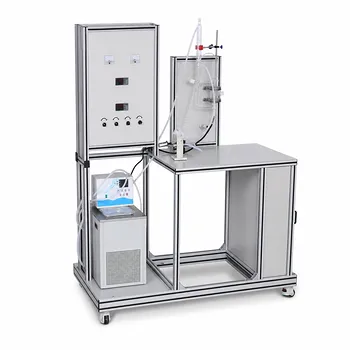
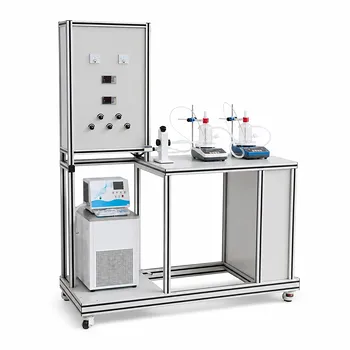
The short answer is that acetic acid molecules don’t play by the rules. Standard vapor-liquid equilibrium (VLE) models break down because acetic acid aggressively forms dimers, trimers, and higher-order oligomers in both the vapor and liquid phases. The monomer-only assumption baked into classic equations of state can’t capture this self-association, leading to wildly inaccurate predictions for pressure, temperature, and composition. To fix this in pilot-plant simulations, engineers combine standard phase equilibrium with explicit chemical reaction equilibrium—most commonly by using the Hayden-O’Connell virial equation with the Nothnagel chemical theory to rigorously correct vapor-phase fugacity and enthalpy.
A pilot plant running organic acid separation is a high-stakes proving ground for thermodynamics. When standard VLE models ignore molecular association, column sizing, tray efficiency, and energy targets become dangerously wrong. The solution isn’t a black-box fix—it’s a deliberate fusion of chemical theory and phase equilibrium that explicitly accounts for acetic acid dimers and higher complexes.
The Root Cause: Molecular Association in Organic Acids
Acetic acid (CH₃COOH) isn’t a passive collection of individual molecules. Its carboxylic group (–COOH) creates strong hydrogen bonds that drive molecules to pair up or cluster.
The Dimerization Phenomenon
In both the liquid and vapor phases, two acetic acid molecules readily form a stable dimer via two hydrogen bonds.
This isn’t a trace side reaction—at many conditions, the dimer population dominates the vapor phase. A typical vapor sample might contain far more dimeric pairs than isolated monomers.
Standard VLE models assume each species behaves independently. When the real mixture contains a large fraction of dimers with very different volatility and interaction forces, the models start generating fiction.
Beyond Dimers: Trimers and Higher-Order Oligomers
At higher concentrations or specific temperature windows, acetic acid doesn’t stop at pairs. Trimers and higher-order polymers can form, further complicating the true molecular landscape.
Each oligomer has its own effective size and energy characteristics. Ignoring these extra species means the model sees a simpler, less associated fluid—much like trying to predict traffic flow while pretending cars don’t form platoons.
How Standard VLE Models Fall Short
A conventional Peng–Robinson or NRTL model is built on the idea of distinct, non-reacting molecular entities. Acetic acid shatters that foundation.
The Flawed Assumption of Monomeric Behavior
Most equations of state and activity coefficient models use parameters regressed from pure-component properties that assume monomeric units. For acetic acid, those parameters inherently average over the real aggregation state.
When applied to mixtures, the model then estimates vapor-liquid distribution based on monomer concentrations. But because a huge fraction of the “monomer” mass actually exists as dimers, the computed partial pressures and relative volatilities are systematically off.
In a pilot-plant distillation column, this misprediction translates directly to wrong stage counts, incorrect feed tray location, and poor reflux ratio estimates.
Consequences for Pilot Plant Design and Operation
If you trust a standard VLE model for an acetic acid-water system, you’ll likely undersize the column or misjudge the temperature profile.
The vapor phase sees stronger deviations because dimers are more stable there. Vapor-phase non-ideality skyrockets, and neglect of dimerization leads to large errors in enthalpy calculations—crippling energy balance predictions around the reboiler and condenser.
In a pilot plant, those errors don’t stay on paper. They show up as flooding, unexpected azeotropic-like pinches, or inability to meet separation targets despite having enough theoretical stages.
The Modeling Solution: Chemical Theory Meets Phase Equilibrium
The fix isn’t to abandon thermodynamic models—it’s to layer a chemical reaction framework on top of the physical phase equilibrium.
The Hayden-O’Connell and Nothnagel Approach
A proven strategy in process simulators is to use the Hayden-O’Connell virial equation of state for the vapor phase, coupled with the Nothnagel chemical theory. This approach explicitly treats dimerization as a reversible chemical reaction.
In practice, a subroutine calculates the “true” species distribution—monomer, dimer, and sometimes higher associates—at each iteration. The fugacity coefficients and vapor-phase enthalpies are then corrected to reflect that real mixture, not the hypothetical all-monomer fluid.
This method restores accuracy to VLE predictions across wide ranges of pressure and temperature, directly solving the convergence and sizing errors that plague standard methods.
Integrating Chemical Reaction Equilibrium
The core concept is to solve chemical potential equilibrium for the association reactions simultaneously with the usual phase equilibrium equations.
For the dimerization reaction 2HAc ↔ (HAc)₂, the equilibrium constant is built into the thermodynamic framework. The model then computes the partial pressures and liquid activities of each species—monomeric and dimeric—independently, before summing them into the overall mass and energy balances.
Specifying at least the dimer formation is often sufficient to correlate pilot-plant VLE data accurately. When conditions push toward higher association, trimer terms can be added, but even the dimer correction removes the bulk of the error.
Practical Implementation in Simulation Software
Modern flowsheet simulators allow you to switch on the Hayden-O’Connell model or activate an association option for your chosen property method. This isn’t a cosmetic flag—it fundamentally alters the fugacity calculations.
Engineers must then validate the model against experimental binary data. In a pilot plant, this means generating diagnostic diagrams—T-x-y, y-x, and P-x-y plots—for the acetic acid system to confirm that the corrected model reproduces the real behavior before attempting multicomponent simulations.
Tools like VLEFIT can take the experimental P-T-X-Y data from the pilot plant and regress any remaining adjustable parameters, ensuring the association model is tuned to the specific operating window.
Trade-offs and Pitfalls in Modeling Associated Systems
Adopting chemical theory is powerful, but it isn’t a magic wand. Several practical challenges remain.
Parameter availability is a major hurdle. Reliable binary interaction parameters for acetic acid mixtures are sparser than for hydrocarbons, and the association equilibrium constants themselves may need adjustment for your pressure and temperature range.
Computational load increases. Every iteration now solves a reaction equilibrium alongside the phase equilibrium, which can slow down dynamic simulations or column profile convergence.
Extrapolation risk is real. A model tuned at atmospheric pressure may still misbehave when the pilot plant runs at 15 atm or near the mixture’s critical region. In such cases, the liquid reference state may also need correction—through methods like Chao-Seader or Henry’s Law for supercritical components.
Finally, over-reliance on simulation without pilot-plant validation is dangerous. The only way to know your dimer-corrected model is right is to generate your own experimental VLE data under controlled pilot conditions and check thermodynamic consistency (e.g., via the Van Ness method). If the pilot column’s actual temperature profile deviates, it’s feedback that the association chemistry isn’t yet fully captured.
Making the Right Choice for Your Pilot-Plant Goal
The decision to move beyond standard VLE models for organic acids isn’t optional—it’s a necessity. How you implement that correction depends on your primary objective.
- If your primary focus is accurate column sizing and stage counting: Prioritize activating the Hayden-O’Connell + chemical theory framework in your simulator and validate the binary VLE predictions with in-house pilot-plant data before finalizing tray numbers.
- If your primary focus is energy optimization and heat integration: Pay special attention to the corrected vapor-phase enthalpy. Even small dimerization miscalculations cascade into large errors in reboiler and condenser duties at pilot scale.
- If your primary focus is scaling up to industrial pressures: Run the pilot plant at the elevated pressures you expect industrially, and use the experimental data to adjust association constants or switch to a Gibbs excess energy model that can handle the pressure-dependent association.
- If your primary focus is education or model development: Use the pilot plant as a teaching tool—generate ternary data, test the limit of dimer-only assumptions, and demonstrate how thermodynamic consistency checks reveal model deficiencies.
True thermodynamic confidence in organic acid separations comes from a blend of chemical insight and physical validation. The pilot plant is your arena to prove that the molecules don’t have to be mysterious—once you stop pretending they’re alone.
Summary Table:
| Feature | Standard VLE Models | Association-Corrected Models (HOC) |
|---|---|---|
| Vapor-Phase Assumption | Monomers only (ignores clustering) | Accounts for dimers & oligomers |
| Enthalpy Accuracy | High error in heat calculations | Accurate reboiler & condenser sizing |
| Pilot Plant Risk | Column undersizing & flooding | Reliable scale-up & separation targets |
Bridge the Gap Between Thermodynamic Theory and Pilot-Scale Reality
At LABPARK, we help universities, research institutes, and enterprises transition seamlessly from theoretical modeling to physical validation. Our state-of-the-art Educational and Vocational Unit Operations Pilot Plants in chemical engineering, bioprocess & biotech, and environmental & water treatment are engineered to help you verify complex thermodynamics in real-world scenarios.
Ready to optimize your pilot operations and scale-up calculations? Contact LABPARK today to discover how our pilot plants can support your research and training goals!
Related Products
- Binary System Vapor Liquid Equilibrium Data Determination Educational Unit Operations Pilot Plant
- Ternary Liquid-Liquid Equilibrium Educational Pilot Plant
People Also Ask
- How can pilot plants assist in validating VLE models? Bridge theory and physical reality.
- Why Collect Isothermal vs. Isobaric VLE Data? Key Pilot Unit Advantages
- How Do Equations of State Predict VLE in Pilot Plants? Optimize Your Separation Design
- How do intermolecular forces and molecular kinetic energy govern gas liquefaction and vaporization? Explore VLE pilot plants
- For VLE Experiments: Fugacity vs. Activity Coefficient Method Selection Criteria