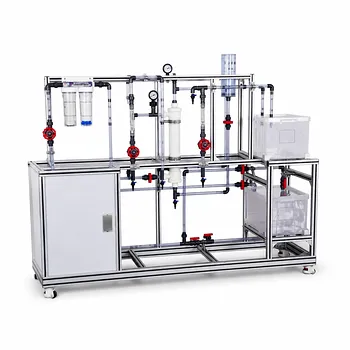
The simple answer is reliability and fouling resistance.
Modern water treatment pilot plants, particularly in educational settings, overwhelmingly choose spiral-wound membrane modules for reverse osmosis (RO) demonstrations because they tolerate variable feed water quality and resist mechanical failure far better than hollow-fine-fiber modules. Hollow-fine-fiber membranes are unsupported, prone to trapping particulates, and can collapse under high pressure—making them a high-risk choice when students are running unpredictable experiments.
Choosing the right membrane module for a pilot plant isn't just about separation performance on paper. It's about matching the technology to the operational reality of a teaching lab, where feed water is inconsistent, downtime is unacceptable, and the goal is to clearly demonstrate real-world industrial principles without constant clogging or failure. Spiral-wound modules win that battle decisively.
The Core Design Difference That Drives Reliability
The entire decision hinges on a fundamental structural difference in how the membrane is housed and supported.
How Hollow-Fine-Fiber Modules Fail Under Pressure
In a hollow-fine-fiber module, the actual RO membrane is formed into hair-thin, self-supporting tubes. These fibers must withstand full operating pressure without any backing. When feed water contains even small amounts of suspended solids, those particles get trapped inside the fiber bundle, creating flow blockages. More critically, if the feed pressure spikes or the water quality causes chemical attack, the unsupported membrane can suffer plasticization or outright collapse. Once fibers are damaged, the module cannot be cleaned or repaired—entire replacement is the only option.
How Spiral-Wound Modules Build In Robustness
A spiral-wound module constructs its membrane as a flat sheet composite. This sheet is made by depositing a thin, selective polyamide layer on a microporous support that is itself backed by a nonwoven paper fabric. The result is a mechanically tough laminate that can handle high differential pressures without deforming. When these sheets are rolled into a spiral, the feed channels remain open and less likely to trap particulate matter irreversibly. This built-in structural integrity is what allows spiral-wound modules to casually handle the “student soup” of varied lab waters.
Why Fouling Behavior Dictates Teaching Plant Design
For a pilot plant dedicated to demonstration and training, the biggest enemy is unplanned maintenance. The fouling characteristics of each module type make one a workhorse and the other a headache.
Hollow-Fine-Fiber: A Trap for Particles
The extremely fine lumen spaces in a hollow-fine-fiber module demand a feed water clogging index (FI) typically less than 3. This requires rigorous and consistent pre-treatment, including multimedia filtration and often chemical conditioning. In a student lab, where someone might inadvertently run a high-turbidity sample, the module acts like a depth filter, trapping particles irreversibly within the fiber bed. Cleaning is nearly impossible—you cannot physically scrub inside a hair-thin fiber.
Spiral-Wound: A Cleanable, Forgiving Channel
Spiral-wound modules also require pre-treatment, but their feed spacer design creates a cross-flow channel that sweeps particles across the membrane surface rather than embedding them. With a moderate FI requirement of less than 4, they are far more forgiving of temporary lapses in pre-treatment. And while cleaning a heavily fouled spiral can be challenging, the flat-sheet geometry allows for chemical cleaning cycles that can restore performance, unlike a hollow-fiber mat.
Understanding the Trade-offs
Transparency about what you lose by choosing spiral-wound is critical for building a sound pilot plant strategy.
Packing Density Isn’t Everything
Hollow-fine-fiber modules boast an enormous packing density (16,000–30,000 m²/m³), far exceeding the spiral-wound’s moderate 650–1,600 m²/m³. In a high-volume industrial setting with a pristine, pre-treated feed, that density translates to a smaller system footprint. However, in an educational pilot plant, the priority is operational uptime and visual clarity, not squeezing the last liter of permeate from a cubic meter of volume. The reliability gained by sacrificing some packing density is the entire point.
The Real-World Relevance Factor
Students are there to see what happens in industry at scale. The vast majority of modern industrial RO trains use spiral-wound elements. Teaching with a module type that has become a niche solution for ultra-clean water polishing or gas separation would be a mismatch with the goal of preparing students for typical plants. The representative industrial configuration is the spiral, making it the right choice for a meaningful demonstration.
Making the Right Choice for Your Training or Pilot Goal
Your selection should be driven by what you need the equipment to teach and tolerate. Here is how to align your module choice with your true objectives.
- If your primary focus is reliable, low-maintenance education on industrial RO: Spiral-wound is the only logical choice. Its structural durability and tolerance of variable feed water will keep the plant running while students learn the fundamentals without constant shutdowns.
- If your primary focus is demonstrating high-efficiency, advanced polishing on a pre-purified feed: A hollow-fiber module could then be considered, as you would have the necessary pristine conditions. However, this shifts the lesson away from typical industrial RO and toward a specialized polishing process.
- If your primary focus is absolute ease of cleaning and membrane replacement for highly fouling streams: Step back even further and consider a plate-and-frame module. It offers the simplest manual cleaning but sacrifices the representative industrial format entirely.
- If your primary focus is matching the largest number of modern, real-world RO installations: Spiral-wound modules are the overwhelming industrial standard for desalination and water reuse, making them the authentic tool for workforce preparation.
The best pilot plant isn't the one with the most exotic specification on paper—it’s the one that teaches real principles because it's actually running when the students walk in.
Summary Table:
| Feature | Spiral-Wound Modules | Hollow-Fine-Fiber Modules |
|---|---|---|
| Support Structure | Flat sheet laminate with support backing; resists pressure spikes | Unsupported thin fibers; prone to collapse or plasticization |
| Fouling Tolerance | High; forgiving of variable feed water (Clogging Index < 4) | Low; requires strict pre-treatment (Clogging Index < 3) |
| Cleanability | Chemical cleanable; cross-flow channel sweeps particles | Near impossible to clean; particles trap inside fiber bundle |
| Packing Density | Moderate (650–1,600 m²/m³) | Very High (16,000–30,000 m²/m³) |
| Industrial Relevance | High; the standard for modern industrial RO plants | Low; niche applications (polishing, gas separation) |
Build a Reliable and Industrially Relevant Training Lab
Ensure your students and researchers train on systems that reflect modern industrial realities without the constant headache of equipment downtime.
LABPARK provides state-of-the-art Educational and Vocational Unit Operations Pilot Plants in chemical engineering, bioprocess & biotech, and environmental & water treatment. Tailored for universities, research institutes, and enterprises, our pilot plants are built with durable, industry-standard components—like spiral-wound membrane modules—to guarantee reliable performance and low maintenance.
Ready to elevate your practical training programs? Contact LABPARK today to discuss your laboratory project!
Related Products
- Multifunctional Membrane Separation Educational Pilot Plant with Ultrafiltration, Nanofiltration, Reverse Osmosis
- Ultrafiltration Membrane Separation Educational Pilot Plant
- Photocatalytic Membrane Separation and Degradation Unit Operations Pilot Plant
- Multi-Functional Membrane Separation Educational Pilot Plant for Unit Operations Lab
- Hollow Fiber Ultrafiltration Membrane Separation Educational Pilot Plant
People Also Ask
- How do PEI, PVDF, and PSU membranes compare in pilot plants? Find the best fit.
- Pervaporation vs. Vapor Permeation: Handling Suspended Solids in Membrane Pilot Plants
- What are the trade-offs of polymer vs inorganic membranes in teaching pilot plants? Key laboratory comparison.
- What are the key flow configuration loops in membrane pilot plants? Optimize Performance
- How can operators optimize operating conditions and cleaning protocols in membrane separation pilot plants to mitigate fouling?