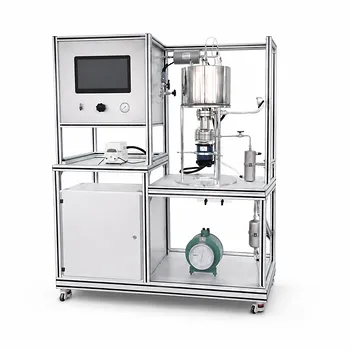
Time is the enemy of catalyst innovation. Parallel heterogeneous reactor systems are used in pilot plants to test dozens of catalyst samples simultaneously under tightly controlled, scalable conditions. This high-throughput approach collapses months of sequential single-reactor testing into weeks, delivering quantitative, representative data that industrial development cycles demand.
The fundamental reason parallel reactors dominate modern catalyst screening is their ability to marry speed with industrial relevance. They are engineered to replicate the heat and mass transfer of conventional pilot units, ensuring that the rapid data you collect is directly meaningful for scale-up—not just a qualitative glimpse.
The Crippling Bottleneck of Sequential Single-Reactor Testing
Conventional pilot plants test one catalyst at a time. For modern formulations requiring exploration of promoter metals, support structures, and activation protocols, this creates a critical barrier.
The Linear Time Trap
In a single-reactor setup, each experiment must be queued after the previous one. Testing 50 formulations under multiple conditions can take months of continuous plant operation. This forces teams to either limit their search space or delay critical decision gates.
The Drift in Experimental Integrity
Long sequential campaigns risk data drift. Ambient conditions, feed impurity levels, or the baseline state of analytical instruments can shift over weeks. This makes direct comparison between Catalyst A tested in January and Catalyst Z tested in March inherently noisier and less reliable.
How Parallel Systems Collapse the Screening Timeline
Parallel heterogeneous reactor arrays solve these problems by design. They turn months into days while introducing the control needed for rigorous research.
The Power of Simultaneous Testing
By integrating multiple micro-reactors into a single matrix, you can evaluate a full library of candidates under identical feed, temperature, and pressure profiles. This side-by-side approach instantly eliminates the time-based drift that plagues sequential campaigns and makes head-to-head comparisons statistically robust.
The Non-Negotiable Design Objective: Emulate Conventional Reactors
Speed is worthless without scalable data. The primary objective when designing parallel pilot units is to approximate the heat and mass transfer capabilities of conventional single-reactor systems. This means each channel must operate in a near plug-flow regime with individual temperature measurement inside the catalyst bed, replicating the transport phenomena that will govern performance at commercial scale.
Fitting Parallel Screening Into the Full Development Workflow
Parallel reactor arrays are not a replacement for larger pilot plants; they are the engine that feeds them with validated leads.
From High-Throughput Scan to Focused Validation
The workflow is staged: Parallel Screening → Micro/Lab → Pilot → Demo → Commercial. Parallel units rapidly scan a wide parameter space to select the most promising candidates. This narrows the field to 1-2 viable samples that then advance to conventional pilot plants for detailed lifetime, mechanical stability, and recycling studies under authentic industrial conditions.
The Critical Role of Secondary Screening
It is essential to distinguish between primary screening (often qualitative, >100 samples, limited control) and secondary screening (16-80 samples, precise independent control). Parallel pilot units typically operate as secondary screening platforms. They provide quantitative, representative data with no cross-talk between reactors, independent flow/pressure/temperature loops, and automated protocols (often via LabVIEW). This is the data quality required to study catalyst activation, deactivation, and kinetics accurately—before committing to expensive scale-up.
Understanding the Trade-offs
No technology is a panacea. Implementing parallel systems requires an honest look at their inherent compromises.
Throughput Versus Data Quality
Parallel secondary screening hits a sweet spot, but it forces a choice. You trade the extreme throughput of primary screening (which can test hundreds of samples but yields only qualitative trends) for deep, scalable kinetic information. If you need a simple activity ranking and can sacrifice fluid dynamic fidelity, a higher-throughput array might be acceptable. For pilot-level engineering data, secondary parallel control is mandatory.
Automation Complexity and Capital Cost
Running 16+ independent reactors with full temperature, flow, and sampling automation dramatically increases initial hardware and integration cost compared to a single manual unit. The informatics layer must manage parallel safety alarm triggers and multi-step protocols. This complexity demands skilled oversight, even if it reduces long-term operational labor. For groups with very low screening volume, a single well-instrumented reactor may remain more cost-effective.
Making the Right Choice for Your Screening Goal
The decision to adopt a parallel system must align with your primary objective. Apply these guidelines to your specific context.
- If your primary focus is pure speed of candidate identification: Use a parallel secondary screening unit. It gives you the throughput to evaluate a broad design space in weeks, while still providing the representative plug-flow conditions that make the data credible.
- If your primary focus is generating scalable kinetic parameters for reactor modeling: Choose a parallel system with independent temperature sensors in each bed and validated flow distribution. This ensures each channel truly mimics a conventional pilot reactor, giving you the quantitative reaction rate and deactivation data you need.
- If your primary focus is minimizing upfront capital without a sustained screening program: A highly instrumented single-reactor system may suffice. However, accept that longer time-to-result and potential data drift will limit the depth of your comparative studies.
Parallel heterogeneous reactor systems are not simply a laboratory convenience—they are the strategic link that connects speculative chemistry to confident industrial scale-up.
Summary Table:
| Feature | Parallel Reactor Systems | Conventional Single-Reactors |
|---|---|---|
| Throughput | High (simultaneous testing of dozens of samples) | Low (sequential testing, one sample at a time) |
| Screening Timeline | Weeks (collapses development cycles) | Months (linear time trap) |
| Data Consistency | High (eliminates temporal data drift) | Low (vulnerable to baseline and ambient drift) |
| Scale-up Reliability | Excellent (mimics heat/mass transfer of larger units) | High fidelity but slow, bottlenecking scale-up validation |
| Complexity & Cost | High initial capital and automated control | Lower upfront cost, high long-term operational labor |
Accelerate Your Research and Scale-Up with LABPARK
Optimizing catalyst screening requires precision engineering. LABPARK provides state-of-the-art Educational and Vocational Unit Operations Pilot Plants in chemical engineering, bioprocess & biotech, and environmental & water treatment.
Tailored for universities, research institutes, and enterprises, our advanced pilot units deliver high-precision, scalable data to move your chemical processes from the laboratory to commercial scale faster.
Contact LABPARK today to discuss your pilot plant needs and get a custom solution for your facility!
Related Products
- Fixed Bed Gas Solid Catalytic Reaction Educational Pilot Plant
- Educational Unit Operations Pilot Plant for Intraparticle Diffusion Effective Factor Measurement
- Methanol Synthesis and Catalyst Performance Evaluation Educational Unit Operations Pilot Plant
- Micro-Scale Gas-Solid Catalytic Reaction Educational Pilot Plant
- Multi Functional Catalytic Reaction and Reactor Evaluation Educational Unit Operations Pilot Plant
People Also Ask
- How do reactor pilot plants safely study gas-solid reactions? Master kinetics with thermal & flow control.
- How does the Mears criterion evaluate transport resistance? Key Guide to Intrinsic Kinetics
- Fluidized vs. Fixed Bed Reactors: Comparing Heat & Complexity in Pilot Plants
- Why is a multibed configuration necessary for exothermic reactions? Optimize your pilot plant trajectory.
- What are the differences between pseudohomogeneous and heterogeneous models in pilot plants?