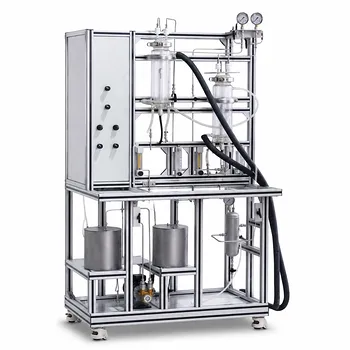
Hydrophobic membranes are chemically tough, but they are natural water-blockers. In their standard form, materials like polypropylene (PP) and polytetrafluoroethylene (PTFE) actively repel aqueous solutions, making it impossible to push liquid water through them in a filtration pilot unit. To unlock their exceptional chemical resistance for wastewater treatment or water purification, these membranes must be aggressively modified—turning their surface from water-hating to water-loving. For PP, this is typically done by incorporating surfactants or applying reactive surface treatments. For PTFE, a more complex route is needed: physically blending the polymer with hydrophilic fillers like silica during membrane formation, then chemically anchoring that filler in place to create a permanently wettable pathway through the membrane’s pores.
The core challenge is that the very chemical inertness that makes PP and PTFE so valuable in harsh wastewater streams is also what makes them impossible to wet. The solution is never to change the bulk polymer, but to engineer a stable, water-attracting interface on its surface: through physical blends, chemical grafts, or—beyond simple hydrophilicity—electrostatic charges that actively guard against organic fouling.
The Inherent Challenge: Why Unmodified Membranes Fail for Aqueous Filtration
Hydrophobic membranes are like a finely woven fabric that repels water droplets. For a pilot unit to filter anything, the liquid must be driven through microscopic pores. If the membrane itself shoves water away, you have a fundamental problem that no amount of pressure can solve effectively.
The Wetting Barrier: Hydrophobicity and Water Flux
Standard PP and PTFE membranes possess low surface energy. Water has a high surface tension, so liquid water beads up rather than spreading into the pores.
This means the energy required to force water across the material is extremely high, leading to negligible or zero flux in a typical pilot operation. Water vapor can pass through PTFE, but liquid transport—essential for separating dissolved contaminants—is completely blocked.
The Motivation: Unmatched Chemical Resistance
So why bother with such difficult materials? Because PP and PTFE survive aggressive chemical environments that would destroy most conventional filters.
In wastewater treatment pilot plants, streams often contain strong oxidizers, extreme pH levels, or organic solvents. The polymer backbone of PP and PTFE can shrug off these attacks, giving a membrane durability that no hydrophilic polymer like polyamide could match.
Transforming the Surface: Modification Strategies for PP and PTFE
The modification target is always the same: create a stable, water-wettable surface without destroying the underlying chemical backbone that provides the resistance. The routes differ based on the polymer’s processability and chemistry.
Polypropylene (PP): Surfactant Incorporation and Surface Treatments
PP is somewhat more amenable to surface engineering because its carbon chain can be lightly oxidized or functionalized.
One common route is the incorporation of surfactants—amphiphilic molecules that have a water-loving head and a polymer-friendly tail. When blended into the membrane dope before casting, these surfactants migrate to pore surfaces and pivot their water-loving heads outward, temporarily lending hydrophilicity.
For a more permanent effect, surface treatments are used. This includes plasma treatment that adds oxygen-containing functional groups to the PP surface, or UV-induced graft polymerization of hydrophilic monomers. These techniques chemically tether a thin, water-wettable layer directly to the membrane, reducing the risk of surfactant leaching over time.
PTFE: Blending with Hydrophilic Fillers during Formation
PTFE is exceptionally inert, making direct surface grafting extremely difficult. The most reliable method for pilot-scale membranes is a physical-chemical hybrid route done during the membrane’s creation.
The process typically starts during paste extrusion. PTFE powder is mixed with a hydrophilic agent, such as nano-sized silica, and a surfactant. The surfactant helps disperse the silica uniformly. After extrusion and the removal of lubricants, you have a composite: hydrophobic PTFE matrix with silica particles embedded in the pore walls.
But without an anchor, these silica particles might wash out. Here, a critical chemical treatment step follows, such as heating the membrane with dimethyl octadecyl chlorosilane in toluene. This reagent reacts with the silica’s surface hydroxyl groups, grafting long hydrocarbon chains that become entangled and fused within the PTFE matrix. The result is a robustly anchored hydrophilic filler that water can constantly reach, enabling stable, long-term flow.
Going Beyond Hydrophilicity: Charge-Modified Membranes for Anti-Fouling and Selectivity
Often, simply allowing water to pass is not enough. Pilot plants grapple with membrane fouling from proteins, oils, and other organics that stick to surfaces and clog pores.
Here, the modification strategy goes a step further for PP and other membranes: introducing a fixed electrostatic charge. By grafting charged chemical groups onto a hydrophilized surface, the membrane actively repels foulants with a similar charge through electrostatic repulsion.
This same charge-based approach can also enhance selectivity, causing the membrane to target specific dissolved ions. A positively charged PP membrane, for example, can reject multivalent cations, aiding in pre-treatment for desalination or in affinity separation experiments within a pilot unit.
Understanding the Trade-offs
Every modification that solves hydrophobicity introduces its own set of durability and performance compromises. Ignoring these pitfalls will cause a pilot study to fail for reasons no one expected.
The Stability Challenge: Leaching vs. Permanent Modification
A simple surfactant blend is cheap and effective—until it isn’t. In a flowing aqueous stream, physically entangled surfactants inevitably leach out, causing the membrane to slowly revert to its hydrophobic state and lose flux. This can also contaminate the permeate water.
Permanent chemical grafts or anchored fillers solve the leaching problem but often add complexity and manufacturing cost. The harsh dimethyl octadecyl chlorosilane treatment for PTFE, while effective, requires careful handling and complete post-treatment rinsing to remove unreacted chemicals before the membrane is pilot-ready.
Impact on Filtration Performance and Membrane Integrity
Adding silica fillers or a grafted surface layer alters membrane morphology. The effective pore size may shrink, and pure water permeability may actually be lower than a hypothetical native-hydrophilic membrane of the same pore rating.
Furthermore, while PP and PTFE are chemically resilient, the modifications themselves can become the weak link. A grafted hydrophilic layer might degrade under extreme oxidizers that the base polymer would easily withstand, nullifying the very reason for choosing PP or PTFE in the first place.
Making the Right Choice for Your Pilot Unit
The ideal modification path is not universal; it flows directly from what your pilot unit must actually endure and measure. You must align the method with your primary operational goal.
- If your primary focus is chemical inertness in aggressive oxidative streams: A PTFE membrane with a permanently anchored silica filler is the most credible choice. Validate that the filler-anchoring chemistry is itself inert to your process, and accept a potential sacrifice in peak permeability for long-haul stability.
- If your primary focus is rapid, low-cost proof-of-concept for mild aqueous streams: Use a surfactant-modified PP membrane. Plan for a gradual decline in flux as the surfactant washes out, but treat the data as indicative of separation performance, not a steady-state process.
- If your primary focus is minimizing organic fouling with proteins or oils: Select a charge-modified PP membrane that has been permanently grafted with hydrophilic and ionic groups. The electrostatic repulsion will extend run times significantly, giving cleaner data on true separation mechanisms.
- If your primary focus is the selective removal of trace heavy metals or ions: Explore a charge-modified PP membrane engineered for ion-exchange-type interactions. This allows you to couple simple size exclusion with a targeted electrostatic pull, increasing specificity in a single pilot step.
Empowering your pilot study with a modified hydrophobic membrane is an exercise in clever compromise—exploiting the best of chemical resistance while surgically altering the surface chemistry to make water welcome.
Summary Table:
| Membrane Material | Modification Method | Key Advantages | Major Trade-offs |
|---|---|---|---|
| Polypropylene (PP) | Surfactant incorporation, plasma/UV grafting, electrostatic charging | Cost-effective, high charge customizability, anti-fouling properties | Surfactants can leach; grafted layers may degrade under oxidizers |
| Polytetrafluoroethylene (PTFE) | Blending with hydrophilic fillers (silica) + chemical anchoring | Extreme chemical durability, permanent and stable hydrophilicity | Complex manufacturing process, potential reduction in pore size |
Optimize Your Water Treatment Research & Training with LABPARK
Developing efficient membrane filtration processes requires precise, reliable equipment. LABPARK provides advanced Educational and Vocational Unit Operations Pilot Plants in chemical engineering, bioprocess & biotech, and environmental & water treatment designed specifically for universities, research institutes, and enterprises.
Whether you are studying membrane fouling, testing novel PP/PTFE modifications, or training the next generation of engineers, our scalable pilot units deliver the industry-grade data you need.
Contact LABPARK today to discuss your pilot plant requirements and request a customized quote!
Related Products
- Photocatalytic Membrane Separation and Degradation Unit Operations Pilot Plant
- Multifunctional Membrane Separation Educational Pilot Plant with Ultrafiltration, Nanofiltration, Reverse Osmosis
People Also Ask
- What are the key differences in membrane configurations? Choose the Right Unit Operations Pilot Plant
- How Do Pervaporation, Vapor, and Gas Permeation Differ in Pilot Plants? Key Comparison
- What are the structural & performance trade-offs of flat-sheet, spiral-wound, & hollow-fiber membrane modules?
- How do PEI, PVDF, and PSU membranes compare in pilot plants? Find the best fit.
- Pervaporation vs. Vapor Permeation: Handling Suspended Solids in Membrane Pilot Plants