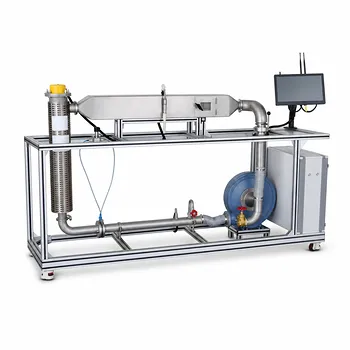
The core reason to avoid the transition flow region in a heat exchanger pilot plant is simple: it turns a predictable teaching tool into a source of unreliable data. The fluid behavior in this zone is inherently unstable. This instability makes the heat transfer coefficient fluctuate wildly, making it nearly impossible to correlate experimental results with the well-defined theoretical models that students are meant to learn.
For chemical engineering pilot plants designed to validate heat transfer theory through hands-on experimentation, the transition flow region introduces excessive and unacceptable uncertainty. It undermines the very purpose of the training: to build a clear, repeatable link between physical operation and fundamental engineering principles.
The Inherent Instability of the Transition Zone
The transition region is not a stable middle ground between laminar and turbulent flow. It’s a chaotic battleground where the flow structure continuously shifts.
Unpredictable Flow Structures
In a tube, laminar flow is smooth and orderly, while turbulent flow is dominated by energetic, chaotic eddies. In the transition region, the fluid oscillates between these two states in an unpredictable manner. Bursts of turbulence can appear and collapse sporadically along the length of the exchanger. This means the flow regime is never truly steady, even if the flow rate is held constant.
The Direct Impact on the Heat Transfer Coefficient
The heat transfer coefficient is a direct function of the flow regime. Because the flow itself is constantly changing, the heat transfer coefficient becomes a moving target. You cannot assign it a single, reliable value. This makes it impossible for students to calculate a coefficient using a standard Nusselt number correlation and get a result that meaningfully matches their experimental measurement.
Why This Destroys the Learning Objective
Unit operations pilot plants are built to demonstrate clear, repeatable principles. Operability in the transition zone directly conflicts with this goal.
Eroding Confidence in Theoretical Models
A key pedagogical goal is to show students that the Dittus-Boelter or Colburn equations for turbulent flow work. When an exchanger runs in transition, the measured coefficient won't match the turbulent model, nor will it match the laminar model. A student's first instinct is to blame their own technique, not the physics. This creates confusion and erodes confidence in the fundamental correlations they need to trust for real-world design.
Obscuring Key Performance Comparisons
Pilot plants are often used to compare exchanger types, like shell-and-tube versus plate exchangers, under different conditions. The transition region makes this comparison meaningless. If one unit operates in transition, its performance data is essentially random noise. A student cannot fairly evaluate pressure drop versus heat transfer efficiency trade-offs when one set of data is inherently corrupted by flow instability.
Understanding the Trade-offs and Pitfalls
While avoidance is the primary strategy, a complete understanding requires acknowledging the real-world constraints and the potential for a controlled teaching moment.
The Conservative Design Fallback
As the primary reference states, if operation in the transition zone is absolutely unavoidable—perhaps due to equipment limitations or a specific process fluid—you must take a conservative approach. You would calculate the heat transfer coefficient using both the laminar and turbulent equations and then select the lower value. This ensures a safe design but deliberately sacrifices accuracy for a margin of safety. It's a design compromise, not a precise measurement technique, and it should never be confused with experimental data validation.
A Distraction from Scale-up Principles
One key advantage of pilot-scale testing is teaching how heat transfer behavior changes with scale. The transition region masks these effects. The slower heat transfer rates observed in larger vessels are governed by changes in the surface-area-to-volume ratio, not by unpredictable flow instability. Introducing transition zone noise prevents students from isolating and understanding this critical scale-up principle.
Making the Right Choice for Your Training Goal
The operating flow regime must be a deliberate choice tied to your specific teaching objective. Avoid the transition zone by design.
- If your primary focus is validating classical heat transfer correlations: Operate the exchanger firmly in the turbulent region (Re >> 10,000). This is the only way to achieve a predictable, stable heat transfer coefficient that students can confidently compare against textbook equations.
- If your primary focus is studying the fundamental difference between laminar and turbulent heat transfer: Operate in the deeply laminar region (e.g., Re < 2,100) and then in the fully turbulent region. Run these as two separate, steady-state experiments to provide a clear, contrasting data set.
- If your primary focus is equipment characterization: Even here, avoid the transition zone. The goal is to measure equipment-specific performance metrics like the overall U-value. Unpredictable internal flow mixing will make a clean UA calculation impossible.
The power of a pilot plant lies in its ability to make complex physics visible and repeatable. By deliberately operating outside the transition zone, you ensure the lesson delivered is clear, truthful, and directly applicable to the safe design of industrial-scale systems.
Summary Table:
| Flow Regime | Reynolds Number (Re) | Flow Characteristics | Suitability for Training & Correlations |
|---|---|---|---|
| Laminar | Re < 2,100 | Smooth, orderly, and predictable | High (Provides a clear baseline for laminar equations) |
| Transition | 2,100 ≤ Re ≤ 10,000 | Chaotic, oscillating, and unstable | Low (Causes random data & experimental model mismatch) |
| Turbulent | Re > 10,000 | Chaotic eddies, fully mixed | High (Validates Dittus-Boelter & Colburn models) |
Set Up Reliable Engineering Labs with LABPARK
Ensure your students and researchers achieve precise, repeatable experimental results. LABPARK provides state-of-the-art Educational and Vocational Unit Operations Pilot Plants in chemical engineering, bioprocess & biotech, and environmental & water treatment. Designed specifically for universities, research institutes, and enterprises, our pilot plants deliver the stability and control needed to validate engineering theories without the headache of unstable data.
Ready to upgrade your laboratory training equipment? Contact LABPARK today to find the perfect pilot plant system for your curriculum!
Related Products
- Shell and Tube Heat Exchanger Heat Transfer Coefficient Determination Educational Pilot Plant
- Comprehensive Multi-Modal Heat Transfer Unit Operations Pilot Plant for Engineering Training
- Dual Mode Heat Transfer Pilot Plant for Unit Operations Training
- Three-Tube Heat Transfer Educational Pilot Plant for Unit Operations Training
- Comprehensive Heat Transfer Coefficient Determination Educational Unit Operations Pilot Plant
People Also Ask
- Why Apply LMTD Correction in Shell-and-Tube Pilot Plants & How to Determine It
- How to Estimate Shell-Side Pressure Drop in a Shell-and-Tube Heat Exchanger Pilot Plant: Key Parameters Explained
- Why adjust baffle spacing in shell-and-tube heat exchanger pilot plants? Master heat transfer & pressure drop.
- How is the fouling factor (Rd) evaluated? Key Pilot Plant Insights for Students
- How is fouling factor demonstrated using shell and tube pilot plants? Practical Lab Guide