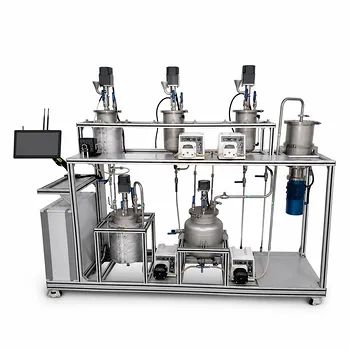
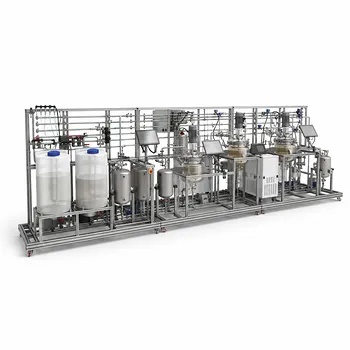
The fundamental distinction in bioreactor design for pilot plant education comes down to one factor: how energy is delivered to the system. Bioreactors are classified into three primary categories based on energy introduction: vessels using mechanically moved internals, those relying on external liquid pumping, and systems that use gas compression. The in-depth study of alternatives to the classic stirred-tank reactor in a pilot plant setting is not an academic exercise—it is a direct response to the crippling scale-up limitations of stirred tanks, specifically high energy demands, heat removal nightmares, and destructive mechanical shear.
The core takeaway is this: A stirred-tank reactor is an excellent small-scale workhorse, but its fundamental design becomes a liability at industrial volumes. Pilot plants must, therefore, explore alternative energy transfer methods—like pneumatics and external pumps—that solve the intertwined problems of excessive power consumption and cell viability at scale.
The Three Pillars: Classifying Bioreactors by Energy Input
A pilot plant serves as the critical proving ground between a benchtop concept and a manufacturing reality. The first lesson it must teach is how a reactor’s energy source dictates its entire performance envelope. The classification is rigid and physically determined.
Reactors with Mechanically Moved Internals
This is the conceptual extension of the standard stirred tank. A physical impeller, driven by a motor, directly transfers kinetic energy into the fluid.
The goal here is to retain the high mixing intensity of a stirred tank while mitigating its flaws. Designs like mechanically stirred loop reactors and cascade reactors fall into this category. They often use internal draft tubes or compartmentalization to create more ordered flow patterns, reducing the random, high-shear turbulence that damages cells.
Reactors Utilizing External Liquid Pumping
This category fundamentally separates the mixing device from the main reaction vessel. A mechanical pump circulates the liquid broth externally.
This approach allows for highly targeted energy application. In jet-loop or tubular-loop reactors, energy is introduced via a high-velocity liquid jet that entrains gas and drives bulk circulation. This design offers excellent plug-flow characteristics and can completely uncouple heat removal into an external heat exchanger, solving the thermal bottleneck of large-scale sterilisations.
Reactors Utilizing Gas Compression
These systems abandon mechanical moving parts entirely. Here, compressed gas—usually air or oxygen—is the sole source of energy input for both mixing and mass transfer.
The pneumatic power difference creates the mixing action in a bubble column or airlift reactor. An airlift mammoth loop refines this by introducing an internal draft tube, which stabilizes fluid circulation, reduces random turbulence, and produces a highly predictable, low-shear environment.
Why Pilot Plants Must Go Beyond the Stirred Tank
The stirred tank is the default benchmark, but scaling it up by sheer brute force is a thermodynamic and biological dead end. A pilot plant's educational purpose is to demonstrate precisely why this happens.
The Power and Heat Removal Inequity
The core physical problem is a catastrophic decline in surface area relative to volume. A stirred tank’s cooling relies on a jacket, but as the vessel grows, the metabolically generated heat—proportional to the cubed power of the radius—outpaces the jacket’s surface area, which only squares with scale.
Maintaining adequate mixing with a larger impeller demands an exponential leap in power input. Almost all of that motor energy ultimately degrades into heat, creating an impossible cooling demand. Alternative designs—especially pneumatically driven ones—have drastically lower specific energy costs and can integrate more efficient external heat exchangers into the liquid loop.
The Biological Cost: Substrate Loss and Shear-Induced Damage
High power input doesn't just create a thermal problem; it creates a mechanical one. The tip speeds of large impellers generate high-shear zones that are lethal to sensitive filaments or mammalian cells.
This mechanical trauma causes two failures. First, direct cell damage or lysis reduces the viable biomass concentration. Second, it leads to lower yields due to substrate losses, where nutrients are redirected from product formation into cellular repair mechanisms, or where lysed cells release proteases and other contaminants that spoil the final product. Alternatives like the airlift reactor create a gentler, more uniform turbulence profile to avoid this.
Understanding the Trade-offs
Objectivity demands we acknowledge that alternative reactor designs are not a universal panacea. Choosing one means accepting a new set of potential bottlenecks.
Reduced Volumetric Mass Transfer
The high power input of a stirred tank can drive an extremely high volumetric mass transfer coefficient. Airlift and bubble column reactors generally exhibit lower oxygen transfer rates per unit volume, particularly with highly viscous, non-Newtonian fermentation broths where bubble coalescence becomes severe. This can create oxygen-depleted zones if not properly modeled.
Mixing Time Limitations
While stirred tanks can reach near-perfect mixedness in seconds, achieving homogeneous mixing in a low-shear pneumatic reactor takes significantly longer. This can be a critical failure point if a pH control acid or base is not rapidly and locally neutralized. The pilot plant must validate that mixing time remains within tolerable biological limits.
Making the Right Choice for Your Educational Pilot Plant
The reactor selection for a bioprocess training facility must mirror the intended industrial application of its students. Base your capital decisions on the biological system, not just the hardware familiarity.
- If your primary focus is high-density microbial fermentations for commodity chemicals: A stirred tank or mechanically moved internal loop reactor remains highly relevant, as the metabolic heat and oxygen demands justify the complex utility infrastructure.
- If your primary focus is cultivating mammalian cells or filamentous fungi for high-value therapeutics: An airlift or external-loop system is non-negotiable. Mastering the separation of energy input from mechanical shear is the single most critical skill for students to learn.
- If your primary focus is demonstrating end-to-end process scalability and thermodynamic efficiency: Prioritize reactors utilizing external liquid pumping, as they offer the most modular approach to decoupling residence time, mixing, and heat transfer into independent, scalable units.
The ultimate goal is not to teach students how to operate one machine but to instill a physics-based intuition for how energy transfer shapes the biological outcome.
Summary Table:
| Bioreactor Class | Energy Source | Key Examples | Primary Advantage |
|---|---|---|---|
| Mechanical Internals | Motor-driven impeller | Stirred tank, cascade | High mixing intensity |
| External Liquid Pumping | External pump | Jet-loop, tubular-loop | Decoupled heat removal |
| Gas Compression | Compressed gas/air | Airlift, bubble column | Low-shear environment |
Equip Your Lab with Advanced Bioprocess Pilot Plants
Choosing the right bioreactor configuration is critical for preparing students and researchers for real-world scale-up challenges. LABPARK provides premium Educational and Vocational Unit Operations Pilot Plants in chemical engineering, bioprocess & biotech, and environmental & water treatment.
We help universities, research institutes, and enterprises bridge the gap between theory and industrial reality with high-quality, scalable systems.
Ready to enhance your training facilities? Contact LABPARK today to discuss your custom pilot plant needs!
Related Products
- Bio-fermentation Ethanol Production Practical Training Unit Operations Pilot Plant
- Natural Product Extraction Unit Operations Training Pilot Plant
- Continuous Batch Extractive Distillation Educational Pilot Plant
- Electrolyte Distillation Purification and Formulation Educational Pilot Plant
- High-Gravity Emulsification and Mass Transfer Educational Pilot Plant
People Also Ask
- Why Use PTFE & Hastelloy in Chemical Pilot Plants? Prevent Corrosion & Ensure Safety
- Why Compare Predicted and Experimental Excess Enthalpy? Key to Accurate Pilot Plant Scale-up
- Why is the chemical plant startup schedule crucial? De-risk scale-up with pilot plants.
- When to transition from PID to adaptive control in pilot plants? Key process indicators.
- Why must batch and fed-batch fermentation pilot plants be designed to accommodate changing rheological conditions?