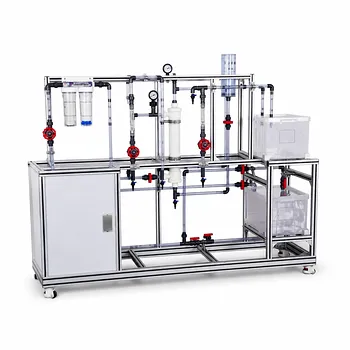
Packing density, fouling resistance, and ease of maintenance form the deciding triangle. In chemical engineering pilot plants, the choice between plate-and-frame, tubular, spiral-wound, and hollow-fiber modules boils down to a structural trade-off: membrane area per unit volume versus the ability to handle dirty feeds. Plate-and-frame and tubular designs prioritize accessibility and ruggedness at the cost of compactness, spiral-wound modules strike a practical middle ground, and hollow-fiber configurations maximize active area but demand pristine feed streams and are nearly impossible to clean once fouled.
For pilot-plant education and research, the module geometry is a teaching tool in itself. Hollow-fiber systems pack the most membrane into the smallest footprint, perfectly mirroring industrial high‑efficiency processes, while plate-and-frame and tubular modules trade packing density for unmatched hands-on learning, effortless cleaning, and resilience against suspended solids — exactly what you need when students are running unpredictable, fouling-prone experiments.
A Structural Overview of Membrane Module Geometries
To truly compare these modules, you must first visualize how each one is built. The fundamental structural differences dictate everything from fluid dynamics to maintenance protocols.
The Stacked Simplicity of Plate‑and‑Frame Systems
Plate‑and‑frame modules are built like a filter press.
Flat sheet membranes are layered on rigid support plates, separated by liquid‑tight gaskets and spacers that form flow channels. The entire stack is held together by a mechanical frame or hydraulic press.
The structure is complex to assemble but brilliantly simple to service. Because the stack can be opened, individual membranes can be cleaned manually with a soft cloth or replaced one at a time — no special chemicals needed.
The Straight-Channel Design of Tubular Modules
Tubular modules house membranes inside thick‑walled support tubes, typically 5–25 mm in diameter.
The feed flows through the tube’s bore, and permeate exits radially through the porous wall. The large, straight channels offer minimal hydraulic resistance.
This design is inherently non‑fouling. The “line‑of‑sight” flow path and large internal diameter allow suspended solids and even fibrous material to pass through without blocking the channel. When cleaning is required, you can mechanically scrub the bore or simply use a pigging device.
The Spiral‑Wound Roll: Compact Engineering
Spiral‑wound modules are the industry workhorse for reverse osmosis (RO) and ultrafiltration (UF).
The construction is elegantly compact: a flat sheet membrane is sandwiched between feed and permeate spacer meshes, then wound tightly around a central permeate collection tube. The result looks like a roll of cooking parchment and a fine screen. Feed flows axially through the mesh‑filled channel, permeate spirals inward to the central tube, and concentrate exits at the far end.
This “Swiss roll” geometry provides a high area per module volume while maintaining a single, disposable cartridge form factor. However, the mesh spacers trap particles easily, making pretreatment a must.
The Self‑Supporting Bundle of Hollow‑Fiber Modules
Hollow‑fiber modules operate like a bundle of microscopic straws.
Each fiber is a self‑supporting capillary with a wall thickness that withstands high pressure from either the bore or the shell side. The fibers are potted at both ends into an epoxy block, creating a flow geometry that can be run in cocurrent, countercurrent, or crossflow orientation simply by redirecting the feed.
This configuration achieves the highest possible surface‑area‑to‑volume ratio — often 16,000 to 30,000 m²/m³ — because there are no bulky support plates or spacers. The trade‑off is that the fiber lumens are extremely small, typically 0.5–2 mm, and once debris gets lodged, you cannot fish it out.
Operational Characteristics and Performance Trade‑offs
Structure dictates operation. The way each module handles pressure, fouling, and maintenance determines its place in a pilot plant.
Packing Density: The Space‑Efficiency Spectrum
The four technologies fall on a clear spectrum.
- Hollow‑fiber modules top the chart at 16,000–30,000 m²/m³, giving them an overwhelming advantage in footprint‑sensitive labs and mimicking industrial seawater RO very closely.
- Spiral‑wound modules sit in the middle with a practical 650–1,600 m²/m³, enough to teach large‑scale membrane plant design without occupying half the lab.
- Plate‑and‑frame and tubular modules occupy the low end, at 160–500 m²/m³ and 33–330 m²/m³ respectively. This makes them bulky but incredibly easy to physically inspect.
For a pilot plant, low packing density isn’t just a drawback — it is an educational asset, letting students see and touch the membranes.
Feed Water Quality and Pretreatment Demands
This is where the operational philosophy of each module diverges most sharply.
Hollow‑fiber and spiral‑wound modules cannot tolerate suspended solids. The primary reference specifies that hollow‑fiber modules need feed with a clogging index (FI) of less than 3 and spiral‑wound modules demand FI < 4. If your pilot plant is fed from a surface water source or a student‑brewed mixture of starch and bentonite, either module will foul within minutes.
Plate‑and‑frame and tubular modules are far more forgiving. Their wide, open channels permit feeds with significantly lower water quality, meaning you can skip an extensive pretreatment train. Tubular modules, in particular, can process streams with high suspended solids or even viscous solutions, making them the de facto choice for microfiltration of whole broths or waste streams.
Cleaning, Maintenance, and Membrane Replacement
Ease of cleaning directly impacts the educational throughput of a pilot plant.
Tubular and plate‑and‑frame modules are the clear winners here. With tubular systems, you can mechanically clean the bore with a sponge ball or brush; plate‑and‑frame stacks can be disassembled so students can wipe each membrane sheet by hand. If a membrane tears, you replace that single sheet — not the entire module.
Spiral‑wound and hollow‑fiber modules are sealed units. When they foul, chemical cleaning is the only option, and recovery is often incomplete. If a hollow fiber breaks, the entire cartridge is discarded. This may be acceptable for a demonstration of industrial best practice, but it drives consumables budgets and downtime in an educational setting.
Pressure Drop and Permeation Characteristics
Structural geometry also determines energy consumption and flux.
Tubular modules exhibit a very low pressure drop along the flow channel due to their large diameter, making them efficient for high‑flow, low‑pressure microfiltration.
Hollow‑fiber modules, because of their tiny lumen diameters, generate a high pressure drop. This can be mitigated by flowing feed on the shell side (when the fibers are self‑supporting), but even then, permeation resistance can be higher than in flat‑sheet configurations, requiring a larger driving force. The ability to run countercurrent flow, however, is a unique advantage for maximizing mass transfer in gas separation or liquid contacting experiments.
Spiral‑wound modules fall in between, with a moderate pressure drop and good flux density, making them the most cost‑effective choice for teaching membrane scale‑up rules.
Understanding the Trade‑offs: Common Pitfalls to Avoid
Selecting a module based on a single specification like packing density will almost certainly set you up for failure. Three pitfalls are especially common in academic pilot plants.
- Choosing hollow‑fiber for a “dirty feed” UF experiment. The high surface area is tempting, but the moment the feed contains particulates above the FI limit, the module becomes a high‑pressure filter cake that cannot be cleaned. You will spend more time troubleshooting than teaching.
- Overlooking the educational value of physical access. Spiral‑wound cartridges are a black box. While they perfectly represent industrial reality, they do not let students see how flow maldistribution or concentration polarization develops. A plate‑and‑frame unit, by contrast, turns membrane separation into a transparent process.
- Ignoring module replacement cost per experiment. Tubular modules have a high per‑membrane cost, but if you are running abrasive or highly fouling streams, they may be the only module that survives the semester. Replacing a single tubular membrane segment is often cheaper than ruining an entire spiral‑wound element.
Making the Right Choice for Your Pilot Plant
Your ideal membrane module depends on what you are trying to teach, what feeds you will run, and how much hands‑on maintenance your team can sustain. Use the following goal‑based framework to guide your decision.
After a careful comparison of structure, operation, and maintenance, here are the clear recommendations:
- If your primary focus is teaching fundamental membrane principles and visualization of concentration polarization: Choose a plate‑and‑frame module. Its transparent stack allows manual inspection, easy membrane replacement, and operation with low‑quality feed water.
- If your primary focus is processing highly fouling, high‑solids feeds for microfiltration or ultrafiltration: Select a tubular module. It offers the lowest pressure drop, mechanical cleanability, and the highest tolerance for suspended solids — even though its packing density is the lowest.
- If your primary focus is simulating industrial reverse osmosis, nanofiltration, or gas separation with a moderate budget: Pick spiral‑wound modules. They provide the best balance of packing density, moderate pretreatment needs, and a realistic industrial footprint for standard water and gas treatment curricula.
- If your primary focus is exploring high‑efficiency processes like advanced water polishing, countercurrent gas separation, or dialysis with pristine feeds: Use hollow‑fiber modules. Their enormous surface area and flexible flow orientation (cocurrent, countercurrent, crossflow, shell‑fed or bore‑fed) turn them into a powerful research tool — as long as the feed water is impeccably clean.
Ultimately, a well‑designed pilot plant should house at least two module types, enabling students to physically compare the trade‑offs in packing density, fouling resistance, and cleaning effort, and thereby grasp the essential compromise that defines membrane process engineering.
Summary Table:
| Module Type | Packing Density (m²/m³) | Fouling Resistance | Ease of Cleaning | Best Use Case |
|---|---|---|---|---|
| Plate-and-Frame | 160–500 | High | Very Easy (Manual) | Fundamental teaching & visual learning |
| Tubular | 33–330 | Very High | Easy (Mechanical/Pigging) | High-solids, viscous, & dirty feeds |
| Spiral-Wound | 650–1,600 | Moderate | Moderate (Chemical) | Industrial RO/NF scale-up simulation |
| Hollow-Fiber | 16,000–30,000 | Low | Difficult (Chemical only) | High-efficiency runs & pristine feeds |
Build the Perfect Pilot Plant with LABPARK
Selecting the right membrane geometry is critical for matching your research goals and teaching curriculum. LABPARK provides advanced Educational and Vocational Unit Operations Pilot Plants in chemical engineering, bioprocess & biotech, and environmental & water treatment.
We help universities, research institutes, and enterprises design flexible, robust systems that turn complex separation principles into hands-on practical knowledge.
Ready to elevate your laboratory? Contact our engineering experts today to find the perfect pilot plant configuration for your institution!
Related Products
- Multifunctional Membrane Separation Educational Pilot Plant with Ultrafiltration, Nanofiltration, Reverse Osmosis
- Multi Functional Membrane Crystallization Educational Unit Operations Pilot Plant
- Photocatalytic Membrane Separation and Degradation Unit Operations Pilot Plant
- Ultrafiltration Membrane Separation Educational Pilot Plant
- Multi-Functional Membrane Separation Educational Pilot Plant for Unit Operations Lab
People Also Ask
- How do PEI, PVDF, and PSU membranes compare in pilot plants? Find the best fit.
- Pervaporation vs. Vapor Permeation: Handling Suspended Solids in Membrane Pilot Plants
- What are the trade-offs of polymer vs inorganic membranes in teaching pilot plants? Key laboratory comparison.
- What are the key flow configuration loops in membrane pilot plants? Optimize Performance
- How can operators optimize operating conditions and cleaning protocols in membrane separation pilot plants to mitigate fouling?