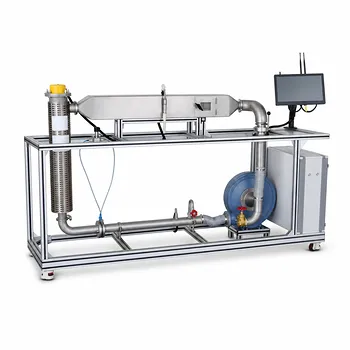
Double-pipe heat exchangers are the preferred configuration in chemical engineering pilot plants when the heat transfer duty is modest and the primary process goals are simplicity, flexibility, and transparent teaching. This simplest of exchanger designs excels where the required heat transfer area is small (typically a few square meters), flow rates are low to moderate, and the ability to connect units in series for capacity expansion outweighs the need for a compact footprint. In pilot‑plant environments, a double‑pipe unit also shines because its straightforward geometry allows direct, repeatable measurement of heat transfer coefficients and pressure drops—making it an ideal bridge between theory and industrial practice.
The double‑pipe exchanger is the go‑to choice for chemical engineering pilot plants when you need a small, adaptable teaching tool that transparently demonstrates co‑current and counter‑current heat transfer. It is preferred under conditions of low‑to‑moderate heat loads and flow rates, where educational value and experimental flexibility carry more weight than minimizing space or maximizing throughput.
When Process Conditions Make Double-Pipe the Ideal Choice
1. Small Heat Transfer Area and Low Duty
The double‑pipe exchanger’s defining advantage is its economic sweet spot at small heat transfer areas. Because each unit consists of just two concentric pipes, the surface area per unit length is limited. For duties requiring a few square meters of area, fabricating a double‑pipe from standard pipe fittings is far cheaper and simpler than building even a small shell‑and‑tube bundle.
If you try to push a double‑pipe to larger duties, the required length becomes unwieldy. Therefore, pilot‑plant processes with low heating or cooling requirements—such as conditioning a small side‑stream or reacting at bench scale—align perfectly with this design.
2. Low to Moderate Flow Rates and Manageable Pressure Drop
Double‑pipe exchangers operate with single‑pass flow in the annulus, which creates a higher pressure drop per unit length compared to a shell‑side with baffles that promote cross‑flow. Consequently, they are best suited to low to moderate flow rates, keeping pressure drop within acceptable limits for small pumps and sensitive instrumentation.
In a teaching pilot plant, the resulting pressure drop is not just a penalty—it is a measurable quantity that students can use to validate correlations. The simple flow path makes pressure drop calculations transparent and directly comparable to textbook equations.
3. Educational Transparency: Direct Teaching of Fundamentals
A core reason double‑pipe units are chosen for pilot plants is that they are the clearest physical representation of co‑current and counter‑current heat transfer. Because the fluids travel along a straight, well‑defined path with no baffles or complex passes, students can trace temperature profiles, measure inlet and outlet conditions, and calculate the overall heat transfer coefficient from first principles without geometric complications.
This transparency extends to material compatibility experiments. For instance, if you need to heat a corrosive fluid like hydrochloric acid, you can easily install an inner tube made of impervious graphite (Karbate) or other resistant materials, while the outer shell remains standard carbon steel. The simple construction makes custom material pairings practical and affordable—a key advantage when the pilot plant must handle an array of chemical systems.
4. Flexible Scale-Up through Series Connection
One underappreciated strength for pilot‑plant work is that double‑pipe exchangers can be connected in series to increase heat transfer capacity without redesign. If an experiment demands a larger heat load than originally planned, you can rapidly add a second or third identical unit, boosting area while maintaining the same flow configuration.
This modularity means the pilot plant can adapt to evolving research needs. The same laboratory infrastructure that starts with a single small unit can be expanded to two, three, or more in series, enabling a parametric study of heat transfer performance as duty increases.
Understanding the Trade-Offs: When Double-Pipe Falls Short
Despite its educational and small‑scale strengths, the double‑pipe exchanger has clear limitations that pilot‑plant designers must weigh.
Space and Compactness
Achieving even 10 m² of area requires a long length of piping, consuming significant bench or floor space. A shell‑and‑tube exchanger packs the same area into a much smaller volume. If the pilot plant must fit in a cramped laboratory or mirror industrial compactness, the double‑pipe becomes impractical.
High Flow Rates and Pressure Drop
At flow rates typical of scaled‑up pilot processes, the annular pressure drop can grow rapidly, demanding larger pumps and increasing energy costs. In these cases, a plate‑and‑frame exchanger (with low per‑pass pressure drop due to its short path length) or a shell‑and‑tube unit (where the shell‑side flow is distributed over many tubes) is more efficient.
Fouling and Cleaning Accessibility
While the double‑pipe is easy to disassemble for cleaning individual tube or annulus surfaces, it offers no in‑situ mechanical cleaning like a floating‑head shell‑and‑tube exchanger. If the process fluid is highly fouling and requires frequent bundle extraction and cleaning, a U‑tube or floating‑head design may be necessary—though at the pilot scale, the simplicity of swapping a double‑pipe tube often compensates.
Making the Right Choice for Your Pilot-Plant Goals
The best heat exchanger selection always starts with your specific process and teaching objectives. Use the following guide to decide whether a double‑pipe unit belongs in your pilot plant.
- If your primary focus is educating students on fundamental heat transfer principles: A double‑pipe exchanger is unmatched. Its simple geometry lets learners directly observe co‑current and counter‑current profiles, calculate coefficients by hand, and gain confidence before encountering more complex industrial designs.
- If your primary focus is handling corrosive fluids in a small‑scale setup: Choose the double‑pipe configuration. Its simplicity permits cost‑effective use of specialized tube materials like impervious graphite, without the fabrication complexity of a full shell‑and‑tube bundle.
- If your primary focus is a compact, high‑throughput pilot process that mimics industrial scale: A double‑pipe will likely be too bulky and pressure‑drop‑heavy. Opt for a shell‑and‑tube or plate heat exchanger to better represent real plant conditions.
- If your primary focus is rapid reconfiguration and experimental flexibility: The double‑pipe’s series‑connectability and ease of disassembly allow you to quickly change inner tube materials, lengths, or add units, making it the most adaptable choice for evolving research programs.
In a chemical engineering pilot plant, the double‑pipe heat exchanger is the instrument of choice when learning and adaptability matter as much as the physical process itself. Used under the right conditions—small duties, low flow, and a need for crystal‑clear heat transfer insights—it remains an irreplaceable workhorse of engineering education.
Summary Table:
| Selection Criterion | Preferred Process Condition | Key Advantage for Pilot Plants |
|---|---|---|
| Heat Transfer Area & Duty | Low heating/cooling loads (a few square meters) | Highly cost-effective and simple design |
| Flow Rate & Pressure Drop | Low to moderate flow rates | Manageable pressure drop, direct textbook validation |
| Teaching & Research | Co-current and counter-current demonstration | High educational transparency, direct coefficient calculations |
| Fluid Chemistry | Corrosive fluids requiring custom materials | Simple construction allows easy swap of inner tube materials |
| Scale-up Needs | Variable research capacities | Flexible expansion by connecting units in series |
Optimize Your Engineering Labs with LABPARK
Are you looking to enhance your laboratory’s training and research capabilities? LABPARK provides state-of-the-art Educational and Vocational Unit Operations Pilot Plants in chemical engineering, bioprocess & biotech, and environmental & water treatment.
Designed specifically for universities, research institutes, and enterprises, our pilot plants—including customizable heat exchanger units—bridge the gap between academic theory and industrial practice. We help you deliver hands-on, transparent learning experiences and accurate experimental scale-ups.
Ready to elevate your engineering curricula or research capabilities? Contact LABPARK today to discuss your custom pilot plant configuration with our technical experts!
Related Products
- Shell and Tube Heat Exchanger Heat Transfer Coefficient Determination Educational Pilot Plant
- Comprehensive Multi-Modal Heat Transfer Unit Operations Pilot Plant for Engineering Training
- Dual Mode Heat Transfer Pilot Plant for Unit Operations Training
- Three-Tube Heat Transfer Educational Pilot Plant for Unit Operations Training
- Comprehensive Heat Transfer Coefficient Determination Educational Unit Operations Pilot Plant
People Also Ask
- Why Apply LMTD Correction in Shell-and-Tube Pilot Plants & How to Determine It
- Why adjust baffle spacing in shell-and-tube heat exchanger pilot plants? Master heat transfer & pressure drop.
- How to Estimate Shell-Side Pressure Drop in a Shell-and-Tube Heat Exchanger Pilot Plant: Key Parameters Explained
- How is the fouling factor (Rd) evaluated? Key Pilot Plant Insights for Students
- How is fouling factor demonstrated using shell and tube pilot plants? Practical Lab Guide