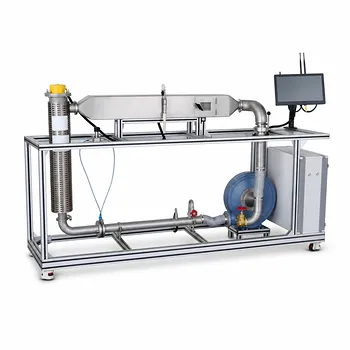
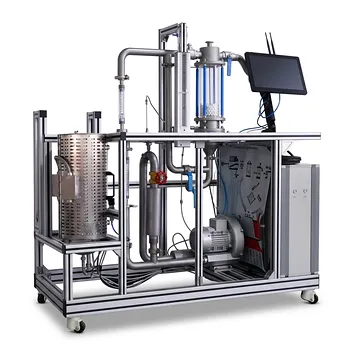
The cost of a pilot-scale heat exchanger is never just a function of its size. The final purchase equipment cost is profoundly shaped by two multiplicative factors: the materials of construction and the operating pressure. A base cost, calculated for carbon steel and low-pressure operation, is multiplied by a material factor (Fm) and a pressure factor (Fp) to reflect the real-world demands of your process. For example, simply moving from carbon steel to full stainless-steel construction can triple the purchase price, while pushing a design past its low-pressure baseline triggers a pressure factor that grows rapidly as the required pressure increases.
The base cost of a heat exchanger assumes the most economical conditions: carbon steel materials and operation below 10 barg. When corrosive chemicals or high pressures are involved, you apply multiplicative cost factors that can easily increase the final bare module cost by 5 to 12 times, making material and pressure selections the single most critical lever in pilot-plant budgeting.
Understanding the Baseline: Where the Cost Estimate Begins
Before any correction factors are applied, all pilot-scale heat exchanger cost correlations assume a standard, least-expensive configuration.
The Assumed Base Case Is Carbon Steel and Low Pressure
Industry-standard cost data, including those used in academic plant design, generate a base purchase cost (Cp) for shell-and-tube and double-pipe exchangers using carbon steel on carbon steel (cs/cs) construction and an operating pressure below 10 barg.
This baseline keeps correlations simple but can be dangerously misleading if your pilot process operates far from these ideal conditions.
How the Base Cost Scales with Size
The initial Cp is driven by the heat exchange surface area (A), not by material or pressure.
Cost-estimating correlations often follow a power-law relationship (Cp ∝ A^n), with exponents like 0.6 for floating-head exchangers. This economy-of-scale effect means that doubling the area does not double the cost—it raises it by a factor of (2^0.6) ≈ 1.5. However, this scaling only tells you the baseline starting point, which is then dramatically reshaped by the two factors at the heart of your question.
The Material Factor: How Your Alloy Choices Multiply the Price
Corrosion resistance, product purity, and fluid compatibility force you to move beyond carbon steel. That decision directly multiplies your equipment bill.
Material Factors Translate Alloy Selection into a Cost Multiplier
The material factor (Fm) is a dimensionless number that represents how much more expensive a unit is compared to the carbon steel baseline. The primary cost data is clear:
- Carbon steel on carbon steel (cs/cs): Fm = 1.00 (the baseline)
- Stainless steel on stainless steel (ss/ss): Fm = 3.00
- Titanium on titanium (Ti/Ti): Fm = 12.00
So, a 200-ft² stainless heat exchanger does not simply cost “a bit more” than its carbon steel counterpart—it costs three times the base price. If titanium is required for extreme corrosion resistance, the cost skyrockets to twelve times the carbon steel figure.
Partial Upgrades Have a Smaller But Still Significant Impact
You do not always need a full ss/ss construction. Selecting just the tube bundle in stainless while keeping a carbon steel shell reduces the material factor.
For example, a shell-and-tube exchanger with stainless steel tubes can run about 80% more expensive than a pure carbon steel unit—roughly an Fm of 1.8 rather than 3.0. This hybrid approach often strikes the right balance between handling corrosive tube-side fluids and controlling capital spend.
The Pressure Factor: Why Operating Pressure Is a Silent Cost Driver
Even if the material is fixed, the pressure at which your heat exchanger operates directly commands a thicker, heavier, and more expensive design.
A Low-Pressure Baseline Must Be Adjusted for Higher Demands
The base cost Cp is valid only for operation below 10 barg (or a similar low-pressure threshold like 50 psig for vessels). When your pilot process requires a higher design pressure, you must multiply the cost by a pressure factor Fp.
This factor grows non-linearly as you climb the pressure scale. While exact values depend on the exchanger type and mechanical code, the trend is universal: moving from 50 psi to 100 psi may apply an Fp of 1.25, but pushing to 1000 psi can drive the factor to 4.2, and reaching 3000 psi can explode it to 8.75.
Wall Thickness Drives the Pressure Factor Curve
The physical reason is straightforward. Higher pressures demand thicker shell walls, stronger tube sheets, and more robust channel designs. The material weight increases, and the fabrication difficulty escalates, leading directly to a higher Fp. In pilot-scale designs where space and weight are already contrained, this effect is even more pronounced because you cannot simply add infinite thickness without altering the thermal performance.
How the Two Factors Combine into a Final Bare Module Cost
The real purchase equipment cost is neither the base Cp nor a single factor—it is their product.
The Bare Module Cost Equation
In rigorous cost estimation, the bare module cost (CBM) is the true purchase cost of the installed equipment. For heat exchangers, this is calculated as:
CBM = Cp × (Fp × Fm)
The combined factor Fbm = Fp × Fm can be terrifyingly large for a pilot plant that handles hot, corrosive fluids at high pressure. A stainless–stainless unit (Fm=3.0) operating at a pressure that requires an Fp of 1.5 would have an Fbm of 4.5—raising the cost to 4.5 times the carbon steel, low-pressure base price. Add titanium instead, and the factor leaps to 12 × 1.5 = 18.
Understanding This Multiplication Prevents Catastrophic Budgeting Errors
A common mistake is to use the base cost correlation directly without applying any factors. That gives a gross underestimate that can derail a pilot-plant project before procurement even begins. Always treat material and pressure as cost multipliers, not optional add-ons.
Understanding the Trade-offs and Common Pitfalls
The power to control heat exchanger cost comes with hard trade-offs that every pilot plant designer must navigate.
Corrosion Resistance Versus Capital Budget
Carbon steel is cheap and strong but rusts in the presence of water, acids, or corrosive solvents. Stainless steel (304 or 316) provides the hygienic, cleanable surfaces essential for bioprocessing and wide chemical compatibility, but at a 1.8–3.0× premium. Titanium solves nearly any corrosion problem but may consume the entire equipment budget for a single exchanger.
The pitfall: Selecting an overly conservative alloy “just in case” can waste resources that could be used for better instrumentation, more parallel reactions, or larger capacity.
Pressure Capability Versus Structural Cost
Designing for a pressure that far exceeds your actual operating envelope is equally wasteful. If your reaction never goes above 5 barg, designing for 50 barg multiplies the cost unnecessarily. Conversely, underestimating the potential pressure surge during an exotherm or a blocked outlet can lead to a catastrophic safety failure.
The pitfall: A pilot plant should be designed for the safe upper limit of the process, not just typical operating conditions, but that limit must be determined through process hazard analysis rather than arbitrary safety margins.
Sacrificing Functionality for Familiarity
In educational environments, the number of tube passes drives heat transfer efficiency. Configurations with fewer than three tube passes tend to be uneconomical due to poor flow distribution. However, exotic multi-pass designs in expensive materials can push costs even higher. Teaching students to balance thermal performance with material and pressure constraints is exactly why pilot-scale cost estimation is a core engineering skill.
Making the Right Choice for Your Pilot Plant Budget
Your specific process goals determine where you should accept cost multipliers and where you can resist them.
- If your primary focus is low procurement cost and standard chemical training: Select carbon steel construction with a design pressure as close to the actual process as safety permits. Use the cs/cs baseline (Fm=1.0) and minimize Fp to keep costs at bare module level.
- If your primary focus is handling corrosive process fluids or bioprocess purity: Budget for a stainless steel tube bundle at minimum (Fm≈1.8), or a full ss/ss unit (Fm=3.0) if both sides are aggressive. Accept that this material factor is non-negotiable for experiment integrity.
- If your primary focus is high-pressure reactions or supercritical processes: Shift your budget from material factors to the pressure factor. Even with carbon steel, a high design pressure can drive Fp above 4, so invest in accurate process control and relief systems to avoid over-designing the pressure envelope.
- If your primary focus is maximum experimental flexibility for an academic lab: Choose stainless steel for broad chemical compatibility and design for a moderate pressure margin (e.g., Fp≈1.5) to cover a wide range of future student projects without wasting funds on unnecessary alloy or pressure capacity.
Every budget decision in a pilot-scale heat exchanger echoes through your plant’s capability, safety, and lifespan. By seeing material and pressure as multiplicative cost factors rather than simple add-ons, you turn a rough correlation into a precise, defensible financial plan.
Summary Table:
| Cost Factor | Material / Pressure Option | Cost Multiplier (Fm / Fp) | Budget Impact & Common Application |
|---|---|---|---|
| Material (Fm) | Carbon Steel on Carbon Steel (cs/cs) | 1.00 (Base) | Lowest cost; baseline for non-corrosive processes |
| Material (Fm) | Stainless Steel on Stainless Steel (ss/ss) | 3.00 | Triples cost; standard for bioprocess and purity requirements |
| Material (Fm) | Titanium on Titanium (Ti/Ti) | 12.00 | Massive cost increase; reserved for extreme corrosion |
| Pressure (Fp) | Low Pressure (< 10 barg) | 1.00 (Base) | Economy baseline; thin-walled construction |
| Pressure (Fp) | Medium Pressure (~70 barg) | ~4.20 | Significant cost increase; requires thicker shell walls |
| Pressure (Fp) | High Pressure (~200 barg) | ~8.75 | Explodes fabrication cost; requires robust channel design |
Design Your Next Pilot Plant with LABPARK's Engineering Expertise
Balancing material durability, operating pressure, and equipment cost is critical to building a successful pilot setup. At LABPARK, we provide high-performance Educational and Vocational Unit Operations Pilot Plants in chemical engineering, bioprocess & biotech, and environmental & water treatment.
Whether you are a university upgrading your engineering lab, a research institute testing new processes, or an enterprise scaling up operations, we deliver tailored pilot-scale systems that match your technical requirements and budget.
Ready to optimize your pilot-scale setup? Contact us today to consult with our process design experts!
Related Products
- Shell and Tube Heat Exchanger Heat Transfer Coefficient Determination Educational Pilot Plant
- Comprehensive Multi-Modal Heat Transfer Unit Operations Pilot Plant for Engineering Training
- Dual Mode Heat Transfer Pilot Plant for Unit Operations Training
- Three-Tube Heat Transfer Educational Pilot Plant for Unit Operations Training
- Comprehensive Heat Transfer Coefficient Determination Educational Unit Operations Pilot Plant
People Also Ask
- Why Apply LMTD Correction in Shell-and-Tube Pilot Plants & How to Determine It
- How is the fouling factor (Rd) evaluated? Key Pilot Plant Insights for Students
- How is fouling factor demonstrated using shell and tube pilot plants? Practical Lab Guide
- Why is simulating and calculating fouling factors crucial when operating educational heat exchanger pilot plants?
- Why Keep Shell-Side Reynolds Number Above 2100? Maximize Pilot Plant Heat Transfer