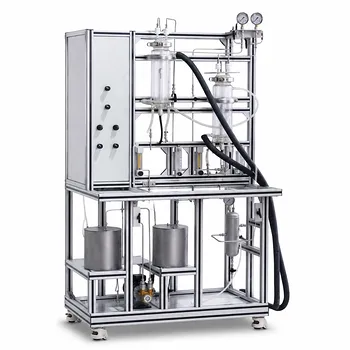
The maintenance routine your team dreads—or barely notices—starts with the reactor’s silhouette. A flat-plate photoreactor is built for fast, tool-free disassembly, letting you wipe every light-transparent surface and swap reaction mixtures in minutes. A pseudoannular reactor wraps its fluid channel tightly around a central lamp in a sealed housing, making physical access nearly impossible but enabling thorough in-situ chemical flushes that dissolve residues without dismantling. In a chemical engineering unit operations pilot plant, this difference defines whether your cleaning protocol leans on mechanical scrubbing or solvent circulation.
While a flat-plate reactor gives you the rapid, hands-on turnaround ideal for frequent student rotations, a pseudoannular design trades that mechanical simplicity for robust chemical cleanability and the ability to sustain longer, more process-representative runs—so your choice is essentially a decision about how much downtime you can tolerate and what kind of labor you prefer to invest.
Why Reactor Geometry Defines Your Cleaning Protocol
Residual organic films, catalyst deposits, and photoproduct buildup on light-transmitting surfaces can slash photon efficiency and degrade reaction yields run after run. How easily you can remove that fouling is locked into the reactor’s physical form.
The Flat-Plate Advantage: Designed for Disassembly
A flat-plate photoreactor stacks flat gaskets, glass plates, and a simple frame. Opening it is typically a matter of loosening a few clamps or bolts.
This mechanical accessibility means operators can scrub every part that contacts the reaction medium. For a pilot plant supporting unit operations training, that translates to minimal turnaround time between student groups or experimental conditions.
The straightforward design also makes it easy to visually confirm cleanliness—no shadowy corners where residues hide. When time is the scarcest resource, this design virtually eliminates the hidden labor of preparing the reactor for the next run.
The Pseudoannular Reality: Inaccessible but Chemically Resilient
A pseudoannular reactor forces fluid through a narrow annular gap surrounding a central lamp, often inside a sealed metal housing. You cannot simply open it and reach the walls with a brush.
Because of this geometric constraint, mechanical cleaning becomes impractical or outright damaging to the precision surfaces. However, these reactors are highly receptive to chemical cleaning: hot solvents, dilute acids, or specialized cleaning solutions can be circulated through the reactor loop to dissolve deposits and flush them out completely.
Since these reactors often operate at elevated pressures and with enhanced heat transfer, the sealed, pressurized cleaning path becomes a natural extension of the process itself—no disassembly required, but a disciplined solvent handling protocol is mandatory.
How Cleaning Routines Shape Operational Downtime and Training Value
In a unit operations pilot plant, maintenance isn’t just about cleanliness; it directly impacts how many students can work on the equipment and how deeply they can explore process parameters.
Flat-Plate: Maximizing Hands-On Time
The quick-open design allows a flat-plate reactor to be drained, disassembled, cleaned, reassembled, and recharged in well under an hour. For an educational setting with back-to-back lab sessions, this rapid turnaround preserves precious contact hours.
Students can even participate in the cleaning step, learning how fouling affects light attenuation and why operator discipline in cleaning matters. The exposure builds practical intuition that purely in-situ cleaning cannot teach.
Pseudoannular: Minimizing Physical Labor at the Cost of Flexibility
A pseudoannular reactor’s cleaning is largely automated: you switch the feed to a cleaning-in-place (CIP) sequence, set the circulation pump, and let the chemistry do the work. The physical labor is low, but the cycle time can be surprisingly long.
A thorough chemical flush—especially if you need to heat the cleaning solution, circulate for 30–60 minutes, then rinse multiple times—can eat up half a day. For tightly scheduled pilot plant rotations, this can become a bottleneck. The payoff is that the reactor can run continuous campaigns with intermediate CIP between batches without ever being opened, mimicking industrial practice.
Understanding the Trade-offs
No single photoreactor design dominates across all maintenance metrics. The right choice exposes the hidden costs you’re willing to pay.
Flat-plate limitations: While mechanically cleanable, the flat gaskets and larger seals can become sites for leaking if not reassembled perfectly. They also struggle with reactions requiring significant heat removal or elevated pressures, potentially limiting the range of experiments that can be run. If a reaction forms a hard, baked-on film, even mechanical scrubbing may scratch the light-transparent surfaces, gradually degrading optical quality.
Pseudoannular limitations: Chemical cleaning is not a magic bullet. Some stubborn polymer deposits or inorganic scales may resist even aggressive solvents, and there is no fallback mechanical access. Solvent waste volumes can be significant, adding environmental, cost, and safety compliance overhead in a university pilot plant. Additionally, if a lamp needs replacement, the entire sealed assembly may require a more complex service procedure.
Hidden labor trade-off: Mechanical cleaning looks fast but requires constant hands-on effort and skill. Chemical cleaning looks hands-off but demands strict procedural adherence, thorough rinsing validation, and waste handling—work that often goes unrecognized until a failed run exposes a poorly flushed reactor.
Making the Right Choice for Your Goal
Your selection should align the reactor’s cleaning profile with what your pilot plant is ultimately trying to achieve—efficient training, relevant scale-up data, or both.
- If your primary focus is educational flexibility and rapid student turnover: Choose a flat-plate reactor. Its mechanical disassembly fosters hands-on learning about light-path fouling and keeps the equipment moving from one lab group to the next with minimal dead time.
- If your primary focus is running industrially representative campaigns with higher pressures or longer residence times: Choose a pseudoannular reactor. Commit to developing a robust chemical cleaning standard operating procedure and build the necessary solvent flush time into your schedule—you’ll gain process realism without burdening operators with constant manual scrubbing.
- If your primary focus is balancing both needs on a limited floor space: Consider a flat-plate reactor for the teaching-focused modules and a small pseudoannular system for dedicated scale-up projects, clearly separating the maintenance expectations and training responsibilities for each.
By letting your cleaning tolerance guide the reactor geometry decision, you turn a mundane maintenance chore into a deliberate pedagogical and operational strategy that keeps your pilot plant productive and instructive.
Summary Table:
| Feature | Flat-Plate Photoreactor | Pseudoannular Photoreactor |
|---|---|---|
| Cleaning Method | Manual mechanical scrubbing (rapid disassembly) | Chemical cleaning-in-place (CIP) circulation |
| Turnaround Time | Fast (under 1 hour) | Slow (several hours for flushing) |
| Operator Labor | High (hands-on scrubbing & reassembly) | Low (automated circulation) |
| Best Used For | Rapid student rotations, educational flexibility | Continuous runs, process-representative scale-up |
| Key Risks | Seal leaks, potential surface scratching | Stubborn deposit accumulation, solvent waste safety |
Optimize Your Unit Operations Pilot Plant with LABPARK
Choosing the right photoreactor geometry is essential for balancing hands-on education and process realism. LABPARK provides premium Educational and Vocational Unit Operations Pilot Plants in chemical engineering, bioprocess & biotech, and environmental & water treatment.
Whether you are a university, research institute, or enterprise, our systems are engineered to streamline maintenance and enhance learning outcomes. Contact us today to find the perfect pilot plant solution for your needs!
Related Products
- Photocatalytic Membrane Separation and Degradation Unit Operations Pilot Plant
- Rising and Falling Film Evaporation Educational Unit Operations Pilot Plant
- Educational Unit Operations Pilot Plant for Intraparticle Diffusion Effective Factor Measurement
People Also Ask
- What are the key differences in membrane configurations? Choose the Right Unit Operations Pilot Plant
- How Do Pervaporation, Vapor, and Gas Permeation Differ in Pilot Plants? Key Comparison
- What are the structural & performance trade-offs of flat-sheet, spiral-wound, & hollow-fiber membrane modules?
- How do PEI, PVDF, and PSU membranes compare in pilot plants? Find the best fit.
- Pervaporation vs. Vapor Permeation: Handling Suspended Solids in Membrane Pilot Plants