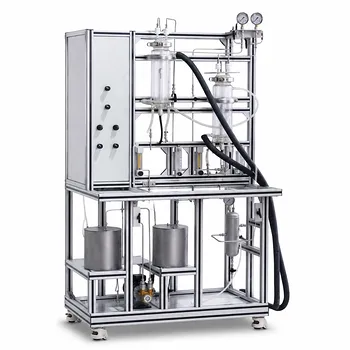
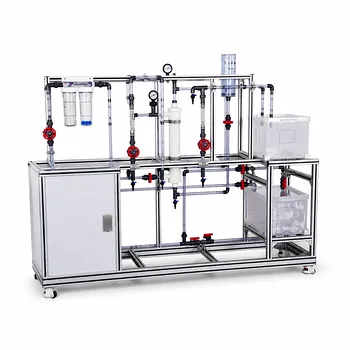
The short answer is essential for a working pilot plant: standard hydrophobic PTFE membranes physically repel liquid water, preventing the aqueous waste stream from even entering the pores. Without a wetted membrane, there is no liquid flow—and no filtration experiment. Only a hydrophilically modified PTFE membrane, where the surface chemistry has been permanently altered to attract water, allows the aqueous feed to spontaneously soak in and pass through, making educational demonstrations of membrane filtration possible.
Understanding why “normal” PTFE won’t work reveals a core lesson in membrane science: filtration is not just about pore size, but about the fundamental interaction between the fluid and the membrane surface. For an aqueous waste treatment pilot plant to turn a pump and a module into a teachable moment, that interaction must be engineered from the start.
The Fundamental Wetting Challenge
Hydrophobic PTFE is chemically inert, thermally stable, and mechanically tough—attributes that make it a superstar in many industrial applications. However, its very nature creates a dead-end for aqueous liquid filtration.
How PTFE’s Hydrophobicity Blocks Water Flow
Standard PTFE membranes exhibit an extremely low surface energy. Water molecules, held together by strong hydrogen bonds, prefer to stick to themselves rather than spread across the PTFE surface.
The result is a high contact angle: water beads up tightly and will not spontaneously penetrate the pores unless an impractically high pressure is applied to overcome the capillary resistance.
The Effect on Pilot Plant Experiments
In a teaching lab, this wetting failure isn’t a minor inconvenience—it’s a complete system shutdown.
Students would see only a dry membrane and zero permeate flow, with no way to observe flux decline, rejection rates, or fouling behavior. The core objective of the pilot plant—demonstrating how a membrane removes contaminants from liquid waste—becomes impossible.
Hydrophilic Modification: Turning a Barrier into a Filter
The solution is not to replace PTFE altogether, but to re-engineer its surface so that it welcomes water. A hydrophilically modified membrane retains most of PTFE’s chemical robustness while gaining the one property it critically lacks: water-wettability.
The Chemistry Behind the Switch
During the membrane fabrication process, PTFE is blended with hydrophilic agents before the structure is locked in. A common approach mixes the PTFE resin with silica nanoparticles and a surfactant during paste extrusion.
Subsequent chemical treatments—for instance, heating with organosilane compounds in a solvent—covalently anchor the silica to the PTFE matrix, creating a stable, permanently hydrophilic network within the membrane. This modification changes the surface from water-repelling to water-attracting without significantly sacrificing chemical resistance.
Ensuring Reliable Aqueous Filtration
Once modified, the membrane’s pores activate immediately upon contact with water.
The aqueous waste stream spontaneously wicks into the pores, establishing a continuous liquid phase through the membrane. From that point, normal crossflow or dead-end filtration can proceed, allowing students to study pressure-driven separation, membrane fouling, and permeate quality in a realistic manner.
What Educational Goals Demand Hydrophilic Membranes
The choice between hydrophobic and hydrophilic PTFE connects directly to what you are trying to teach. An educational pilot plant is not a black-box production unit; it is a platform for observation and understanding.
Teaching Liquid-Phase Separation Principles
When the curriculum centers on aqueous waste treatment, the membrane must consistently produce a permeate stream under practical pressures.
Hydrophilic PTFE allows users to visualize flow dynamics, measure flux, and analyze rejection—transforming abstract theory into hands-on experience. A hydrophobic membrane would instead mislead students, suggesting that the technology simply “doesn’t work” for water-based streams.
Contrasting with Vapor-Phase Applications
Standard hydrophobic PTFE remains valuable for specific educational scenarios, such as membrane distillation or gas separation demonstrations, where water vapor transport is desired and liquid penetration must be prevented.
However, for liquid aqueous waste filtration, that same property becomes a flaw. Understanding this distinction is itself a powerful learning outcome about surface chemistry in membrane selection.
Understanding the Trade-offs
While the necessity of hydrophilic modification is clear, an honest technical assessment must acknowledge that no modification is without consequence.
Potential Alterations in Pore Structure
Incorporating silica nanoparticles and surfactants during the membrane formation can slightly alter the pore size distribution or overall porosity.
In a carefully controlled pilot plant, this might mean the final membrane’s nominal pore rating doesn’t exactly match an unmodified PTFE equivalent. Educators should validate membrane characteristics before designing experiments around cut-off expectations.
Long-Term Stability and Surfactant Leaching
If the surfactant is not fully immobilized, a small amount could leach into the permeate during initial runs, affecting water quality analyses.
Additionally, repeated aggressive chemical cleanings might degrade the hydrophilic coating over extended use. For educational purposes, these are manageable risks—rinsing protocols and periodic membrane replacement can maintain experiment integrity without undermining the learning goals.
Making the Right Membrane Choice for Your Teaching Lab
The membrane you select should align with the pilot plant’s educational mission. Use the following guidelines to match your goal with the correct configuration.
- If your primary focus is hands-on aqueous waste filtration: Use a silica-and-surfactant-modified hydrophilic PTFE membrane. This is the only reliable way to achieve spontaneous wetting and stable liquid flux, giving students a functional system to explore pressure, concentration, and fouling effects.
- If your primary focus is membrane material science or surface modification: Include both unmodified hydrophobic and hydrophilically modified PTFE membranes in the curriculum. Run side-by-side experiments to demonstrate how surface chemistry alone dictates device operability, even when pore size remains similar.
- If your primary focus is long-term pilot plant durability with aggressive chemicals: Validate the specific modification against your expected chemical environment. While modified PTFE retains excellent resistance, always conduct a short-term leachate and integrity test to ensure educational data are not compromised by initial surfactant release.
When teaching aqueous filtration, the membrane’s surface chemistry is not a minor detail—it is the difference between a device that functions and one that refuses to cooperate.
Summary Table:
| Feature | Standard Hydrophobic PTFE | Hydrophilically Modified PTFE |
|---|---|---|
| Water Interaction | Repels water (high contact angle) | Attracts water (spontaneous wetting) |
| Permeate Flow | Zero flow for aqueous liquids | Continuous, stable liquid flow |
| Primary Education Use | Gas separation & distillation | Aqueous waste treatment & filtration |
Equip Your Lab with the Right Filtration Technology
Choosing the correct membrane chemistry is vital for successful hands-on learning. LABPARK provides premium Educational and Vocational Unit Operations Pilot Plants in chemical engineering, bioprocess & biotech, and environmental & water treatment designed specifically for universities, research institutes, and enterprises.
Avoid configuration mistakes and ensure your students get accurate, real-world data. Contact LABPARK today to customize your pilot plant setup and boost your lab's educational impact!
Related Products
- Photocatalytic Membrane Separation and Degradation Unit Operations Pilot Plant
- Hollow Fiber Ultrafiltration Membrane Separation Educational Pilot Plant
People Also Ask
- What are the key differences in membrane configurations? Choose the Right Unit Operations Pilot Plant
- How Do Pervaporation, Vapor, and Gas Permeation Differ in Pilot Plants? Key Comparison
- What are the structural & performance trade-offs of flat-sheet, spiral-wound, & hollow-fiber membrane modules?
- How do PEI, PVDF, and PSU membranes compare in pilot plants? Find the best fit.
- Pervaporation vs. Vapor Permeation: Handling Suspended Solids in Membrane Pilot Plants