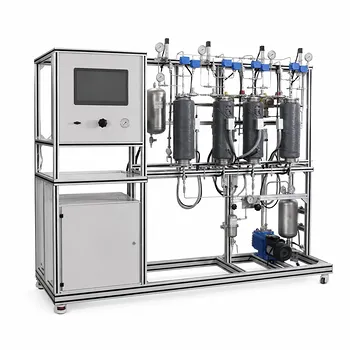
The fundamental choice between batch and continuous drying pilot plants in chemical engineering education hinges on what you want your students to learn. A batch tray dryer is the perfect tool for teaching drying kinetics and analyzing rate curves with small, diverse materials. A continuous dryer—like a fluid bed or rotary system—brings industrial reality into the lab, demonstrating steady-state efficiency, uniform product quality, and the control loops that run modern manufacturing.
The core decision is pedagogical, not just technical. Choose batch to build a deep, hands-on understanding of drying fundamentals, cycle‑by‑cycle behavior, and material flexibility. Choose continuous to teach the high‑capacity, thermally efficient processes and real‑time automation that define industrial drying. Your curriculum should dictate the equipment, not the other way around.
Aligning the Pilot Plant with Educational Objectives
Your dryer is a teaching instrument. Its operating mode must serve the specific concepts you want to reinforce, from basic thermodynamics to advanced process control.
Teaching Drying Kinetics with Batch Tray Dryers
Batch tray dryers excel at revealing the time‑dependent nature of moisture removal. Because the material stays put while air flows over it, students can easily weigh samples at intervals and construct classic drying rate curves.
This intimate control over a single cycle makes it simple to demonstrate the constant‑rate period, the falling‑rate period, and the critical moisture content. With no incoming or outgoing streams to manage, learners focus purely on temperature, humidity, and time—the building blocks of every drying process.
The batch mode’s flexibility also allows you to run multiple small test materials in rapid succession. A single dryer can handle pharmaceutical granules, food particles, or mineral samples with minimal cleanup, making it invaluable for survey courses that emphasize hands‑on experimentation.
Demonstrating Industrial Efficiency with Continuous Dryers
Continuous fluid bed and rotary dryers bring the factory floor into the laboratory. Here, wet material enters at one end and dried product exits at the other, maintaining a steady state that mirrors large‑scale production.
This setup lets students explore thermal efficiency metrics—energy consumption per kilogram of evaporated water—and see how counter‑current airflow or multi‑zone heating profiles affect performance. Uniform product quality becomes a tangible concept when they sample from the outlet over hours of operation.
Crucially, continuous dryers introduce process control loops that simply don’t exist in batch units. Trainees can tune feed rates, adjust inlet air temperature, and interact with PID controllers to stabilize the final moisture content, developing skills that translate directly to industry.
Bridging Both Worlds with Modular Pilot Plants
The best chemical engineering programs often incorporate both modes, not as isolated islands but as complementary learning stages. A modular design—one that can be reconfigured or scaled—allows students to start with batch kinetics and then advance to continuous operation.
Such a system might use a common air‑handling unit and interchangeable drying chambers. This demonstrates in a single afternoon how the same thermodynamic principles govern both batch and continuous drying, while highlighting the dramatically different operating philosophies.
Understanding the Trade-offs
No single drying mode is universally superior. The choice involves real compromises in flexibility, capital, and operational complexity that you must weigh against your training goals.
Flexibility and Multi-product Capability
Batch tray dryers are inherently versatile workhorses. Their open trays accept pastes, granules, or delicate materials that would clog the distribution plates or screw feeders of a continuous dryer. This makes them ideal for teaching specialty chemicals, food science, or bioprocessing where product variety is high.
Continuous dryers, by contrast, are optimized for a narrow range of materials. Changing products often requires substantial disassembly or a different internal configuration, limiting the number of different experiments you can run without extensive downtime.
Capital Investment and Operating Scale
At pilot scale, a batch tray dryer is typically simpler and less expensive to build, install, and maintain. It needs no precision feeders, rotary valves, or complex discharge mechanisms, freeing budget for data acquisition systems or other pedagogical tools.
A continuous dryer carries a higher upfront cost but demonstrates true industrial throughput. If your curriculum emphasizes scale‑up, mass balances, and the economics of 24/7 operation, this investment aligns directly with the learning outcomes.
Process Control and Data Acquisition
Batch operation is manual and observation‑intensive—perfect for foundational teaching but limited in control complexity. Students weigh trays by hand, record temperatures manually, and see the results of a single set of conditions.
Continuous dryers natively integrate with modern automation platforms. Temperature sensors, belt speed controllers, and humidity transmitters feed a central SCADA system, allowing students to analyze steady‑state data, calculate residence time distributions, and design feedback loops that maintain product quality.
Sanitation and Cleanability
In drying labs that handle food or bioproducts, easy sanitation is non‑negotiable. Batch tray dryers have fewer internal crevices and can be fully disassembled for washdown, a critical advantage when teaching good manufacturing practices (GMP).
Continuous dryers, especially those with perforated distributor plates or screw conveyors, are harder to clean and sterilize thoroughly. They may be less suitable for courses that frequently switch between biological and chemical materials.
Making the Right Choice for Your Drying Curriculum
Your decision should flow directly from what you want your students to carry with them into their careers. Here’s how to map goals to equipment.
- If your primary focus is teaching core drying fundamentals and kinetics: A batch tray dryer will give your students the clearest, most hands‑on experience with moisture‑content‑over‑time curves and the critical moisture point, with minimal setup complexity.
- If your primary focus is demonstrating industrial drying operations and process control: A continuous fluid bed or rotary dryer is essential for showing steady‑state efficiency, uniform product quality, and the real‑time control loops that define modern manufacturing.
- If your program needs maximum flexibility across many materials and small batches: Stick with batch tray dryers—they handle the widest variety of feedstocks and allow rapid changeovers between experiments without extensive re‑engineering.
- If you want to provide a complete, end‑to‑end educational experience: Invest in a modular system that can operate in both modes, or acquire separate batch and continuous units. Students will then be able to compare the two paradigms directly, learning not just how each works but why the industry chooses one over the other.
The best drying pilot plant is the one that exactly matches your educational narrative—empower your students with the mode that makes the principles they need most visible and measurable.
Summary Table:
| Feature | Batch Drying (Tray Dryer) | Continuous Drying (Fluid Bed/Rotary) |
|---|---|---|
| Primary Focus | Drying kinetics & rate curves | Industrial steady-state & efficiency |
| Material Flexibility | High (handles pastes, granules, foods) | Low (optimized for specific feedstocks) |
| Process Control | Simple, manual observations | Advanced automation (PID, SCADA, loops) |
| Cleanability | Easy disassembly & sanitation | Complex cleaning (conveyors, plates) |
| Capital Cost | Lower initial investment | Higher upfront cost |
Build the Ultimate Unit Operations Lab with LABPARK
Selecting the right drying mode is critical to aligning your laboratory with modern educational standards and industrial realities. LABPARK provides state-of-the-art Educational and Vocational Unit Operations Pilot Plants in chemical engineering, bioprocess & biotech, and environmental & water treatment.
We help universities, research institutes, and enterprises worldwide design, configure, and install custom pilot plants tailored to their specific curricula and research goals.
Ready to elevate your engineering department? Contact LABPARK today to discuss your project requirements!
Related Products
- Multi-Functional Drying Educational Unit Operations Pilot Plant
- Multi-Reactor Educational Pilot Plant for Reaction Engineering Unit Operations
- Solid Waste Pyrolysis and Refining Educational Pilot Plant for Unit Operations
- Multi-Modal Distillation Unit Operations Training Pilot Plant
- Fixed-Bed Chemical Reaction and Gas Dust Tar Removal Unit Operations Pilot Plant
People Also Ask
- Vacuum vs. Atmospheric Drying: How to Choose the Right Pilot Plant Configuration for Your Lab
- How do seasonal changes affect drying pilot plant blower requirements? Key sizing tips.
- Why is dry-basis moisture content preferred over wet-basis? Simplify your drying pilot plant balances.
- How can unit operations pilot plants demonstrate simultaneous removal of light and heavy impurities? Configure a modular setup
- How do deviations in estimating latent heat impact pilot plant thermal systems? Avoid hardware mis-sizing.