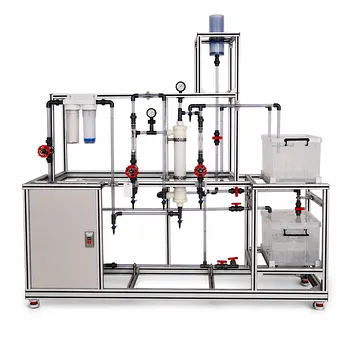
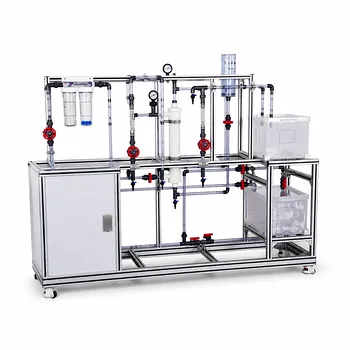
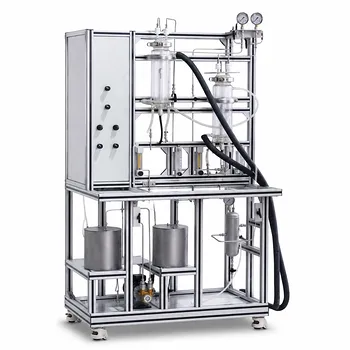
The defining characteristics to highlight in pilot plant nanofiltration (NF) experiments are its unique selective separation window and charge-based rejection profile. You must demonstrate the membrane’s ability to reject organic compounds with a molecular weight between 200–400 Da while simultaneously achieving a 90–98% rejection for divalent anions like magnesium sulfate, contrasted with a much lower 20–80% rejection for monovalent anions like sodium chloride. These experiments bridge the gap between textbook theory and industrial reality by visualizing partial demineralization and organic-inorganic sorting in real time.
A successful pilot plant experiment doesn't just display an NF membrane's ability to filter; it demonstrates its ability to choose. The core insight is validating the selective rejection of divalent ions over monovalent ions and establishing the real-world flux and fouling behavior under variable pressure, which is the critical path to sizing industrial systems accurately.
Defining the Separation Spectrum
The unique value of NF lies in its position between dense reverse osmosis (RO) and open ultrafiltration (UF). Your pilot experiments must clearly visualize this "separation gap" to justify process selection over competing technologies.
Highlighting the Molecular Weight Cutoff (MWCO)
The primary separation indicator is the molecular weight cutoff (MWCO), where NF membranes effectively reject uncharged organic solutes. Your pilot plant should target the standard industrial range of 200–400 Da, though modern lab-scale tests can extend to 100 Da. By introducing a feed containing a known marker like glucose (180 Da) or sucrose (342 Da), you can visually confirm this rejection boundary.
A tight NF membrane (150-300 Da) will retain these sugars at rates exceeding 90%. This isn't just about pore size; it validates the membrane's ability to concentrate valuable pharmaceutical products or remove organic pollutants before they become a downstream problem.
Demonstrating Charge-Dependent Salt Rejection
This is the star characteristic of NF and the most critical result to capture in pilot plant logs. Unlike passive sieving, NF membranes actively repel ions based on their charge. You must run a comparative test using magnesium sulfate (MgSO₄) as a divalent salt and sodium chloride (NaCl) as a monovalent salt.
Under standard operating parameters (roughly 3.5 to 16 bar), you should document high divalent rejection of 90–98% for magnesium sulfate. Conversely, the rejection of sodium chloride should collapse to the 20–80% range. This demonstrable leakiness toward monovalent salts while tightly retaining multivalent hardness ions defines the industrial value of water softening and Total Dissolved Solids (TDS) reduction.
Critical Pilot Plant Performance Metrics
Beyond separation specifications, a pilot plant exists to verify operational feasibility. You must highlight the real-world engineering factors that determine capital and operational expenditure before a full-scale investment is authorized.
Verifying Real-World Permeate Flux
A datasheet MWCO is useless without correlating the throughput in liters per square meter per hour (LMH) with pressure. Your experiments must map the relationship between transmembrane pressure (TMP) and flux, noting the point of diminishing returns. You should highlight the stark difference in flux between membrane types. A highly hydrophilic membrane with a low contact angle (e.g., 25°) can deliver nearly double the pure water flux (roughly 120 L/m²h) compared to a more hydrophobic version (65 L/m²h) at the same 6 bar pressure. This translates directly to smaller pump sizes and reduced energy consumption for the industrial user.
Analyzing Fouling Propensity and Mitigation
The deep need of any pilot trial is to predict the cleaning frequency, as membrane fouling is the silent killer of operational efficiency. Highlight the decay of flux over time under constant pressure when processing real wastewater or bioprocess media.
You must go further by testing the membrane's tolerance to aggressive chemical clean-in-place (CIP) regimes. Select membranes that can tolerate a wide pH range (2–11) for your trials. This allows you to demonstrate harsh cleaning cycles to students or investors, proving that permeability can be restored even after heavy organic fouling.
Mapping the Energy-Pressure Profile
NF operates in a "sweet spot" of pressure between 3.5 and 16 bar, significantly lower than the often 15-bar-plus environment of reverse osmosis. Your pilot plant data should highlight comparative energy consumption curves. By manipulating the feed pump speed, you can visually map how selective rejection of divalent ions is achieved at a lower driving pressure. This proves that for partial desalination or water softening, NF offers a lower operational cost than forcing water through the denser structure of an RO membrane where pores approach 0.0001 microns.
Understanding the Material Chemistry Trade-offs
Your experiments must address the critical failure points of polymeric membranes. The chemistry of the membrane, not just its pore size, dictates success.
Solvent Stability and Swelling
In biprocess or advanced wastewater applications involving aggressive carriers, your pilot protocols must test for degradation. Standard polymeric membranes, like crosslinked polyacrylonitrile (PAN), offer stable performance in harsh solvents like acetone, toluene, or tetrahydrofuran (THF). You should highlight the need to match the membrane's hydrophilicity with the solvent matrix to prevent structural swelling. Documenting zero loss of selectivity in a solvent stream validates the system for novel solvent-resistant nanofiltration (SRNF) research.
The Trade-off Between Purity and Throughput
You must explicitly demonstrate a fundamental inverse relationship in your experimental results. A tighter membrane (lower MWCO) increases the rejection of small organics but chokes the throughput. Your pilot plant should prove that a 150-300 Da membrane might deliver 94% retention, while a slightly looser membrane offers lower retention (e.g., 90%) but significantly higher flow. The pilot plant is the arbiter of whether ultra-high purity justifies the lower production volume.
Making the Right Choice for Your Pilot Objectives
The definition of a successful experiment changes based on your ultimate application. You must tailor the highlighted metrics to the specific process goal.
- If your primary focus is Water Softening or TDS Reduction: Focus entirely on the logarithmic difference in rejection between calcium/magnesium ions and sodium chloride, along with the net driving pressure required.
- If your primary focus is Bioprocess Concentration (Pharmaceuticals): Demonstrate the sharp MWCO curve for the target protein or metabolite and validate the Clean-in-Place (CIP) recovery using extreme pH solutions to guarantee product safety and membrane lifespan.
- If your primary focus is Organic Solvent Nanofiltration (OSNR): Quietly disregard aqueous salt rejection. Highlight instead the inertness of the membrane structure, showing zero mass loss or change in the contact angle after continuous exposure to harsh industrial solvents.
A successful NF pilot plant experiment proves not just that a membrane can filter, but that it can reliably differentiate between molecules of similar size based on charge, provide enough volume to be profitable, and survive the aggressive cleaning it takes to stay operational.
Summary Table:
| Parameter | Nanofiltration (NF) Target Metric | Key Experimental Insight |
|---|---|---|
| MWCO (Molecular Weight Cutoff) | 200–400 Da (down to 100 Da) | Validates organic retention (e.g., sugars, micropollutants) |
| Divalent Salt Rejection (MgSO₄) | 90–98% | Demonstrates high retention of multivalent hardness ions |
| Monovalent Salt Rejection (NaCl) | 20–80% | Shows selective leakiness for partial demineralization |
| Operating Pressure Range | 3.5–16 bar | Proves lower energy consumption compared to RO systems |
| CIP Chemical Tolerance | pH 2–11 | Verifies flux recovery after aggressive cleaning cycles |
Ready to elevate your research, teaching, or process scale-up? LABPARK provides premium Educational and Vocational Unit Operations Pilot Plants in chemical engineering, bioprocess & biotech, and environmental & water treatment for universities, research institutes, and enterprises. Our pilot systems are engineered to help you accurately model membrane separation, fouling mitigation, and real-world process dynamics.
Contact LABPARK today to discuss your pilot plant requirements and get a tailored solution for your laboratory!
Related Products
- Multifunctional Membrane Separation Educational Pilot Plant with Ultrafiltration, Nanofiltration, Reverse Osmosis
- Multi-Functional Membrane Separation Educational Pilot Plant for Unit Operations Lab
- Ultrafiltration Membrane Separation Educational Pilot Plant
- Hollow Fiber Ultrafiltration Membrane Separation Educational Pilot Plant
- Photocatalytic Membrane Separation and Degradation Unit Operations Pilot Plant
People Also Ask
- How do PEI, PVDF, and PSU membranes compare in pilot plants? Find the best fit.
- Pervaporation vs. Vapor Permeation: Handling Suspended Solids in Membrane Pilot Plants
- What are the trade-offs of polymer vs inorganic membranes in teaching pilot plants? Key laboratory comparison.
- What are the advantages of membrane separation in pilot plants? Efficient Organic Vapor Recovery
- How can operators optimize operating conditions and cleaning protocols in membrane separation pilot plants to mitigate fouling?