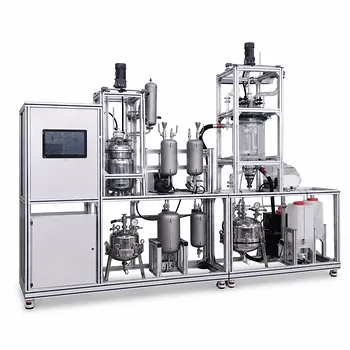
Instructors are not just buying equipment—they are investing in a bridge between theoretical electrochemistry and tangible industrial reality. The most critical parameters to evaluate are material corrosion resistance (PVDF, PP, or high-grade acrylics to withstand hot acidic CuSO₄), a fully adjustable DC power supply to explore the impact of current density, precise temperature control, and built-in instrumentation for real-time measurement of voltage, current, and deposition rates. Without this foundation, a pilot plant becomes a leak hazard and a pedagogical dead end.
The ideal educational pilot plant must simultaneously serve as a safe, durable chemical reactor and a transparent window into electrochemical principles. It balances robust construction against visual accessibility, and precise process control against operational simplicity, ensuring students can both observe the metal deposition process and quantify the variables that govern purity, adhesion, and efficiency.
The Foundation: Material Compatibility and Safety
An educational pilot plant must first survive its own chemistry. Acidic copper sulfate solutions and, in some refinements, nitric acid mixtures, are unforgiving to standard materials.
Selecting Construction Materials for Aggressive Electrolytes
Look explicitly for wetted components made from PVDF, polypropylene (PP), or high-grade cast acrylic. These polymers offer the necessary chemical inertness to prevent cell degradation, contamination of the electrolyte, and dangerous structural failure over repeated use.
Stainless steel or common metals must be entirely avoided in the cell body and plumbing. Even small amounts of iron dissolution can poison the electrolyte, leading to flaky, non-adherent deposits that confuse students and obscure the underlying science.
The Pedagogical Power of Transparency
For a teaching tool, a transparent cell is not a luxury—it is a requirement. Instructors should demand clear, chemically resistant viewing panels that allow direct observation of anode dissolution, dendrite growth, and gas evolution.
Opaque industrial cells hide these crucial micro-events, forcing students to rely on abstraction. A transparent vessel transforms electrolysis from a theoretical exercise into a visually intuitive phenomenon, making concepts like mass transfer and current distribution immediately visible.
Instrumentation and Control: The Heart of Data-Driven Learning
A pilot plant’s educational value collapses without the ability to manipulate variables and measure the outcomes. Select a system built around a scientific, not just operational, interface.
The Adjustable DC Power Supply
The rectifier must allow fine control over both voltage and current (amperage). This is essential for demonstrating the direct relationship between current density and deposit morphology—moving from powdery, loose deposits at low densities, to smooth, adherent plates at the optimal range, and finally to burnt, rough deposits at excessive levels.
Pre-set power bricks are insufficient. The system should permit students to intentionally push parameters into non-ideal regions to observe and diagnose failure modes, a critical skill for both electroplating operators and process engineers.
Precision Temperature Management
Electrode kinetics are exponentially sensitive to temperature. The pilot plant needs an integrated heating element and PID controller capable of maintaining the electrolyte at a setpoint (commonly 50–60°C for copper refining) with minimal fluctuation.
Uncontrolled temperature leads to inconsistent results, making it impossible to isolate the effect of other variables like concentration or current density. Look for direct temperature readout and the ability to log data for later analysis.
Comprehensive Process Monitoring
The minimum viable instrumentation suite must measure cell voltage, total current, and electrolyte temperature in real time. Superior systems will also integrate sensors for mass change (via load cells on the cathode), allowing students to perform live mass balance calculations.
The ability to export voltage, current, and time-series data to a computer enables rigorous calculation of current efficiency and specific energy consumption, moving the lab from qualitative observation to quantitative engineering analysis in line with Faraday’s laws.
Mimicking Industrial Realities for Deeper Insight
A truly powerful educational pilot plant does more than plate metal; it replicates the chemical engineering challenges faced in real refineries.
Anode Slime Collection and Mass Balance
In copper electrorefining, the anode contains noble impurities like silver, gold, and platinum that do not dissolve. The cell must be designed with a dedicated sludge collection zone at the bottom of the tank.
Instructors should be able to recover, dry, and weigh this anode slime. This transforms a simple refining lab into a lesson on economic viability, allowing students to calculate the value of recovered by-products alongside the energy cost of purification.
Demonstrating Faraday’s Laws and Current Efficiency
The pilot plant is a physical calculator for Faraday’s laws. Ensure the setup includes precise coulomb counters (ampere-hour integrators) and a method for accurately weighing the cathode before and after deposition.
By comparing the actual mass of deposited copper to the theoretical mass predicted by Faraday’s law, students can directly calculate the cathode current efficiency. This teaches the critical lesson that side reactions (like hydrogen evolution) and short-circuits steal from the desired product, a fundamental concept in both electrorefining and electroplating.
Understanding the Trade-offs
Objective selection requires acknowledging that no single design excels at everything. Sacrifices are inevitable.
Cost vs. Chemical Resilience
High-purity quartz immersion heaters may offer faster temperature response than coated metal elements, but dramatically increase cost. Similarly, PVDF offers superior chemical resistance to cheaper acrylic but is more opaque and expensive. Balance your budget against the frequency of use and the strength of acids you intend to handle.
Observability vs. Industrial Realism
A fully transparent cell made of acrylic cannot withstand the same mechanical abuse or wide temperature swings as a lined steel vessel. While transparency is vital for education, the geometry (often simplified rectangular cells) may not mimic the complex flow patterns of industrial electrolytic cells. Acknowledge this gap to students, framing the pilot plant as a validated analog, not a perfect miniature.
Control Complexity vs. Student Cognitive Load
A fully automated SCADA system with 20 interlockable variables can overwhelm students who are still grasping the core concepts of ion migration. For foundational courses, prioritize manual control knobs with clear digital readouts over a purely screen-based, programmable logic controller interface. The tactile act of adjusting a voltage dial helps build an intuitive feel for the process.
Making the Right Choice for Your Curriculum
The best pilot plant directly serves your specific learning outcomes, not a generic feature checklist. Weigh your final decision against your program’s primary goal.
- If your primary focus is teaching fundamental electrochemistry: Prioritize a transparent cell with a highly adjustable power supply and integrated mass measurement. Visual observation of deposition and a direct route to Faraday’s law calculations matter more than industrial material grades or automation.
- If your primary focus is simulating industrial copper refining and by-product recovery: Insist on robust PVDF construction, precise temperature control up to 60°C, and a dedicated, easily accessible anode slime collection system. The economic mass balance exercise is your key learning outcome.
- If your primary focus is electroplating quality control on various substrates: Select a system that permits easy interchange of cathode materials and includes agitation or electrolyte circulation control. The ability to evaluate deposit adhesion and uniformity under varied current densities is non-negotiable.
Ultimately, the right pilot plant makes the invisible visible—turning abstract equations into a controlled, measurable, and unforgettable physical event for every student in the lab.
Summary Table:
| Parameter | Key Requirement | Educational Value |
|---|---|---|
| Material Compatibility | PVDF, PP, or transparent acrylic cell bodies; no standard metals | Prevents corrosion, ensures safety, and enables direct visual observation of deposition. |
| Power & Temp Control | Adjustable DC power supply & PID heating (50-60°C) | Demonstrates current density effects, deposit morphology, and electrode kinetics. |
| Instrumentation | Real-time voltage, current, and mass change sensors | Enables quantitative analysis of Faraday's laws and calculation of current efficiency. |
| Industrial Simulation | Dedicated anode slime collection zone | Teaches economic viability and by-product recovery alongside chemical purification. |
Ready to bridge the gap between electrochemical theory and industrial reality? LABPARK provides high-quality Educational and Vocational Unit Operations Pilot Plants in chemical engineering, bioprocess & biotech, and environmental & water treatment. Specially designed for universities, research institutes, and enterprises, our durable and transparent systems maximize student engagement and analytical accuracy. Contact us today to find the perfect pilot plant for your lab!
Related Products
- Electrolyte Distillation Purification and Formulation Educational Pilot Plant
- Gallium and Indium Selective Extraction Educational Pilot Plant
- Carbon Material Thermal Pretreatment Multiphase Separation Educational Pilot Plant
- Multi-Functional Special Distillation Educational Pilot Plant
- Solid Waste Pyrolysis and Refining Educational Pilot Plant for Unit Operations
People Also Ask
- Why does simple distillation yield higher efficiency than flash distillation? Key thermodynamic differences.
- How to Integrate Spectroscopy in Distillation Pilot Plants for Advanced Process Control
- How do batch and continuous distillation pilot plants differ? Master their dynamic behavior
- How does operating pressure influence Methylal/Methanol VLE? Discover its impact on distillation
- Why is the acentric factor important in pilot plants? Fluid property prediction.