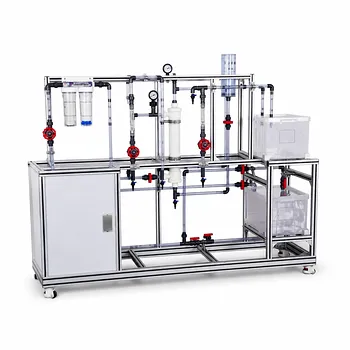
Selecting filtration media for a pilot plant is not a one-size-fits-all decision. The correct answer depends on a systematic analysis of the solid material’s particle size, the slurry’s chemical and physical nature, and the expected behavior of the filter cake. At a minimum, you must evaluate minimum particle size retention, slurry viscosity, feed concentration, chemical corrosiveness, cake compressibility, and whether filter aids are required. These criteria allow you to match media types—from membranes (retaining 0.005 µm) to ceramics (1 µm) up to perforated plates (100 µm)—to the separation task, ensuring reproducible filtration rate, consistent cake resistance, and clear filtrate.
The core challenge is not only meeting a particle size specification but also anticipating how the cake will compress or blind the medium under the pressures used in pilot-scale runs. A proper media selection exercise therefore weaves together fluid properties, solid characteristics, and the operating constraints of the unit operation to deliver scalable, teachable results.
Building a Filter Media Selection Framework
Matching Pore Size to the Solid’s Minimum Dimension
The most direct parameter is the smallest particle the medium must retain. For membranes, retention can go down to 0.005 µm; ceramics typically capture solids in the 1 µm range; woven cloths and sintered metals cover intermediate sizes; while perforated metal plates only stop particles greater than 100 µm.
Perform a particle size distribution analysis of your slurry (via sieve or laser diffraction) and choose a media grade that retains the d50 or d90 of your solids, depending on the required filtrate clarity.
Classifying the Precipitate Character
Quantitative filter paper selection provides a tangible example. Gelatinous, amorphous precipitates like iron hydroxide demand fast-filtering media (white band, 60‑100 s) to prevent pore blockage. Medium precipitates like calcium oxalate suit medium-speed papers (blue band, 100‑160 s). Fine crystalline powders such as barium sulfate require slow-speed paper (red band, 160‑200 s) to avoid leakage.
Applying this principle to pilot-scale cloths or membranes means the media must accommodate the particle structure, not just its diameter.
Key Slurry Properties to Evaluate
Viscosity and Feed Concentration
High slurry viscosity reduces flow through the medium and can increase pressure drop. When combined with a high solids feed concentration, the cake builds rapidly, demanding media with sufficient mechanical strength and permeability.
A concentrated, viscous slurry may favor a coarser woven cloth or a filter aid pre-coat to maintain acceptable flux, even if the target retention is lower.
Chemical and Thermal Aggressiveness
The corrosiveness of the liquid phase (acids, bases, solvents) directly dictates the material of construction. In an educational pilot plant, this teaches students how PTFE, PVDF, or stainless steel screens prevent media degradation.
Chemical compatibility is non-negotiable: using a media that swells, weakens, or leaches contaminants destroys both the experiment and any scaling-up data.
Material Flow and Abrasiveness
Sticky, high-moisture, or highly abrasive solids influence media durability and blinding. Abrasives eat through soft polymer cloths, while stickiness encourages particles to embed in pores permanently.
One must assess bulk density, stickiness, and moisture content to anticipate whether a surface-coating or a smooth metallic medium will better discharge the cake and extend cycle life.
The Critical Role of the Cake
Compressibility and Pressure Drop
Laboratory bench filtration often gives a falsely optimistic flux because thin cakes barely compress. In a pilot plant, higher pressure drops (ΔP) can significantly compress the cake, slashing filtration rates.
The media’s support structure must resist deformation when the cake contracts; otherwise, the compressed cake crushes against the media, rapidly increasing resistance. This is precisely why pilot plant leaf-filter studies teach students to measure flux vs. cake height under realistic ΔP.
Cake Cracking and Channeling
Some wet cakes crack during isolation or washing, creating solvent channels that bypass the cake entirely. While more a cake-handling issue, media surface smoothness and pore pattern can influence whether a cake adheres uniformly and resists cracking.
For crack-prone materials, a finely textured filter cloth or a pre-coat layer can help maintain cake integrity.
Filter Medium Blinding – A Hidden Variable
Over multiple cycles, solid particles lodge permanently within the media pores, gradually increasing medium resistance. Blinding cannot be reliably cured by mechanical agitation or gas blowback in a pilot plant without risking damage; instead, a chemical regeneration step (solvent wash to dissolve in-pore solids) is the standard remedy.
Media selection should therefore consider cleanability: choose pore geometries and materials less prone to irreversible plugging, especially when working with soft or gelatinous solids.
Understanding the Trade‑offs
- Fine pores vs. high flux: The tighter the retention, the lower the flow. Always test whether a slightly coarser medium, combined with a filter aid, gives a more scalable balance.
- Chemical resistance vs. cost and availability: Exotic alloys or high-performance polymers deliver robustness but may be unavailable in the required weave or pore size for a teaching lab.
- Mechanical stability vs. cleanability: A very smooth surface prevents blinding but may lead to poor cake release; textured media can release better but trap fines.
- Generic grade vs. particle-tailored medium: The quantitative filter paper rule (white/blue/red bands) demonstrates that a single “all‑purpose” medium often underperforms compared to a grade matched to the precipitate morphology.
How to Apply This to Your Project
Every pilot-plant filtration exercise should start with a structured media selection workflow based on your specific objectives.
- If your primary focus is educational repeatability: Standardize media grades by minimum particle size retention and chemical compatibility. Have students plot filtrate clarity and cake resistance for different grades on the same slurry to link theory to observation.
- If your primary focus is scaling up a production process: Run leaf-filter tests with the actual slurry at pilot-scale ΔP. Measure flux decay, cake compressibility, and blinding tendency across multiple cycles before fixing a media specification.
- If your primary focus is handling a challenging, sticky, or toxic solid: Prioritize chemical resistance, non-stick surface properties, and containment-compatible media that minimize operator exposure and cleaning downtime.
- If your primary focus is filtrate clarity with an amorphous precipitate: Immediately select a fast-speed (coarser) medium and consider using a filter aid body feed or pre-coat to avoid blinding from gelatinous solids.
By integrating particle size, fluid properties, cake mechanics, and long-term blinding behavior, you turn media selection from guesswork into a rigorous engineering decision—exactly what a well-designed laboratory pilot plant is meant to teach.
Summary Table:
| Selection Parameter | Slurry Characteristic & Impact | Recommended Media Type |
|---|---|---|
| Particle Size | Minimum dimension dictates retention limits | Membranes (0.005µm) to Perforated Plates (>100µm) |
| Precipitate Type | Gelatinous (blinds pores) vs. Crystalline (porous) | Fast-filtering cloths vs. slow-speed papers |
| Chemical Nature | Corrosiveness and thermal aggressiveness | PTFE, PVDF, Stainless Steel, or Ceramics |
| Cake Mechanics | Compressibility, cracking, and blinding potential | Supported media, cleanable geometries, filter aids |
Elevate Your Unit Operations Training with LABPARK
Accurate solid-liquid separation teaching starts with the right equipment. LABPARK provides state-of-the-art Educational and Vocational Unit Operations Pilot Plants in chemical engineering, bioprocess & biotech, and environmental & water treatment. Designed specifically for universities, research institutes, and enterprises, our pilot plants ensure students and researchers gain scalable, hands-on experience with real-world filtration mechanics, cake compressibility, and media selection.
Ready to enhance your laboratory's capabilities? Contact LABPARK today to find the perfect pilot plant solution.
Related Products
- Constant Pressure Filtration Educational Unit Operations Pilot Plant
- Hot Filtration Educational Unit Operations Pilot Plant Laboratory System
- Ultrafiltration Membrane Separation Educational Pilot Plant
- Multifunctional Membrane Separation Educational Pilot Plant with Ultrafiltration, Nanofiltration, Reverse Osmosis
- Multi-Functional Membrane Separation Educational Pilot Plant for Unit Operations Lab
People Also Ask
- How do educational unit operations pilot plants bridge theory and design? Bridge the Engineering Gap
- How do educational unit operations pilot plants bridge theory and industrial process development? Hands-On Learning
- How do educational unit operations pilot plants address safety and waste management when scaling up?
- How do unit operation requirements differ between traditional chemical processes and bioprocesses? Build Better Pilot Plant Curricula
- Why splitting a filtration batch doesn't always reduce cycle time? Pilot Plant Insights