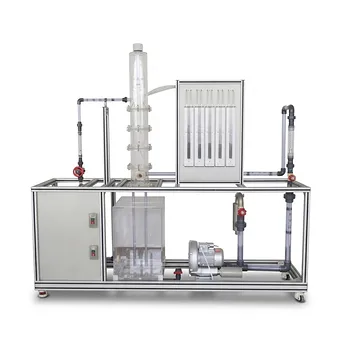
The key to designing a successful bubble column bioreactor lies in predicting fluid behavior under pressure. For a bioprocess pilot plant, the most critical hydrodynamic and physical factors are the superficial gas velocity, the hydrostatic pressure gradient, and the management of axial dispersion. You must select a gas velocity that ensures a stable bubble flow regime, account for the fact that bottom pressure can exceed top pressure by more than 30%, and control backmixing and bubble segregation, as these directly dictate the gas-liquid mass transfer rate and ultimately, the scale-up viability.
Designing a pilot-scale bubble column is fundamentally a battle against fluid dynamics. The central challenge is that the very pressure that enhances mass transfer at the bottom of the reactor also coalesces your bubbles, while the mixing you need to sustain life also destroys the plug-flow efficiency you desire. Success comes from carefully balancing gas velocity and liquid height to control the bubble size distribution.
The Physics of the Fluid: Core Hydrodynamic Factors
The behavior of the gas-liquid mixture is the primary driver of reactor performance. Understanding the interplay between gas input, pressure, and mixing is non-negotiable.
Selecting the Superficial Gas Velocity
The superficial gas velocity ($U_G$) is your primary control variable, and selecting it correctly is the first design decision.
It determines the flow regime. You must target a value that ensures stable bubble flow rather than chaotic churn-turbulent flow. The transition point is critical; in standard bubble columns, operating beyond this limit leads to massive bubble coalescence and a loss of process control.
This velocity directly shapes your energy input. Since these bioreactors lack mechanical agitation, the expanding gas is the sole source of mixing power. Too little velocity, and you get poor mixing and low oxygen transfer. Too much, and you waste gas and risk damaging the culture through shear.
Managing the Hydrostatic Pressure Gradient
In any meaningful pilot column, gravity is a major design parameter. You are not working with a single reactor pressure; you are working with a liquid head.
The pressure at the bottom of the column is substantially higher than at the top. This isn't a minor detail—bottom pressure can easily be more than 30% higher than top pressure. This has direct consequences for bubble dynamics and mass transfer.
This gradient means bubbles compress and decompress as they rise. A bubble's size at the sparger is very different from its size at the liquid surface, affecting the local gas holdup and interfacial area at every axial position.
The Bubble Size Distribution and Axial Dispersion
Not all bubbles are created equal, and this distribution dictates your reactor's efficiency. You must evaluate gas-phase segregation.
Smaller bubbles have a much longer residence time and provide a massive interfacial area per unit volume, making them excellent for mass transfer. Larger bubbles, conversely, shoot through the column, contributing little to oxygen dissolution while driving mixing. The sparger design is your tool to control this population balance.
This bubble size distribution directly causes axial dispersion. The significant liquid backmixing (driven by rising gas) means a bubble column never achieves ideal plug flow. You must model this deviation, as it directly impacts reaction conversion and makes scale-up prediction from small lab units non-linear.
The Unseen Force: Physical Properties and Their Impact
The physical nature of your broth, often overlooked in theoretical models, can easily derail a pilot-plant operation.
The Viscosity Problem
Microbial cultures are not water. As a fermentation progresses, the liquid viscosity ($\mu_L$) and apparent viscosity ($\mu_a$) of non-Newtonian broths can skyrocket.
Increased viscosity is a mass transfer killer. It promotes violent bubble coalescence. This chain reaction rapidly destroys your gas holdup, decimates the interfacial area, and causes the volumetric mass transfer coefficient ($k_La$) to plummet. If you don't account for end-of-batch viscosity, your cells will suffocate.
Thermal Reflections in the Axial Model
In a pilot setting, you are not just teaching mass transfer. The energy balance is intrinsically linked to the fluid dynamics.
When using an axial dispersion model to simulate the reactor, the effective axial thermal conductivity ($E_T$) can be assumed proportional to the mass diffusivity ($E_l$). This is reliable in bubble columns because the same turbulent mixing circulates both fluid and heat. This linkage allows you to accurately model heat exchange with jackets and the heat of reaction using the same mixing parameters.
Understanding the Trade-offs: The Bubble Column Dilemma
Every advantage of a bubble column comes with an inherent limitation. A responsible evaluation requires acknowledging these blind spots.
The Bubble Size Dilemma
This is the classic trade-off. Small bubbles are ideal for mass transfer due to their high surface-to-volume ratio but rise slowly, creating high gas holdup and severe backmixing. Large bubbles are great for inducing liquid circulation and stripping away byproducts but have poor mass transfer efficiency. You cannot optimize for both simultaneously with a simple column; your sparger design must be a compromise.
The Plug Flow Illusion vs. Airlift Control
While a tall bubble column promises closer-to-plug-flow behavior, the reality of axial dispersion reduces this benefit. In an airlift reactor, the structured circulation path gives you far more control over residence time and mixing. However, that control comes at a cost.
In an airlift loop, the transition from bubble to churn-turbulent flow happens at a much higher superficial gas velocity. This means you can pump in more energy while staying in a stable regime. The trade-off is mechanical complexity. A bubble column is remarkably simple and costs about one-third of a stirred tank, making it ideal for applications where ultimate performance is secondary to reliability and low contamination risk.
Uniformity vs. Shear
Bubble columns generate an extremely gentle, low-shear environment. This is perfect for fragile mammalian cells but poor for keeping heavy solids suspended. If your process involves dense pellets or particles, you will struggle to ensure a uniform solid particle concentration without moving to a higher gas velocity that introduces damaging shear. This often marks the boundary where a bubble column becomes unsuitable and an airlift or stirred system becomes necessary.
Making the Right Choice for Your Pilot Plant Goal
In a bioprocess pilot plant, your equipment choice must align with your experimental pain points. Use these guidelines to match the technology to the task.
- If your primary focus is teaching fundamental gas-liquid mass transfer: A simple bubble column is unmatched. It forces students to engage directly with the axial dispersion model and sparger dynamics, exposing the raw relationships between $U_G$, hydrostatic pressure, and $k_La$ without the complexity of moving parts.
- If your primary focus is culturing high-viscosity or non-Newtonian organisms: You must prioritize advanced gas distribution or shift to a loop reactor. Expect a catastrophic loss of gas holdup in a standard column and prepare to use forced circulation to maintain oxygen transfer.
- If your primary focus is achieving precise fluid residence time and minimizing backmixing: An airlift bioreactor is the better tool. The structured cyclic flow, driven by the density difference between the riser and downcomer, directly counters the chaotic axial dispersion that plagues simple bubble columns.
- If your primary focus is operational safety and mechanical design under pressure: You must treat the vessel as a pressure vessel. Even if the process is low-pressure, the liquid head combined with operating temperature requires a strict engineering analysis of wall thickness, head type, and nozzle orientation to ensure safety.
Ultimately, the bubble column is not a simple piece of pipe; it is a finely balanced thermodynamic and hydrodynamic system where the gas and liquid are in a constant, reciprocal negotiation. Mastering its design isn't about following a rule of thumb—it's about understanding how pressure shapes bubbles, and how those bubbles, in turn, dictate life.
Summary Table:
| Factor | Key Impact on Operation | Design & Scale-up Consideration |
|---|---|---|
| Superficial Gas Velocity ($U_G$) | Dictates flow regime, energy input, and mixing power. | Target stable bubble flow; avoid transition to churn-turbulent flow. |
| Hydrostatic Pressure Gradient | Causes bubble compression/decompression; bottom pressure can be >30% higher. | Account for varying local gas holdup and interfacial area along the column height. |
| Axial Dispersion | Induces liquid backmixing, deviating from ideal plug flow. | Model backmixing to predict reaction conversion and avoid scale-up errors. |
| Broth Viscosity ($\mu_L$) | Promotes bubble coalescence, reducing $k_La$ and gas holdup. | Plan for end-of-batch viscosity spikes in non-Newtonian cultures. |
Elevate Your Bioprocess Education and Research with LABPARK
Are you looking to bridge the gap between bioprocess theory and pilot-scale reality? LABPARK provides state-of-the-art Educational and Vocational Unit Operations Pilot Plants in chemical engineering, bioprocess & biotech, and environmental & water treatment.
Designed specifically for universities, research institutes, and enterprises, our systems enable students and researchers to master fluid dynamics, mass transfer, and reactor scaling hands-on.
Ready to equip your laboratory with industry-grade pilot plants? Contact LABPARK today to discuss your project requirements!
Related Products
- Plate Column Hydrodynamics Tray Demonstration Educational Pilot Plant
- Absorption and Desorption Educational Unit Operations Pilot Plant
People Also Ask
- How to update chemometric calibration models in pilot plants? Best practices for process engineers.
- Why Correct Sig Figs & Rounding Matter in Educational Pilot Plants: Ensure Data Accuracy
- How can educational pilot plants be used to teach process safety and risk assessment in chemical engineering curricula?
- How does nuclear yield inefficiency translate to chemical engineering education? Optimize kinetics with pilot plants.
- Why Calculate Sieve Tray Pressure Drop? Optimize Distillation Pilot Plant Performance