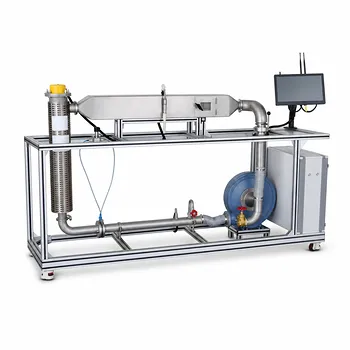
For a chemical engineering pilot plant, the single most critical factor in selecting drying equipment is the feed material’s physical state and thermal sensitivity. Liquid or pumpable slurry feeds demand direct atomization or thin-film contact—spray, drum, or flash dryers. Free-flowing granular solids thrive in fluid beds or rotary drums that provide gentle, continuous tumbling. And heat-sensitive solids require vacuum-capable batch equipment like tray or jacketed rotary dryers to drive off moisture without degrading the product. This immediate mapping of feed condition to dryer archetype eliminates guesswork and ensures the pilot rig mirrors realistic, scalable unit operations.
The feed’s physical form—liquid, slurry, solid granule, paste, or fragile crystal—dictates the three engineering pillars of dryer selection: transport mechanism, heat transfer method, and residence time. A mismatched dryer will either fail to handle the material, ruin its properties, or waste enormous amounts of energy. The art is matching the material’s intrinsic character to the dryer’s operational logic.
How Feed State Determines Your Dryer Family
Every drying technology is built around a specific way of moving and heating the material. The feed’s starting condition immediately rules out entire classes of equipment, which simplifies the decision process.
Liquids, Slurries, and Pumpable Suspensions
If the material arrives as a freely pumpable liquid or suspension (e.g., yeast broths, resins, or milk), thermal drying must first create a large surface area. Spray drying atomises the feed into fine droplets that dry in seconds, making it ideal for large-scale, continuous production of powders. For small batches, drum drying spreads a thin film over heated rotating cylinders, offering simple, economical concentration. Flash (pneumatic) dryers can also accept pumpable suspensions when mixed with recycled dry product to form a moist granular feed that is conveyed and dried in a hot airstream.
Free-Flowing Granular Solids
Crystalline or granular solids that pour easily are best processed where the particles are suspended or continuously lifted. Fluidized bed dryers blast hot gas through a bed of particles, creating a violently turbulent, liquid-like state that delivers exceptionally high heat transfer rates and short drying times. They shine for particles between approximately 0.5 mm and 3 mm. Rotary dryers, on the other hand, use a gently inclined, rotating cylinder to cascade solids through a hot gas stream. They are robust, high-throughput workhorses for continuous processing of free-flowing materials, though they produce some fines and dust.
Problematic Forms: Pastes, Filter Cakes, and Fragile Particles
Paste-like or filter-cake materials (e.g., pigments, starches) do not flow freely and are highly cohesive. Large-scale operations often use belt dryers that spread a thin layer of the wet mass and convey it through drying zones, while small batches are best handled in a vacuum rotary drum dryer that breaks the cake under low shear and dries it under reduced pressure. For shear-sensitive crystals—such as needle-like structures that break easily—static tray dryers or tumble dryers exert minimal mechanical force, preserving the crystal size distribution and bulk density.
Critical Material Properties That Drive the Final Choice
Beyond the broad physical state, a handful of detailed characteristics make or break a drying operation at pilot scale.
Particle Size and Distribution
Each dryer type has an effective particle size window. Fluidized beds handle particles from about 0.03 mm to 6 mm; below 20 µm, gas channelling destroys fluidization, and above 8 mm the air velocity needed becomes impractical. Flash dryers prefer fine, free-flowing granules, as the short residence time (0.5–5 seconds) prevents overheating but gives no time to dry large agglomerates. Rotary dryers, in contrast, are more forgiving of size variation but can suffer from non-uniform residence times.
Thermal Sensitivity
Materials that degrade at elevated temperatures demand low-temperature drying under vacuum. Vacuum tray dryers and vacuum jacketed rotary dryers keep the boiling point low while conductive heat transfer removes moisture without exposing the product to hot gas streams. In atmospheric operations, flash dryers also protect heat-sensitive feeds because the product temperature rarely exceeds the wet-bulb temperature during the fleeting co-current contact.
Physical Fragility and Attrition
Fragile, friable solids lose their value if broken. Tumble dryers and tray dryers apply minimal shear, making them the go-to choices for needle-like crystals or delicate aggregates. In contrast, flash dryers cause intense particle–wall collisions and friction, rapidly degrading fragile materials, and even fluidized beds can cause moderate attrition over long cycles.
Chemical Hazards and Operator Safety
The feed’s toxicity or potency reshapes selection entirely. Closed, agitated conical dryers or filter dryers contain hazardous dust, minimize operator exposure, and use internal agitation to boost heat transfer, slashing cycle time. If the feed is corrosive, the pilot plant must be built from compatible materials—stainless steel (304 or 316) becomes non-negotiable to prevent leaks and ensure long-term integrity.
Understanding the Trade-offs and Limitations
No single dryer is universally ideal. The selection must weigh operational realities that often escape textbook explanations.
Energy Intensity and Pre-treatment Logic
Thermal drying is orders of magnitude more energy-hungry than mechanical dewatering. In a well-designed pilot plant, pre-treatment units like hydrocyclones or press filters concentrate the slurry before it enters the dryer, dramatically cutting steam or electricity demand. Ignoring this step leads to a pilot rig that is both costly to run and unrepresentative of industrial good practice.
Batch versus Continuous: A Scale-Dependent Decision
At pilot or educational scale, batch tray dryers are invaluable for demonstrating drying kinetics and generating drying curves. They handle small, high-value charges and are simple to operate. But they teach nothing about continuous material handling. Conversely, continuous fluid beds or rotary dryers reveal residence time distributions and steady-state control but obscure the fundamental drying rate curves, making batch units indispensable for an instructional lab that aims to expose students to both modes.
Material Wear and Maintenance
Rotary dryers produce dust and fines, requiring downstream dust collection. Flash dryers demand tall installations and have high system pressure drops. Fluidized beds can suffer from fines entrainment and internal baffle erosion. These practical drawbacks do not rule out a dryer type, but they must be factored into the pilot plant’s safety, footprint, and operational cost.
Making the Right Choice for Your Pilot Plant Goal
With the feed material characteristics understood, align your selection with the specific learning or research objective.
- If your primary focus is demonstrating drying kinetics and moisture removal curves: Choose a batch tray dryer for small quantities of paste, wet cake, or granules, and incorporate data logging to let students trace the falling-rate period.
- If your primary focus is high-throughput, continuous processing of free-flowing solids: Select a rotary dryer or a fluidized bed dryer—the rotary for robustness with non-uniform particles, the fluidized bed for intense heat transfer and short drying times.
- If your primary focus is handling heat-sensitive fine powders or hazardous materials: Use a vacuum rotary drum dryer for small filter cakes, or a closed conical (filter) dryer for toxic solids, and ensure the system can operate under controlled vacuum and temperature.
- If your primary focus is bridging the gap from lab to full-scale atomization processes: A spray drying pilot plant with adjustable atomizers and co-current air flow will be the most direct scale-down of industrial liquid drying.
Your feed material’s physical form, sensitivity, and hazard profile write the spec sheet. Pick the dryer that respects those constraints, and the pilot plant will deliver both reliable data and teachable engineering principles.
Summary Table:
| Feed Material State & Characteristics | Recommended Dryer Type | Key Advantages for Pilot Plants |
|---|---|---|
| Liquids, Slurries & Suspensions | Spray, Drum, or Flash Dryers | High surface area generation, rapid continuous drying |
| Free-Flowing Granular Solids | Fluidized Bed, Rotary Dryers | Excellent heat transfer, uniform gas-solid contact |
| Pastes & Sticky Filter Cakes | Belt, Vacuum Rotary Dryers | Handles cohesive feeds, reduces moisture under low shear |
| Heat-Sensitive & Fragile Solids | Vacuum Tray, Conical Dryers | Low-temperature boiling, minimizes thermal & physical degradation |
Optimize Your Unit Operations Lab with LABPARK
Building a high-performance chemical engineering laboratory requires equipment that accurately mirrors industrial processes. LABPARK provides state-of-the-art Educational and Vocational Unit Operations Pilot Plants in chemical engineering, bioprocess & biotech, and environmental & water treatment. Designed specifically for universities, research institutes, and enterprises, our pilot plants ensure safe, scalable, and reliable hands-on learning and research.
Ready to elevate your training and research capabilities? Contact us today to discuss your custom pilot plant requirements!
Related Products
- Multi-Functional Drying Educational Unit Operations Pilot Plant
- Circulating Wind Tunnel Drying and Convective Heat Transfer Coefficient Determination Educational Pilot Plant
- Green Anhydrous Ethanol Refining Practical Training Pilot Plant
- Multi-Modal Distillation Unit Operations Training Pilot Plant
- Multi-Functional Special Distillation Educational Pilot Plant
People Also Ask
- Vacuum vs. Atmospheric Drying: How to Choose the Right Pilot Plant Configuration for Your Lab
- Why is dry-basis moisture content preferred over wet-basis? Simplify your drying pilot plant balances.
- How do seasonal changes affect drying pilot plant blower requirements? Key sizing tips.
- Why Use PTFE & Hastelloy in Chemical Pilot Plants? Prevent Corrosion & Ensure Safety
- Why are particle density, bulk density & voidage critical in pilot plants? Master Bed Fluid Dynamics