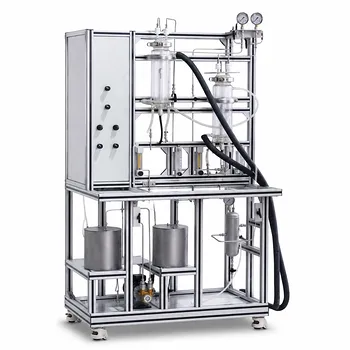
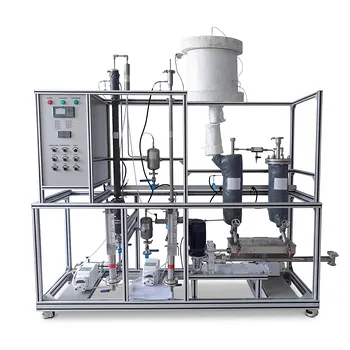
The defining characteristic of an oxygen transport membrane reactor is its function as a dynamic, smart filter that doesn't just purify air but immediately uses the resulting oxygen in a chemical reaction. This is the core working principle: a dense, non-porous ceramic material, typically a perovskite, selectively conducts oxygen ions from an air stream to a hydrocarbon fuel like natural gas and steam on its other side. At high temperatures, this transported oxygen instantly reacts with the fuel in the presence of a catalyst, directly producing syngas in a single, intensified unit.
The primary benefit for advanced pilot plants is the collapse of two massive unit operations—air separation and syngas generation—into one. This teaches a new paradigm of process intensification, demonstrating how to eliminate capital equipment, shrink operational footprints, and model efficiency gains that exceed 30% compared to traditional methods.
How Oxygen Membrane Reforming Works
This isn't simple filtration. The membrane material and its operating conditions create a unique reactive environment.
The Ion Transport Mechanism
The process begins with a multicomponent metallic oxide ceramic structure. One side of this membrane is exposed to air, the other to a hydrocarbon feedstock.
At a critical high temperature, generally well above 800 K, the membrane becomes a conductor for oxygen ions (O2-). Oxygen molecules on the air side dissociate and are absorbed into the ceramic lattice.
A driving force, either a pressure differential or an electrical potential, then pushes these ions through the membrane bulk via defects in the crystal structure. This is a purely selective transport, blocking all nitrogen and other gases from the air stream.
The Reactive Membrane Surface
The transported oxygen ions reach the opposite side of the membrane. Here, the other face of the ceramic acts as both a structural barrier and a catalytic reactor bed.
The oxygen immediately reacts with the adsorbed hydrocarbon fuel, like methane, and steam. This direct chemical conversion on the membrane surface produces synthesis gas, a mixture of carbon monoxide (CO) and two parts hydrogen (2H2).
This is a partial oxidation process that inherently prevents the formation of nitrogen oxides (NOx) because the oxidant is pure oxygen from the source, not air.
The Transformative Benefits for Pilot Plants
Integrating an oxygen membrane reactor into a learning environment fundamentally elevates the educational and research value beyond that of a standard unit operations setup.
A Platform for Teaching Process Intensification
The most profound benefit is its perfect embodiment of process intensification principles. In a traditional flowsheet, an air separation unit (ASU) is an enormous, separate expenditure of energy and capital.
This technology eliminates the need for an external ASU entirely. By combining oxygen separation, steam reforming, and partial oxidation into a single unit, the pilot plant physically demonstrates how to slash capital costs and reduce the number of equipment pieces.
Training students on this system prepares them for modern industrial trends. The goal is to design facilities with a minimized physical footprint, higher systemic efficiency, and a direct alignment with green chemistry principles.
Unlocking Advanced Experimental and Analytical Capabilities
A pilot-scale oxygen membrane reactor is a powerful research tool. It turns abstract scientific principles into tangible, measurable data.
Students can systematically measure the oxygen flux across the metallic oxide membrane, observing how it increases exponentially with temperature. This transforms a complex solid-state physics concept into a direct engineering variable.
Furthermore, the system allows for the granular evaluation of reaction kinetics. Researchers can deconstruct how the reforming reaction behaves when it occurs directly on a membrane surface, rather than in a bulk catalyst bed. This bridges the critical gap between classical reactor design and modern membrane catalysis.
Understanding the Trade-offs and Challenges
While revolutionary, this technology is not without its demanding operational requirements and material constraints that must be part of any pilot plant curriculum.
Strict High-Temperature Dependency
The oxygen flux is a steep function of temperature. For any meaningful production of syngas, the membrane module must be maintained above 800 K.
This creates a substantial heating duty and places enormous thermal stress on seals, housings, and the membrane material itself. A pilot plant must therefore include robust thermal management systems, making a startup and shutdown a non-trivial analytical procedure.
Material and Engineering Hurdles
The membrane material is a critical point of study and failure. Perovskite ceramics must be engineered to survive severe chemical environments: an oxidizing atmosphere on one side and a highly reducing syngas mixture on the other.
Long-term material stability against steam and CO2 in the permeate side is an active area of research. A pilot plant designed to test these mechanisms must include sophisticated analytical tools to monitor for phase decomposition or microstructural cracking, making the unit as much a test-rig for materials science as for chemical engineering.
Making the Right Choice for Your Educational Goal
Deploying an oxygen membrane reforming pilot plant is a strategic decision for a department. Its value depends entirely on the specific learning objectives you prioritize.
- If your primary focus is teaching process intensification and sustainable design: This technology is unparalleled. It provides a single, visual case study for eliminating legacy ASU infrastructure, shrinking plant footprints, and modeling a future of low-emission chemical manufacturing.
- If your primary focus is advanced materials and reaction engineering research: This is an ideal platform. It allows for the precise characterization of oxygen flux rates and the unique kinetics of surface-limited reactions, offering a deep dive into solid-state ionic conductivity.
- If your primary focus is basic unit operations with low operational complexity: This may not be the starting point. The strict high-temperature requirements and complex material behavior demand skilled operators and introduce a cost premium that is less suitable for purely demonstrative, low-intensity training.
The thermal management and material stability challenges are not just obstacles to production; they are precisely the advanced problems that define the frontier of industrial chemistry, making this pilot plant a genuine bridge to the next generation of engineering.
Summary Table:
| Feature | Details |
|---|---|
| Core Principle | Dense ceramic membrane selectively conducts $O^{2-}$ ions at >800 K to produce syngas. |
| Key Benefit | Process intensification (eliminates external ASU, combining separation and reaction). |
| Major Challenges | Strict high-temperature requirements (>800 K) and membrane material durability. |
| Ideal Application | Advanced academic research and hands-on teaching of green chemical engineering. |
Bring Next-Generation Process Intensification to Your Lab
Ready to elevate your engineering curriculum and research? LABPARK provides state-of-the-art Educational and Vocational Unit Operations Pilot Plants in chemical engineering, bioprocess & biotech, and environmental & water treatment. We help universities, research institutes, and enterprises worldwide implement advanced technologies like membrane reactors with robust, safety-engineered training systems.
Contact LABPARK today to discuss your laboratory requirements and get a customized solution!
Related Products
- Photocatalytic Membrane Separation and Degradation Unit Operations Pilot Plant
- Multifunctional Membrane Separation Educational Pilot Plant with Ultrafiltration, Nanofiltration, Reverse Osmosis
- Multi-Functional Membrane Separation Educational Pilot Plant for Unit Operations Lab
- Steam Methane Reforming Hydrogen Production and Purification Educational Pilot Plant
People Also Ask
- How does feed pH affect RO rejection of organic acids? Optimize your pilot plant separation.
- How do PEI, PVDF, and PSU membranes compare in pilot plants? Find the best fit.
- What are the advantages of membrane separation pilot plants? Energy-saving process intensification.
- Why is membrane fouling a critical focus area? De-risk your bioprocess and food-grade scale-up success.
- How do filtration levels (MF, UF, NF, RO) differ? Membrane Pilot Plant Guide