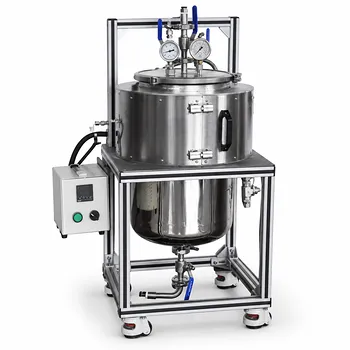
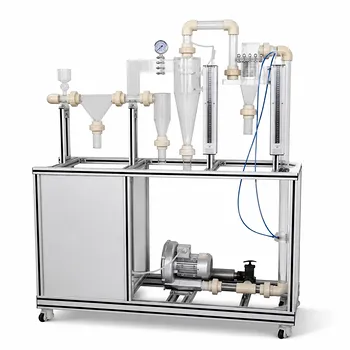
The educational and practical significance is that pilot plant experiments transform an abstract textbook equation into an intuitive, physical understanding of why industrial filtrations fail or succeed, directly teaching the future engineer how to diagnose, predict, and fix a stalled production line.
The core of this learning experience is not just operating equipment; it is internalizing the non-linear relationship between pressure, cake structure, and flow resistance. Without seeing a compressible cake collapse under excessive pressure in a pilot-scale leaf filter, a student cannot develop the engineering judgment required to select the right pressure profile, size the filter correctly, or use a filter aid as a strategic solution rather than a simple powder.
The central pitfall in filtration scale-up is the assumption that behavior is linear. A bench-scale vacuum funnel may show fast, easy filtering, but in a 10-foot industrial press, the same slurry can form a compressed, impermeable skin that brings production to a halt. Studying compressibility and filter aids in a pilot plant bridges this gap, teaching quantitative measurement of the phenomenon and the practical art of mitigating it before the design is locked in.
The Scale-Up Trap: Why Bench-Scale Results Fail
The most dangerous filtration data comes from a simple lab funnel. The supplementary references state that bench-scale flux can be up to 10 times faster than what is seen at scale.
This discrepancy is not a minor error—it is a fundamentally different physics regime. The thin cake heights and low pressure drops of a bench test rarely trigger the compaction mechanisms that dominate industrial equipment.
The Non-Linear Effect of Pressure on Compressible Cakes
For an incompressible material, increasing the pressure drop (ΔP) is the simplest way to increase flow rate. The rigid particles maintain constant voidage, so flow is proportional to pressure.
Compressible cakes behave counter-intuitively. As pressure increases, the soft, colloidal particles deform and collapse into the void spaces. This drastically increases specific cake resistance.
A student must learn this not from a graph in a book, but by watching the filtrate flow rate plateau—or even decrease—as they increase pressure on a pilot unit. This visceral experience creates an indelible lesson: more pressure can mean less productivity.
How Pilot Plants Decode Compressibility
The pilot plant provides the controlled environment needed to move from a qualitative observation of a "slimy" cake to a quantitative engineering parameter.
The Compressibility Index (s): A Measurable Property
The primary reference highlights that filter cakes have a compressibility index ($s$). This is not an arbitrary number; it is derived from experimental data.
By performing constant-pressure runs at multiple ΔP values and calculating the filtration constant $K$ for each, students plot $\lg(K)$ versus $\lg(\Delta P)$. The slope of this line is $(1-s)$, directly yielding the compressibility index.
This lab exercise teaches that a material like diatomaceous earth ($s \approx 0.01$) is forgiving and predictable, while aluminum hydroxide ($s \approx 0.9$) is a process nightmare that will require special handling. Running both in a pilot plant cements the vast operational gulf between them.
Translating Resistance into Industrial Time and Cost
Measuring specific cake resistance alpha ($\alpha$) is not an academic exercise. The supplementary references provide a practical scale for prediction.
- An $\alpha$ value of $10^7 – 10^8$ m/kg signals a fast, easy filtration.
- An $\alpha$ value $>10^{10}$ m/kg signals a process that will be extremely slow and potentially uneconomical without intervention.
A student who calculates a specific cake resistance of $5 \times 10^9$ m/kg for their product understands immediately that they are facing a slow filtration and must budget for a larger filter area or a pretreatment step. This data-driven decision-making is the ultimate educational goal.
The Strategic Solution: Filter Aids as a Process Variable
The primary reference defines filter aids as a direct countermeasure to compressibility. The educational significance is learning to deploy them not as a recipe, but as a unit operation design choice.
The Body-Feed vs. Pre-Coat Decision
In a pilot plant, a student can experiment with two methods of filter aid application. They can add body-feed directly to the slurry, using the rigid, porous particles to physically separate the compressible solids and keep the cake open.
Alternatively, they can use a pre-coat, laying down a protective layer of filter aid on the medium first. This prevents blinding at the cloth and provides a coarse, high-permeability foundation.
Building an Incompressible Skeleton
The practical lesson is that a filter aid functions as a structural skeleton. For a compressible cake like a metal oxide, the goal is not just to trap solids.
The goal is to engineer a new, composite cake that combines the capture efficiency of the product with the incompressible, high-permeability properties of the filter aid. The pilot plant shows that success is measured by a stable flux rate over time, not just initial clarity.
Understanding the Trade-offs of Filter Aid Use
A definitive technical advisor must address the downsides. Filter aids are powerful, but they are not free of complications.
Contamination and Product Purity
The most critical trade-off is that a filter aid intimately mixes with the solid product. For a waste treatment slurry, this is irrelevant. For a high-value, pure active pharmaceutical ingredient, this is a catastrophic contamination unless the filter aid can be separated downstream or is a sacrificial part of the process.
Added Solids Handling and Cost
Using a filter aid increases the total mass of solids to be processed. The body-feed ratio, often by weight, represents an added raw material cost and a larger volume of cake for disposal. The pilot plant experiment teaches this through a simple mass balance demonstration.
The Risk of Over-Reliance
If a process is fundamentally flawed—producing extremely fine, highly compressible particles—filter aid is treating a symptom. The deeper solution may be an upstream particle engineering change, such as modifying the crystallization step to grow larger, more rigid crystals. The pilot plant provides the baseline data to justify such a costly process change to management.
Making the Right Choice for Your Process
The ultimate practical significance of these pilot plant experiments is building a structured, analytical framework for filtration design. The choice of operating strategy must be dictated by the measured properties of the slurry.
- If your primary goal is pure, rigid product (low $s$, low $\alpha$): Your focus should be on optimizing capacity, using higher pressure drops to maximize throughput without fear of cake collapse.
- If your primary goal is a soft, compressible product (high $s$, high $\alpha$): Your strategy must shift from maximizing pressure to limiting pressure drop, and you should immediately begin trials with body-feed filter aids to build a permeable cake structure.
- If your primary goal is to protect a valuable filter medium from blinding: Your pilot work should focus on pre-coat techniques to ensure the primary filter cloth is shielded by a disposable layer of filter aid.
- If your primary goal is to eliminate the problem at its source: You should use the pilot plant data to benchmark the current slurry and then collaborate with upstream colleagues to modify the crystallization or reaction conditions to create larger, harder, less compressible particles.
The engineer who can walk into a plant, measure a filtration curve, diagnose the compressibility problem, and prescribe the correct fix—whether a pressure limit, a pre-coat, or a complete particle redesign—is the one who has internalized these pilot plant lessons, moving beyond theory into genuine, actionable expertise.
Summary Table:
| Filtration Concept | Key Parameter / Application | Practical Significance in Pilot Plants |
|---|---|---|
| Incompressible Cake | Low compressibility index ($s \approx 0.01$) | Flow increases linearly with pressure drop; highly predictable scale-up. |
| Compressible Cake | High compressibility index ($s \approx 0.9$) | High pressure collapses void spaces, severely restricting filtrate flow. |
| Specific Resistance ($\alpha$) | Critical threshold: $> 10^{10}$ m/kg | Predicts slow, uneconomical operations; indicates need for pretreatment. |
| Body-Feed Filter Aid | Mixed directly into the slurry | Builds a rigid, porous physical skeleton to keep cake structure open. |
| Pre-Coat Filter Aid | Deposited on medium before filtration | Shields the filter cloth from blinding and ensures initial filtrate clarity. |
Bridge the Gap Between Theory and Practice with LABPARK
To truly master complex chemical engineering concepts like cake compressibility, specific resistance, and filter aid optimization, hands-on experience is irreplaceable.
LABPARK provides state-of-the-art Educational and Vocational Unit Operations Pilot Plants in chemical engineering, bioprocess & biotech, and environmental & water treatment. Designed specifically for universities, research institutes, and enterprises, our training systems empower students and researchers to transition seamlessly from textbook theory to industrial application.
Equip your laboratory with the tools to train the next generation of engineers. Contact LABPARK today to discuss your pilot plant requirements!
Related Products
- Constant Pressure Filtration Educational Unit Operations Pilot Plant
- Hot Filtration Educational Unit Operations Pilot Plant Laboratory System
- Gas-Solid Heterogeneous Separation Demonstration Educational Unit Operations Pilot Plant
People Also Ask
- How do educational unit operations pilot plants bridge theory and design? Bridge the Engineering Gap
- How do educational unit operations pilot plants address safety and waste management when scaling up?
- Why splitting a filtration batch doesn't always reduce cycle time? Pilot Plant Insights
- Why Demo Constant-Rate to Constant-Pressure Filtration on a Pilot Plant? Key Practical Insights
- How can researchers identify and resolve filter medium blinding? Optimize Your Pilot Plant Runs