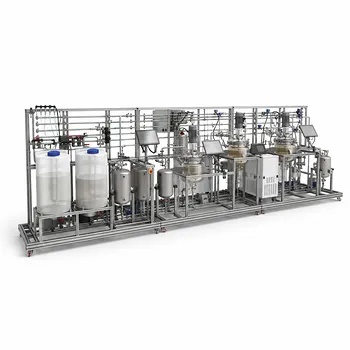
The heart of a fuel-grade bioethanol pilot plant is a two‑stage purification train.
You need a multi‑stage distillation system to concentrate the fermented broth to the ethanol‑water azeotrope (∼96 wt%), followed by a dehydration unit—either molecular sieve adsorption or pervaporation—to break that azeotrope and deliver anhydrous, 99.9 wt% fuel ethanol.
The core challenge is thermodynamic: simple distillation cannot cross the minimum‑boiling azeotrope. A teaching pilot plant must therefore demonstrate both the power and the limits of fractional distillation, then introduce an advanced separation technology that exploits physical adsorption or selective permeation to achieve fuel‑grade purity. The plant becomes a living lesson in phase equilibria, mass transfer, and process integration.
Why Simple Distillation Isn’t Enough
The Fundamental Azeotropic Barrier
Normal distillation enriches ethanol until the vapour and liquid reach identical composition at approximately 96 wt% (at 1 atm).
No additional distillation stages can push the purity higher because the boiling‑point curve stalls at this azeotrope.
Students must experience this ceiling firsthand to appreciate why industrial bioethanol plants never rely on distillation alone.
More Than Just Water: Impurity Management
Real fermentation broth is a complex mixture.
In addition to water, you must remove light ends (e.g., acetaldehyde), fusel oils (higher alcohols), and organic acids that attack fuel quality.
A pilot plant that only boils ethanol‑water misses a critical teaching moment: the role of side‑draws and dedicated columns for impurity removal.
The Backbone: Multi‑Stage Distillation
Stripping and Rectification: The Beer Column Sequence
The first downstream operation after fermentation is often referred to as a beer column train.
A stripper column initially separates ethanol and volatiles from non‑volatile solids and yeast, while a rectifying column further enriches the alcohol stream.
By decoupling stripping and rectification, the pilot plant mirrors industrial practice and lets students study energy integration, tray efficiency, and the management of stillage.
Fusel Oil and Light Ends Draw‑Offs
Fusel oils can be removed from the rectifying column at intermediate trays where their concentration peaks.
Light ends are vented from the top or condensed in a separate pasteurisation section.
Including these side‑draws teaches process control and demonstrates how purity specifications for fuel ethanol (e.g., ASTM D4806) are met stepwise, not just by binary distillation.
Overcoming the Azeotrope: Dehydration Technologies
Molecular Sieve Adsorption (Pressure Swing)
This is the modern workhorse of fuel‑ethanol drying.
Zeolite molecular sieves with precise pore sizes (∼3 Å) physically trap water molecules while excluding larger ethanol molecules.
A pilot‑scale pressure swing adsorption (PSA) system—typically two or three columns cycling between adsorption and regeneration—lets students explore adsorption isotherms, breakthrough curves, and the economic trade‑offs between purge gas usage and product recovery.
Membrane Pervaporation
A compact alternative, pervaporation uses a selective membrane to separate water vapour from liquid ethanol.
The driving force is a pressure differential, often enhanced by a vacuum on the permeate side.
Pilot‑scale pervaporation units demonstrate the power of solution‑diffusion transport and help students compare energy consumption with thermal‑driven adsorption processes.
(Optional) Azeotropic Distillation with an Entrainer
Historically, an entrainer like benzene was added to form a ternary azeotrope that distills at a lower temperature, leaving pure ethanol as the bottom product.
Though still found in some educational labs for its classic thermodynamic elegance, its use raises serious health and environmental concerns.
Including an entrainer‑based column can teach unique phase equilibrium concepts, but only if the pilot plant can safely handle hazardous solvents and the subsequent solvent recovery train.
Supplemental Unit Operations for a Realistic Bioprocess
Yeast Cell Separation and Recycle
Continuous bioethanol production demands that yeast be recovered to maintain high cell density and avoid product inhibition.
A hydrocyclone or disc‑stack centrifuge after the fermenter concentrates the yeast cells for return to the bioreactor.
Integrating this solid‑liquid separation step transforms the pilot plant into a true continuous‑loop system, linking biological kinetics with downstream unit operations.
Feed Pre‑Clarification and Sterile Filtration
While not strictly necessary for distillation, a filter press or microfiltration skid before the beer column reduces fouling in heat exchangers.
This front‑end unit teaches the principle of protecting downstream hardware and can be swapped in to study alternative feedstocks like cellulosic hydrolysates.
Understanding the Trade‑offs
- Safety vs. Pedagogical Breadth: Azeotropic distillation with an entrainer (e.g., benzene) offers a rich case study in ternary phase diagrams, but demands explosion‑proof equipment and rigorous vapour containment. Modern molecular sieve or pervaporation systems are inherently safer and align with industry’s move away from hazardous solvents.
- Realism vs. Simplicity: A full beer‑stripper‑rectifier‑dehydration train with fusel‑oil draws is industrially faithful, yet complex. A simplified single distillation column feeding a dehydration unit can still illustrate the core azeotrope challenge if time and space are limited.
- Cost of Dehydration: Molecular sieves require thermal energy for regeneration; pervaporation units may incur membrane replacement and vacuum costs. A teaching plant should expose students to these operational expenditures, tying separation technology choice to overall process economics.
- Single‑Product Focus vs. Flexible Platform: A pilot plant dedicated to bioethanol will excel at teaching combustion‑grade fuel production. If the educational mission also covers pharmaceutical or organic acid purification, consider modular units (chromatography, evaporation) that can be reconfigured, accepting that the ethanol‑specific dehydration train may become just one of several workflows.
How to Design the Pilot Plant for Your Educational Goal
- If your primary focus is teaching modern industrial bioethanol production: Install a beer column set (stripper + rectifier with side‑draws) directly downstream of a yeast recycle loop, then a pressure‑swing molecular sieve dehydration unit. This configuration mirrors today’s fuel‑ethanol plants.
- If your primary focus is deep thermodynamic understanding: Include a small azeotropic distillation column with a model entrainer like cyclohexane, along with molecular sieves, so students can directly compare three different ways to break an azeotrope—while maintaining stringent safety protocols.
- If your primary focus is process integration and continuous operation: Add a centrifuge for yeast recycle, heat integration between the distillation columns, and online near‑infrared probes for real‑time ethanol concentration monitoring. This turns the plant into a true bio‑refinery simulation.
- If your primary focus is flexibility for multiple bioproducts: Build the ethanol train as a modular skid that can be swapped out for extraction, evaporation, and chromatography modules. This allows the same plant to teach purification of organic acids, enzymes, or antibiotics after the ethanol unit is demonstrated.
A bioprocess pilot plant that tackles the distillation‑dehydration sequence not only teaches how to make fuel‑grade ethanol—it embeds the principles of phase equilibrium, mass transfer, and process safety that every bioprocess engineer must master.
Summary Table:
| Downstream Unit Operation | Key Technology | Primary Educational & Process Function |
|---|---|---|
| Multi-Stage Distillation | Stripper, rectifier & side-draws | Concentrates bioethanol to the ~96 wt% azeotrope and removes fusel oils/impurities. |
| Dehydration Unit | Molecular sieve adsorption (PSA) or Pervaporation | Breaks the water-ethanol azeotrope to achieve >99.9 wt% fuel-grade anhydrous ethanol. |
| Yeast Separation | Disc-stack centrifuge or Hydrocyclone | Recovers and recycles yeast cells to maintain high cell density in continuous fermentation. |
| Pre-Clarification | Filter press or Microfiltration | Removes solids and particulates to prevent fouling in downstream heat exchangers and columns. |
Bring Industrial-Scale Learning to Your Lab with LABPARK
Looking to equip your students or research team with hands-on experience in bioethanol purification? LABPARK designs and manufactures high-performance Educational and Vocational Unit Operations Pilot Plants in chemical engineering, bioprocess & biotech, and environmental & water treatment.
Whether you represent a university, research institute, or enterprise, our modular pilot plants simulate real industrial challenges—from fractional distillation to molecular sieve adsorption—ensuring your graduates and researchers master critical process technologies.
Contact LABPARK today to customize your bioprocess pilot plant and elevate your training programs!
Related Products
- Bio-fermentation Ethanol Production Practical Training Unit Operations Pilot Plant
- Natural Product Extraction Unit Operations Training Pilot Plant
- Continuous Batch Extractive Distillation Educational Pilot Plant
- Electrolyte Distillation Purification and Formulation Educational Pilot Plant
- High-Gravity Emulsification and Mass Transfer Educational Pilot Plant
People Also Ask
- Why Use PTFE & Hastelloy in Chemical Pilot Plants? Prevent Corrosion & Ensure Safety
- Why Compare Predicted and Experimental Excess Enthalpy? Key to Accurate Pilot Plant Scale-up
- Why is the chemical plant startup schedule crucial? De-risk scale-up with pilot plants.
- When to transition from PID to adaptive control in pilot plants? Key process indicators.
- Why must batch and fed-batch fermentation pilot plants be designed to accommodate changing rheological conditions?