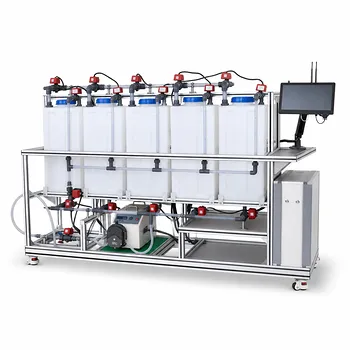
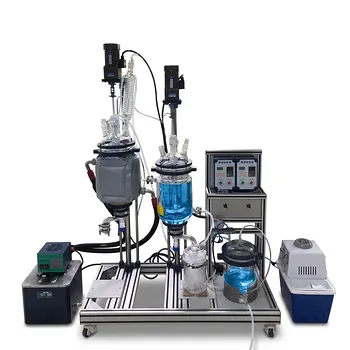
Flow arrangement is the single most critical design factor for demonstrating electrodialysis on a pilot plant—it governs separation speed, energy efficiency, and the physical safety of expensive membranes. A successive (series) flow pattern desalinates rapidly but risks tearing the membranes, while a purely parallel approach is gentle yet slow. The engineering sweet spot for pilot-scale demonstrations is a parallel flow distribution within each stack combined with a counterflow sequence between stacks, a configuration that balances high current efficiency with safe pressure differentials. Mastering this hydraulic design is essential for any chemical engineering unit operations lab aiming to teach industrial realism without damaging equipment.
Demonstrating electrodialysis on a pilot plant demands a flow arrangement that prevents destructive pressure imbalances across membranes. A parallel flow within a single stack equalizes pressure, protecting membranes from deformation or tearing. Pairing this with counterflow between stacks boosts current efficiency and reduces diffusion losses. This combined strategy is the de facto standard for educational and research pilots because it optimizes energy consumption while ensuring long-term equipment reliability.
Why Flow Arrangement is the Heart of an ED Pilot Demonstration
The Hidden Danger of Pressure Differentials
Each membrane stack contains alternating dilute and concentrate chambers separated by thin ion-exchange membranes. When adjacent chambers experience unequal inlet pressures, the membrane deflects.
A cumulative pressure drop across multiple chambers—common in series flow—can cause deformation or catastrophic tearing. A torn membrane ruins the demonstration, cross-contaminates streams, and may release explosive gases like hydrogen.
Performance vs. Protection: The Central Trade-off
Desalting speed is driven by the electric field and concentration gradients. You could increase flow velocity to enhance mass transfer, but that raises the pressure drop across the stack.
The pilot plant must demonstrate both separation performance and safe operation. A flow arrangement that maximizes speed but destroys membranes has no educational value. The goal is to find the configuration that respects both.
Decoding the Three Basic Flow Architectures
Successive (Series) Flow: Fast but Destructive
In series flow, the feed passes from one chamber to the next in sequence. This creates a high residence time per path and increases the desalting rate, as the solution sees a longer effective treatment length.
However, the pressure drop sums across each chamber. The first chamber sees near-inlet pressure while the last operates at a much lower pressure, creating significant pressure differences from chamber to chamber that can deform or tear membranes. This high-risk mode is rarely suitable for educational pilots.
Counterflow: Efficient but Pressure-Intensive
Counterflow—where concentrate and dilute streams flow in opposite directions—reduces diffusion transport of ions back across the membrane, directly increasing current efficiency. It also helps maintain a more uniform concentration driving force.
Yet this advantage comes with a cost: counterflow inherently introduces high pressure differentials between the two streams, particularly at the stack inlets and outlets. Without precise hydraulic balancing, these differentials can strain membranes and complicate control.
Parallel Flow: Safe but Needs a Boost
Feeding each cell in parallel divides the total flow evenly, giving all chambers the same inlet pressure. This equalization is the best protection against pressure-induced membrane damage.
The downside is that each chamber sees only a single-pass residence time, limiting the degree of desalting per pass. That’s why parallel flow within a stack is rarely used alone for deep demineralization. Instead, it’s combined with a counterflow sequence between multiple stacks to multiply the separation effect safely.
How Flow Arrangement Governs Limiting Current and Fouling
The Flow-Velocity Link to $i_{lim}$
The limiting current density ($i_{lim}$) follows the empirical relationship $i_{lim} = A v^n$, where $n$ is typically 1/3 to 1/2. Higher flow velocity thins the diffusion boundary layer near the membrane, allowing you to push more current before concentration polarization occurs.
Flow arrangement dictates the velocity profile in each cell. A parallel arrangement maintains uniform flow and thus a consistent $i_{lim}$ across all chambers. A series arrangement may cause velocity drops in downstream cells, triggering localized polarization, water-splitting, and scaling.
The Counterflow Advantage for Mass Transfer
By keeping a maximum concentration difference along the entire membrane length, counterflow between stacks suppresses back-diffusion. More of the applied current goes to ion removal rather than fighting a dissipating gradient.
In a demonstration, this teaches a key engineering principle: you can improve current efficiency and reduce energy consumption not by changing the membrane, but by intelligently arranging the flows. This is a powerful lesson for students tackling real-world process design.
Understanding the Trade-offs
Pressure Drop vs. Membrane Life
Series and counterflow arrangements increase the risk of destructive pressure differentials. In a teaching lab, a torn membrane halts the experiment and requires expensive replacements. Safety margins and equipment longevity must outweigh a few percent increase in desalting speed. The primary lesson becomes hydraulic integrity, not raw performance.
Pumping Energy vs. Separation Energy
A parallel-within-stack arrangement minimizes the pressure drop through the stack, lowering pumping power. Adding counterflow between stacks raises the overall system pressure drop slightly but boosts current efficiency—often by enough to offset the pump energy increase. This crossover is a perfect demonstration of industrial process optimization, where electrical costs and pumping costs must be balanced.
Operational Complexity vs. Educational Depth
A simple series stack is easy to plumb, but fragile and unsafe. A multi-stack system with internal parallel flow and external counterflow is more complex to start up and control. Yet that complexity is precisely what teaches students about cascade design, instrumentation, and real-world hydraulic balancing. The educational payoff is far greater.
Making the Right Choice for Your Pilot Demonstration
The optimal flow configuration depends on your primary educational or research objective. Align your design with your goal:
- If your primary focus is a quick, single-period demonstration of desalting: Use a series flow stack only with careful pressure monitoring and oversized safety margins. Accept the risk of occasional membrane replacement and emphasize that this is not an industrial best practice.
- If your primary focus is long-term reliability and teaching industrial standards: Implement the recommended combination—parallel flow within stacks and counterflow between stacks. This protects membranes, reduces downtime, and models how commercial plants operate.
- If your primary focus is energy optimization studies: Leverage the combined configuration and systematically vary flow velocities to reveal the trade-off between pumping energy and electrical energy, reinforced by the $i_{lim}$ relationship.
- If your primary focus is fouling resistance and wastewater recovery demonstrations: Use the parallel-within-stack, counterflow-between-stacks design and incorporate electrodialysis reversal (EDR) cycles. This provides stable, long-running experiments that mimic real industrial conditions.
By centering your pilot-plant demonstration on a parallel-within-stack, counterflow-between-stacks flow arrangement, you create a robust, teachable platform where smart hydraulic design visibly protects capital equipment and maximizes separation efficiency.
Summary Table:
| Flow Arrangement | Key Advantage | Membrane Risk | Best For |
|---|---|---|---|
| Series (Successive) | High desalting rate per pass | High (pressure cumulative) | Short demonstrations (high risk) |
| Counterflow | Low back-diffusion; high current efficiency | High (pressure differentials) | Advanced efficiency studies |
| Parallel | Equalized pressure; safest for membranes | Low (but low desalting per pass) | Basic safety & low pressure drop |
| Recommended Combo | Balances high efficiency with safety | Low (uniform pressure in stacks) | Industrial-realism teaching labs |
Elevate Your Chemical Engineering Lab with LABPARK
Are you looking to demonstrate complex unit operations like electrodialysis with industrial-grade realism and absolute equipment safety?
LABPARK provides state-of-the-art Educational and Vocational Unit Operations Pilot Plants in chemical engineering, bioprocess & biotech, and environmental & water treatment. Designed specifically for universities, research institutes, and enterprises, our pilot plants feature optimized flow architectures, robust safety controls, and modular designs that protect your capital investments while maximizing learning outcomes.
Contact LABPARK today to discuss your laboratory requirements and get a customized solution for your department!
Related Products
- Electrolytic Hydrogen Production Educational Unit Operations Pilot Plant
- Electrolyte Distillation Purification and Formulation Educational Pilot Plant
- Water Electrolysis Hydrogen Production and Storage Educational Pilot Plant
- Alkaline Membrane Water Electrolysis Educational Pilot Plant Unit Operations Training System
- Electrochemical Water Treatment Educational Unit Operations Pilot Plant
People Also Ask
- In educational chemical engineering pilot plants, why use absorption and adsorption before reforming?
- How do chemical engineering unit operations pilot plants demonstrate catalytic high-purity hydrogen production from methane?
- SMR, POX, or ATR? Trade-offs in Hydrogen Production Educational Pilot Plants
- How do educational unit operations pilot plants address safety and waste management when scaling up?
- How do educational unit operations pilot plants bridge theory and industrial process development? Hands-On Learning