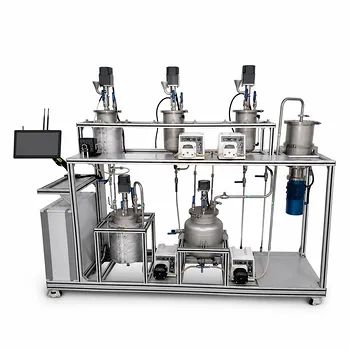
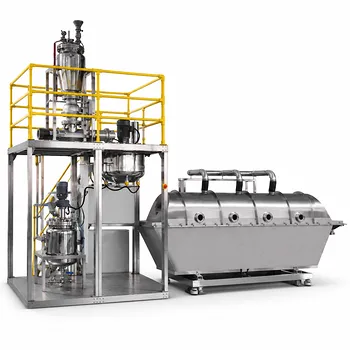
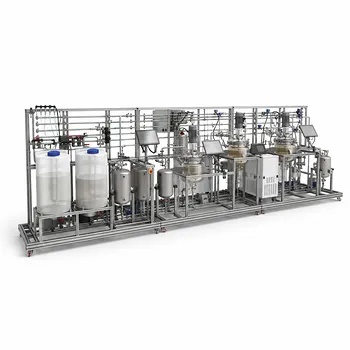
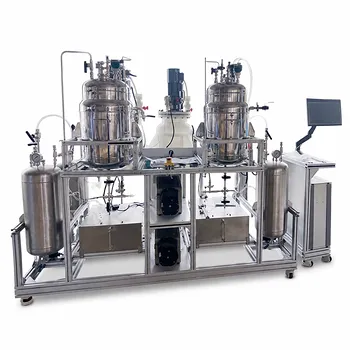
The fundamental challenge is not making the reaction bigger, but managing the physics of heat and force that change dramatically with size. When scaling up temperature-sensitive biological reactions, design considerations must center on maintaining a uniform, precise thermal environment and providing gentle yet effective mixing. As reactor volume increases, the surface area for natural cooling plummets, and the mechanical power needed to mix the broth can create damaging shear forces and destructive hot spots. The pilot plant design must therefore transition from simple lab techniques to sophisticated heat transfer engineering and specialized low-shear agitation systems.
Scaling up a temperature-sensitive bioprocess is fundamentally an exercise in resolving the conflict between mass transfer and cell viability. The core design problem is that the mechanisms for mixing and cooling are the primary threats to the fragile biology they are meant to support, requiring a system engineered to provide maximum uniformity with minimum force.
The Core Physics: Why Bigger Isn't Always Better
The underlying principles governing a 1-liter lab reactor and a 100-liter pilot plant are the same, but their practical manifestations are entirely different. As vessel size increases, key physical ratios change, creating bottlenecks that dictate the entire mechanical design.
The Heat Transfer Bottleneck
The most immediate challenge is thermal control. Reaction volume increases cubically ($r^3$), while the surface area available for cooling through the vessel wall only increases squarely ($r^2$).
This means a larger vessel generates significantly more metabolic heat but has proportionally less surface to dissipate it through a simple jacket. The design must compensate. Pilot systems must incorporate efficient cooling mechanisms, such as dimpled cooling jackets, internal helical coils, or external heat exchangers through which the broth is circulated.
The Mixing and Shear Paradox
Simultaneously, you must maintain adequate mixing and oxygen transfer. Biological entities are only suspended in liquid; turbulence is non-negotiable for ensuring uniform temperature, pH, and nutrient delivery.
However, the impellers that generate this turbulence create shear forces that can rip apart mammalian cells or damage filamentous microorganisms. This creates a paradox: higher agitation speeds improve mass transfer but destroy the culture. The design must resolve this by moving to low-shear impeller geometries and carefully calculated tip speeds.
Re-Engineering Agitation for Cellular Viability
The mechanical heart of the pilot plant—the agitator—must be fundamentally re-imagined from a chemical reactor’s impeller. The goal shifts from creating brute-force turbulence to generating high fluid flow with low shear stress.
Specialized Impeller Configurations
Standard Rushton turbines create high-shear zones that are catastrophic for shear-sensitive cells. Pilot plant design must use specialized agitation configurations.
These often include marine impellers or pitched-blade turbines that create an axial flow pattern, circulating the entire tank volume gently. These designs generate high pumping capacity, eliminating gradients of temperature and nutrients, while minimizing the peak shear forces that occur at the blade tips.
Decoupling Mixing from Damage
A key design consideration is the relationship between impeller tip speed and cell death. The system must be designed to operate within a narrow window: providing enough agitation power per unit volume to achieve the target volumetric mass transfer coefficient ($k_La$), but not exceeding the critical energy dissipation rate that causes cell lysis.
This often involves programming variable-frequency drives to precisely control RPM, allowing the process to be tuned for maximum oxygen transfer without destroying the biological material.
Precision Thermal Architecture and Control
Rejecting metabolic heat without temperature shock is a primary function of the pilot vessel's physical design. The goal is thermodynamic uniformity across every liter of the reactor.
Overcoming Reduced Natural Dissipation
The decreased surface-area-to-volume ratio means natural heat dissipation becomes negligible. The system must therefore be designed as a thermodynamic unit, balancing heat generation with active removal.
The vessel design must integrate multiple cooling strategies: a jacket for base heat removal, and possibly internal cooling coils or a recirculation loop through an external heat exchanger for peak metabolic loads. The selected strategy directly impacts the vessel’s nozzle orientation and internals.
Dynamic Response and PID Tuning
Unlike a simple lab heating block, a pilot plant’s large thermal mass means control systems must be predictive, not just reactive. A poorly tuned controller can easily overshoot the setpoint, cooking the culture.
The design must incorporate cascaded control loops. A fast inner loop controls the jacket inlet temperature, while a slower outer loop trims that setpoint based on the broth’s core temperature. This architecture prevents thermal runaway and maintains the strict temperature maintenance needed to, for example, prevent side reactions or product thermal degradation.
Understanding the Trade-offs and Pitfalls
A successful design is not a perfect design, but one that consciously manages trade-offs. Two critical conflicts must be addressed from the outset.
Agitation vs. Aeration for Mass Transfer
Balancing the agitation rate and gas flow rate directly impacts both biology and capital costs. While higher agitation and aeration rates can increase $k_La$, they can also foam the protein-rich broth significantly.
This forces an economic compromise. High fermentation rates might reduce the fermentor’s capital cost, but they spike aeration, cooling, and anti-foam costs. The design must allow for independent control of airflow and agitation to find the cost-optimal operating point.
Material Sensitivity to Sterilization
The primary constraint of biological temperature sensitivity is often in conflict with the need for steam sterilization (SIP). A system designed to run at 37°C must be built with a jacket that can handle 121°C steam, adding significant mechanical complexity.
This requires classifying the reactor as a pressure vessel. The wall thickness, head types, and gasket materials must all be calculated for the sterilization pressure and temperature, not the operating conditions. This ensures the reactor can safely handle various feed materials while maintaining a sterile envelope.
Making the Right Choice for Your Process Goal
Addressing the deep need of scaling up these reactions requires matching your system’s mechanical design philosophy to your specific biological process goal.
- If your primary focus is maximizing yield of a fragile cell line: Prioritize low-shear axial flow impellers over pure oxygen transfer. Use a combination of jacket and coil cooling to maintain an isothermal environment at the lowest possible agitation rate that prevents sedimentation.
- If your primary focus is controlling a highly exothermic bioconversion: Invest in a cascaded, real-time control system with external heat exchangers. The primary design consideration is dynamic heat removal capacity, ensuring the jacket dynamics and fluid velocity can absorb a rapid metabolic spike without overshooting the setpoint.
- If your primary focus is a viscous, high-solid feed like biomass slurry: Focus on impeller geometry and motor power. Ensure the pilot plant’s agitator is specified not just for RPM, but for torque, to maintain mixing in the non-Newtonian fluid without shearing enzymes, and integrate continuous downstream separation to manage feedback inhibition.
The transition from lab to pilot plant is where process control logic must replace manual intervention. By engineering the system for mass and heat transfer uniformity at the extreme boundaries of your biological material's sensitivity, you build a platform that doesn't just scale the volume, but guarantees the reaction.
Summary Table:
| Design Factor | Scale-Up Challenge | Engineering Solution |
|---|---|---|
| Heat Transfer | Volume grows faster than surface area ($r^3$ vs. $r^2$) | Dimpled jackets, internal coils, external heat exchangers |
| Agitation & Shear | High shear damages fragile biological cells | Axial flow impellers, low-shear geometries, VFD control |
| Temperature Control | High thermal mass leads to setpoint overshoot | Cascaded PID loops (inner jacket loop, outer broth loop) |
| Sterilization | Steam sterilization (SIP) stresses materials | Pressure vessel rating for 121°C, robust gaskets |
Optimize Your Bioprocess Scale-Up with LABPARK
Transitioning from laboratory scale to pilot-scale production requires reliable, precision-engineered equipment. LABPARK provides advanced Educational and Vocational Unit Operations Pilot Plants in bioprocess & biotech, chemical engineering, and environmental & water treatment.
Designed specifically for universities, research institutes, and enterprises, our pilot plants address critical scale-up challenges—ensuring precise temperature control, low-shear agitation, and robust sterilization capabilities to protect your biological cultures.
Ready to elevate your research and training capabilities? Contact us today to discuss your pilot plant needs.
Related Products
- Bio-fermentation Ethanol Production Practical Training Unit Operations Pilot Plant
- Natural Product Extraction Unit Operations Training Pilot Plant
- Electrolyte Distillation Purification and Formulation Educational Pilot Plant
- High-Gravity Emulsification and Mass Transfer Educational Pilot Plant
- Continuous Batch Extractive Distillation Educational Pilot Plant
People Also Ask
- Why Use PTFE & Hastelloy in Chemical Pilot Plants? Prevent Corrosion & Ensure Safety
- Why Compare Predicted and Experimental Excess Enthalpy? Key to Accurate Pilot Plant Scale-up
- Why is the chemical plant startup schedule crucial? De-risk scale-up with pilot plants.
- When to transition from PID to adaptive control in pilot plants? Key process indicators.
- Why must batch and fed-batch fermentation pilot plants be designed to accommodate changing rheological conditions?