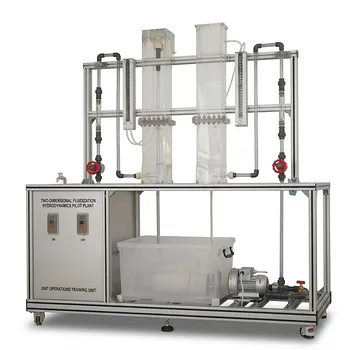
Slurry bed reactors are excellent at heat transfer, but their greatest enemy is the catalyst itself. In a multiphase reaction unit operations training system, the design must pivot from simply maximizing heat removal to managing the abrasive nature of suspended solid particles and preventing settling or clogging. The three non-negotiable design considerations are to avoid internal cooling coils entirely, use an external circulation loop with the slurry flowing through the tube side of the heat exchanger, and ensure any plate-based heat exchanger has a channel gap wide enough to prevent particle blockage.
The core lesson these pilot plants must teach is that a reactor’s physical material characteristics—namely the erosion potential and settling behavior of a solid-liquid slurry—overpower all other thermal design calculations. A design that is thermally optimal on paper can fail catastrophically in practice if it ignores how particles move, settle, and wear down equipment over time.
Why Slurry Bed Reactors Demand Different Heat Management
The intrinsic heat transfer performance of a slurry bed reactor is excellent. The use of small catalyst particles suspended in a liquid provides a massive surface-to-volume ratio for heat exchange. Vigorous backmixing also ensures a near-isothermal temperature profile throughout the vessel, eliminating the destructive hot spots that plague fixed-bed systems.
This uniform temperature is a profound advantage for both reaction selectivity and catalyst lifespan. However, the very thing that makes heat transfer so good—the dense, moving solid-liquid mixture—creates a unique set of maintenance and safety challenges that a training system must accurately replicate. The design problem, therefore, shifts from “how do we get enough heat out?” to “how do we do it without destroying the equipment or choking the flow paths?”
The Abrasion Problem: Solids as a Cutting Tool
Suspended catalyst particles are not passive; they are highly abrasive. When a slurry flows at high velocity, particularly around sharp bends or thin-walled components, the constant impingement of hard particles acts like a slow-motion cutting tool.
This is the single reason why internal cooling coils are forbidden in professional slurry reactor design. A coil submerged directly in a turbulent slurry bed would be sandblasted from all sides, leading to thin walls, pinhole leaks, and a hazardous intermixing of utility fluid and reactants. A training unit cannot teach sensible process safety by including a known failure geometry.
The Settling Problem: Preventing Dead Zones
Unlike a pure liquid, a slurry is a non-Newtonian fluid with a terminal settling velocity for its solid phase. In any zone where the linear velocity drops below this critical threshold, particles will rain out of suspension, accumulate, and eventually pack into a solid mass.
This behavior threatens every stagnant corner, and the complex internal geometry of a coiled heat exchanger is a perfect trap. An effective design must eliminate these dead zones entirely, forcing the slurry to move continuously at a velocity high enough to keep every catalyst particle in a suspended, fluid-like state.
The Three Critical Design Protocols for a Training Reactor
Drawing directly from pilot-plant best practices, three sequential decisions define a robust and educationally valid heat management system for a slurry bed reactor. These are not merely suggestions; they form the logic of a safe operational envelope.
1. Eliminate Internal Cooling Coils
A training system’s first principle is to reject any internal heating or cooling geometry. The primary reference for slurry pilot plants is categorical on this point: internal coils cause severe erosion over time.
For a teaching environment, this rule holds even greater weight. A student operating a reactor with an internal coil would learn a process that is fundamentally unsafe and unscalable. The design must visibly demonstrate that when solids are present, the process side of heat transfer must be kept geometrically simple. Relying solely on a jacketed vessel wall for basic heat removal is sometimes acceptable for small volumes, but for any significant duty, the exchange must be moved outside the main vessel.
2. Rely on an External Circulation Loop with a Pump
The preferred solution is an external pump circulation loop. A robust pump draws slurry from the reactor, forces it through a dedicated external heat exchanger, and returns it to the vessel. This achieves two critical objectives simultaneously.
First, it confines the high-velocity, high-shear flow needed for heat transfer to a separate, maintainable piece of equipment. Second, it allows the system designer to place the slurry on the tube side of the heat exchanger. Tube-side flow provides the most controlled hydraulic path, making it significantly easier to maintain the uniform, high velocity required to prevent particles from settling. If slurries were placed on the shell side, the baffles and cross-flow patterns would create countless low-velocity eddies where solids would immediately accumulate.
3. Optimize Heat Exchanger Spacing for Particles
The final critical choice is the geometry of the external exchanger. If a plate heat exchanger is selected for its compactness and efficiency, the width of the flow channel between the plates becomes the single most important specification.
The plate gap must be wide enough to prevent the largest catalyst particles from clogging the channel or forming a stable bridge. If a single particle wedges at the inlet of a narrow channel, it will quickly trap others, creating a blockage that starves the plate of flow and initiates a cascade of settling. Modular shell-and-tube exchangers with removable tube bundles offer an alternative, providing straight, wide-bore paths that are easier to inspect and clean when handling sticky or fouling slurries.
Understanding the Trade-offs and Hidden Pitfalls
The external circulation loop design is objectively robust, but it introduces secondary educational points that a training system must make explicit. Students should understand that every solution creates a new parameter to control.
Pump Selection and Particle Attrition
The pump in the circulation loop must be a heavy-duty slurry pump, typically a centrifugal design with a wear-resistant impeller and casing. However, a pump that is too aggressive will crush the catalyst particles. Catalyst attrition creates fines that increase slurry viscosity, lower filtration efficiency, and drift through the reactor to foul downstream components. The training exercise must balance pump speed against particle integrity, teaching the concept that the pump itself is a process variable.
Managing Heat Loss and Piping Complexity
Removing the heat exchanger from the vessel means the interconnecting piping becomes a non-insulated radiator. In a small-scale training unit, ambient heat loss can rival the controlled cooling duty. The design must include appropriate insulation and temperature monitoring points along the loop so students can model the system as a network of thermal resistances, not just a single reactor with a fixed heat transfer coefficient. The piping layout must also avoid long horizontal runs where material could settle during an unintended shutdown.
Capital Cost vs. Operational Simplicity
For the same heat duty, an external loop with a dedicated slurry-rated exchanger and pump is more capital-intensive than a simple jacketed vessel with a cooling coil. The trade-off is that the external loop’s operational reliability and ease of cleaning provide an overwhelming advantage when handling solids. A pilot plant demonstrates that professional process design often chooses a higher upfront equipment cost to eliminate a long-term safety and maintenance disaster.
How to Apply This to Your Training System Design
Your design choices must mirror the specific learning outcomes you want to prioritize for your students. The following goal-oriented recommendations will guide you to the right level of complexity and fidelity.
- If your primary focus is teaching industrial safety and erosion mechanisms: Implement an uninsulated external loop with a clear, wide-channel plate exchanger on the tube side. Clearly label and prohibit any internal coil geometry, and require students to perform a pre-start safety review identifying erosion hazards.
- If your primary focus is demonstrating fluid dynamics and settling control: Use a shell-and-tube exchanger with a transparent section or a removable bundle. Design a controlled shutdown procedure where students measure the critical resuspension velocity, visualizing how particles settle when the flow drops below a target threshold.
- If your primary focus is comparing reactor heat transfer strategies: Build the slurry bed reactor alongside a staged fixed-bed system. Let students quantify the near-isothermal profile of the slurry reactor versus the deliberate temperature gradient across multiple fixed beds, then trace those results back to the physical equipment design rules that govern each type.
A well-designed slurry bed training system does not hide its problems; it puts them on display. By externalizing the heat transfer function and forcing a confrontation with particle mechanics, you transform a basic heat balance exercise into a comprehensive lesson in how material properties dictate engineering reality.
Summary Table:
| Design Challenge | Risk & Impact | Recommended Solution |
|---|---|---|
| Catalyst Abrasion | Erosion of internal walls, fluid leaks, and safety hazards | Eliminate internal cooling coils entirely |
| Slurry Settling | Catalyst precipitation, flow dead zones, and system clogging | Implement a high-velocity external pump circulation loop |
| Exchanger Blockage | Particle bridging and flow channel obstruction | Use wide-gap plate or shell-and-tube exchangers (slurry on tube-side) |
Build Safe and Scalable Pilot Plants with LABPARK
Are you looking to equip your laboratory or training facility with high-fidelity, industry-aligned training systems? LABPARK provides state-of-the-art Educational and Vocational Unit Operations Pilot Plants in chemical engineering, bioprocess & biotech, and environmental & water treatment.
We help universities, research institutes, and enterprises teach critical process safety, fluid dynamics, and thermodynamics through robust, real-world system designs. Don't compromise on training quality and safety—contact our engineering experts today to find the perfect pilot plant solution for your institution!
Related Products
- Fluidized Bed Gas Solid Catalytic Reaction Educational Pilot Plant
- Multi Functional Catalytic Reaction and Reactor Evaluation Educational Unit Operations Pilot Plant
- Multi-Reactor Educational Pilot Plant for Reaction Engineering Unit Operations
- Fixed-Bed Chemical Reaction and Gas Dust Tar Removal Unit Operations Pilot Plant
- Fixed Bed Gas Solid Catalytic Reaction Educational Pilot Plant
People Also Ask
- Why is the bed height-to-diameter ratio (L/dt) critical? Fluidized bed pilot plant selection guide.
- How is the minimum fluidization velocity (U_mf) determined and utilized? A Unit Operations Guide
- How does the Mears criterion evaluate transport resistance? Key Guide to Intrinsic Kinetics
- How do reactor pilot plants safely study gas-solid reactions? Master kinetics with thermal & flow control.
- How do pilot plants demonstrate fluidized-bed reactor advantages over fixed-bed? Find Out Now