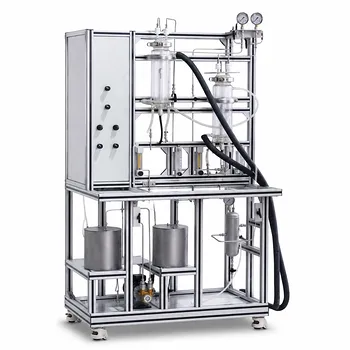
Designing a pilot-scale photoreactor for water treatment is fundamentally a balancing act between photon delivery and process safety. To integrate these systems successfully, you must address three core technical areas: light transmission and the Local Volumetric Rate of Energy Absorption (LVREA), temperature regulation given the inherently poor heat transfer of transparent materials, and chemical material compatibility against corrosive reactants. Equally critical, the pilot plant’s physical architecture must include robust containment and control features that prevent environmental release and enable accurate data collection.
The success of a photoreactor pilot plant hinges not only on optimizing the LVREA through clever geometry and cooling, but also on building a failsafe physical infrastructure. Material incompatibility or a single leak can derail the entire demonstration, making corrosion resistance and secondary containment just as vital as the photochemistry itself.
Mastering Light Distribution: The LVREA Imperative
The performance of photo-assisted catalysis or UV sterilization is governed by the Local Volumetric Rate of Energy Absorption (LVREA). Designing the reactor to maximize this parameter in a uniform, predictable way is your primary optical task.
Why the Inner Wall Must Be Transparent
The reactor’s inner wall—typically quartz or borosilicate glass—must transmit light efficiently to the reaction medium. This transparency is non‑negotiable for photon delivery, but it immediately introduces a critical engineering conflict: the wall acts as a thermal insulator.
Managing the Annular Space
To compensate, you should design the reactor with a dedicated annular space around the transparent tube. This gap can serve a dual purpose: it houses the light source, and it becomes a cooling channel. Circulating a cooling fluid (often water or a process stream) through this space removes excess heat from both the lamp and the reaction zone, preventing thermal runaway.
Reflective Coatings for Photon Recycling
Any external, non‑transparent wall should be coated with a high‑reflectivity material. This strategy bounces escaped photons back into the reaction volume, boosting overall photon utilization without requiring more electrical power. It directly improves the LVREA and helps stabilize the reaction rate.
Tackling the Heat: Thermal Management in Transparent Reactors
Heat removal in a photoreactor is inherently more complex than in a standard stainless‑steel vessel. The very material that enables light transmission cripples conductive heat transfer, so active thermal management must be designed in from the start.
The Exotherm Challenge
Many advanced oxidation processes (AOPs), such as the decomposition of refractory contaminants, can be exothermic. If that heat isn’t dissipated, the reactor can develop hot spots that degrade the catalyst, damage seals, or cause unsafe pressure buildup.
Cooling Mechanisms as Design Constraints
You cannot simply add an external jacket; the light path must remain clear. Effective design options include:
- Internal cooling coils placed outside the light path.
- A flow‑through cooling jacket integrated into the non‑illuminated sections of the reactor body.
- Using the annular fluid itself as the primary coolant, ensuring it has sufficient heat capacity and a controlled flowrate.
Every cooling solution you choose must be validated against its potential to absorb, scatter, or block the light you’ve worked so hard to deliver.
Material Selection: Building for a Hostile Chemical Environment
Pilot plants treating real or simulated wastewater often handle reactants far more aggressive than tap water. Chlorine, chlorinated solvents, and acidic or alkaline process streams will attack conventional materials quickly.
The Corrosion Reality
Primary reference data highlights that reactants like chlorine and chlorinated solvents are highly corrosive. In a pilot plant, a leak not only falsifies mass‑balance data but can also create a direct hazard to operators and the surrounding environment. Therefore, every wetted component—reactor body, seals, gaskets, piping—must be selected for chemical inertness.
Material Compatibility Checklist
- Reactor body and transparent tubes: Quartz or borosilicate glass offer excellent chemical resistance but are fragile. Ensure proper mechanical support and strain relief.
- Metallic components: If you must use stainless steel, choose grades like 316L and verify their compatibility with your specific chemistry at operating temperature.
- Seals and gaskets: Use PTFE, FFKM (perfluoroelastomer), or other high‑purity fluoropolymers. Avoid standard rubber, which can swell and fail rapidly.
- Pumps and sensors: Any wetted parts in recirculation pumps and online analyzers must carry the same chemical resistance rating. A single cheap O‑ring can contaminate an entire experimental run.
Pilot Plant Safety: Containment and Control as Design Fundamentals
The supplementary references underscore that environmental and water treatment pilot plants must meet strict standards, mirroring those of full‑scale facilities. Safety is not a retrofit; it’s a design dimension.
Secondary Containment Architecture
Design all sampling points, pump stations, and wastewater discharge outlets with an underlying containment sump or drip pan. Any undetected leak—whether from a fitting, a burst hose, or an overfilled tank—should drain automatically into a centralized wastewater collection system. This prevents even minor spills from escaping into the lab or environment.
Instrumentation and Safety Interlocks
A pilot plant is a data‑gathering machine. Integrate precise control systems with alarms and safety interlocks that can shut down pumps and UV lamps automatically. Typical triggers include:
- High temperature or pressure in the reactor.
- Low flowrate through the cooling circuit.
- Detection of liquid in the containment sump.
- UV lamp failure or overheating.
Minimizing Human Error
Even a well‑designed rig can be defeated by a momentary lapse. Design your control panel and manual sampling points so that the most common operations are intuitive and the most dangerous ones require deliberate, two‑step actions. Clear labeling of emergency stops and a logical physical layout are just as important as the wiring diagram.
Understanding the Trade‑offs: Performance vs. Practicality
No single design optimizes everything. You will face unavoidable tensions that require deliberate, documented choices.
Transparent Wall Thickness vs. Light Loss
A thinner quartz wall transmits more light, but it is mechanically weaker and less tolerant of pressure fluctuations. A thicker wall improves safety but absorbs more photons, requiring a more powerful lamp or longer residence time. Select the thickness by balancing the maximum expected pressure rating against the acceptable light attenuation for your target wavelength.
Catalyst Immobilization vs. Slurry Systems
If you’re demonstrating heterogeneous photocatalysis (e.g., TiO₂), a slurry of suspended nanoparticles can provide massive surface area but creates a challenging subsequent separation step. Immobilizing the catalyst on the reactor wall or on a structured packing simplifies downstream processing but drastically reduces mass transfer and photon availability. Your pilot’s research goal will dictate which trade‑off you accept.
Standardized vs. Custom Reactor Geometries
There is a historical lack of standardized reactor design models, as noted in the supplementary references. Using a custom‑built, highly optimized geometry can yield excellent kinetic data but makes it incredibly difficult to compare results with published literature or scale up. If your goal is parameter extraction for scale‑up, prioritize a well‑characterized, simple geometry (e.g., an annular reactor with established radiative transfer equations) over an exotic, hyper‑efficient shape.
Making the Right Choice for Your Pilot Plant Goal
How you prioritize these design considerations depends entirely on what your pilot plant is meant to prove.
- If your primary focus is researching fundamental kinetics and extracting quantitative LVREA data: Invest heavily in a simple, annular geometry with precisely known optical properties. Sacrifice some raw throughput for the repeatability and clarity that come from a system you can model with rigor.
- If your primary focus is demonstrating treatment efficacy for a specific pollutant under industrial conditions: Prioritize material compatibility and robust containment over perfect optical homogeneity. Use corrosion‑resistant alloys and redundant leak detection so that a failed seal doesn’t halt your multi‑month validation trial.
- If your primary focus is generating data for commercial scale‑up: Design the reactor with enough flexibility to test different light paths, catalyst configurations, and temperature profiles. Accept a slightly higher capital cost to include multiple sampling ports and variable‑power UV sources; the resulting scale‑up intel will far outweigh the initial outlay.
A thoughtfully designed photoreactor pilot plant is an investment in safe, scalable knowledge. Master the light, respect the heat, choose your materials as if a leak is inevitable, and you will build a system that delivers reliable performance and uncompromised environmental compliance.
Summary Table:
| Design Aspect | Key Challenge | Best Practice Solution |
|---|---|---|
| Light Distribution (LVREA) | Light loss and uneven absorption | Use quartz/borosilicate tubes, annular cooling channels, and reflective coatings. |
| Thermal Management | High heat generation & poor glass conductivity | Implement internal cooling coils or a flow-through cooling jacket in non-illuminated zones. |
| Material Selection | Corrosive chemicals (chlorine, solvents) | Utilize PTFE, FFKM gaskets, and high-grade corrosion-resistant metals (e.g., 316L). |
| Safety & Containment | Chemical leaks and hazardous exposure | Install secondary containment sumps, auto-shutoff interlocks, and fail-safe controls. |
Optimize Your Water Treatment Research with LABPARK
Are you looking to scale up your environmental processes safely and efficiently? LABPARK designs and delivers premier Educational and Vocational Unit Operations Pilot Plants tailored for universities, research institutes, and enterprises. Whether you are focusing on chemical engineering, bioprocess & biotech, or advanced environmental & water treatment, our systems integrate precise controls, reliable thermal management, and robust material safety to match your exact research goals.
Contact LABPARK today to collaborate with our engineering experts and request a custom quote for your pilot plant needs!
Related Products
- Photocatalytic Membrane Separation and Degradation Unit Operations Pilot Plant
- Supercritical High-Gravity Flash Evaporation Educational Unit Operations Pilot Plant
- Rising and Falling Film Evaporation Educational Unit Operations Pilot Plant
- Educational Unit Operations Pilot Plant for Intraparticle Diffusion Effective Factor Measurement
People Also Ask
- What are the key differences in membrane configurations? Choose the Right Unit Operations Pilot Plant
- How Do Pervaporation, Vapor, and Gas Permeation Differ in Pilot Plants? Key Comparison
- What are the structural & performance trade-offs of flat-sheet, spiral-wound, & hollow-fiber membrane modules?
- How do PEI, PVDF, and PSU membranes compare in pilot plants? Find the best fit.
- Pervaporation vs. Vapor Permeation: Handling Suspended Solids in Membrane Pilot Plants