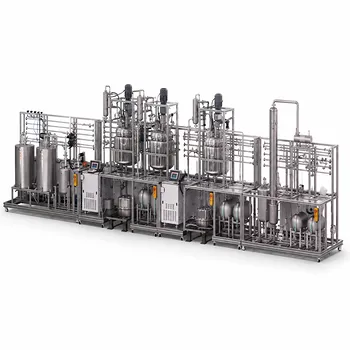
For bioprocess pilot plants handling GMOs or biohazardous materials, the containment and exhaust treatment system must operate as an absolute barrier. Liquid containment is guaranteed through hermetic valve seals or double mechanical shaft seals that prevent any leakage of culture fluid. Exhaust gases, which can carry pathogenic aerosols, must pass through high-efficiency particulate air (HEPA) filters or be destroyed in exhaust gas incinerators before release. These two pillars—liquid-tight enclosure and validated air treatment—are the minimum, non-negotiable safety backbone.
The core imperative is preventing any viable organism from escaping the controlled environment. That means every potential leak path, especially rotating shafts and exhaust air vents, must be physically blocked or neutralized with a validated kill step. The specific technology you choose hinges on the risk profile of the organism and the scale of your pilot operation.
Securing the Liquid Boundary: Containing the Organism
Why Standard Seals Are Not Enough
In a standard chemical reactor, a minor drip from a shaft seal might be a maintenance issue. In a pilot plant handling biohazardous agents, that same drip becomes a containment failure. Genetically modified organisms (GMOs) or pathogens in the liquid phase can escape through even microscopic gaps around rotating equipment or valve stems. The primary reference explicitly mandates hermetic valve seals or double mechanical shaft seals to eliminate this risk. These seals are not simply improved gaskets; they are engineered barriers designed to guarantee zero liquid leakage.
Hermetic Valve Seals and Double Mechanical Seals Explained
Hermetic valve seals – often using a metal bellows or a magnetic coupling – physically isolate the process fluid from the external environment, with no dynamic seal that can wear and leak. For agitators and pumps, double mechanical shaft seals provide a radical step up in reliability. They use two seals in series with a pressurized barrier fluid between them. If the primary seal starts to weep, the barrier fluid—kept at a higher pressure—forces its way into the reactor rather than letting culture broth out. This fails-safe design alerts you to seal degradation before any biological material can escape. In both cases, the choice must be paired with rigorous integrity testing (e.g., helium leak tests) after installation and during CIP/SIP cycles.
Materials That Reinforce the Containment Envelope
While seals are the active guardians, the entire vessel and its internals form the passive containment boundary. The supplementary references stress that 316L stainless steel with electropolished surfaces is the standard for bioprocess systems. Why? A rough surface finish provides microscopic crevices where microorganisms can hide, forming biofilms that resist sterilization and can compromise gasket seats or seal faces over time. Electropolishing creates a mirror-like, hygienic surface that eliminates those niches. Similarly, all O‑rings, gaskets, and diaphragms must be made of inert polymers like EPDM, PTFE, or fluorocarbon rubber. These materials resist degradation during high-temperature steam sterilization and do not leach plasticizers that could feed residual organisms or weaken the seal structure. Without this materials discipline, even the best mechanical seal can fail prematurely.
Neutralizing Aerosols: Exhaust Gas Treatment
The Risk of Aerosolized Biohazards
During fermentation, aeration sparging creates a fine mist of droplets—aerosols—that carry viable cells right out of the liquid and into the headspace. If this gas is vented untreated, it can release a concentrated plume of GMOs or pathogens. Pilot plants, often operating in research or scale‑up facilities with less remote air handling than full-scale plants, demand absolute filtration or thermal destruction.
HEPA Filtration: The Standard for Biological Safety
High-efficiency particulate air (HEPA) filters are the workhorse of biological exhaust treatment. They capture 99.97% of particles down to 0.3 µm, effectively trapping bacteria, yeast, and even many virus-laden droplets (often attached to larger particles). For pilot plants, a single HEPA housing on the vent line is common, but many designs use dual‑bank filters in series with a way to sterilize or replace the first filter while the second maintains containment. The filter must be validated for integrity (via DOP testing) before use and periodically during campaigns. It is not a “set and forget” component; moisture, foam, and particulates can blind a filter, increasing pressure drop and risking blowout.
Thermal Treatment: When Incineration Is Necessary
For highly infectious or hardy biological agents (e.g., bacterial spores, certain viral vectors), exhaust gas incineration offers a kill step that leaves no uncertainty. An electric or gas-fired incinerator raises the exhaust stream to temperatures typically above 800°C for a defined residence time, breaking down all organic material. The primary reference explicitly lists incineration alongside HEPA as an acceptable method. The trade‑off is energy cost and equipment complexity, but for pilot plants handling Risk Group 3 or 4 organisms, incineration is often the default requirement demanded by regulators.
Pre‑treatment: Managing Moisture and Two‑Phase Flow
Bioprocess exhaust is rarely a clean, dry gas. It often carries condensate or foam. Before the gas reaches a HEPA filter, a knockout drum (vapor‑liquid separator) should be installed to remove liquid slugs. A wet HEPA filter not only loses efficiency but can become a breeding ground for captured organisms if they remain viable. The supplementary reference highlights this principle for chemical systems, and it is equally critical for biological containment: a demister pad or cyclone separator upstream of the final barrier ensures the treatment device operates under its designed gas‑phase conditions. For incinerators, a knockout drum prevents thermal shock and incomplete combustion caused by liquid carryover.
Understanding the Trade-offs and Pitfalls
Choosing between these containment and treatment options is not simply a list of features; it is a risk management decision. HEPA filters, while cost-effective, can become a source of contamination during changeout. You must design the housing so that the used filter can be bagged‑out and autoclaved without exposing personnel. Incineration delivers the highest level of kill but demands a continuous energy supply and produces a thermal plume that may require local air permits. Double mechanical seals depend on a clean, stable barrier fluid system; if the barrier fluid pump fails or the fluid becomes contaminated, containment is lost. Furthermore, integrating these features into a pilot plant must not compromise process performance—excessive exhaust restriction from a small HEPA can raise back‑pressure and alter the vessel’s oxygen transfer rate. Validating the entire assembly through clean‑in‑place (CIP) and steam‑in‑place (SIP) cycles is non‑trivial: seals, filters, and ducts must all withstand the thermal cycling and still maintain integrity. The deep need is not just to install these devices but to treat the pilot plant as an integrated, validated containment system.
Making the Right Choice for Your Pilot Plant
Start by defining the organism’s risk group, the potential for aerosol formation, and your facility’s tolerance for on‑site biological waste handling. Your final containment and exhaust design should then reflect your operational priorities.
- If your primary focus is maximum biosafety assurance with no room for error: Combine double mechanical seals with an exhaust gas incinerator, and back it up with a pre‑filtered HEPA for emergency venting. Plan for automated seal barrier fluid monitoring.
- If your primary focus is operational flexibility and rapid turn‑around between runs: Specify a dual HEPA filter system with steam‑in‑place sterilization between batches, and use electropolished vessels with hermetic valve seals to minimize cleaning validation burden.
- If your pilot plant also handles hazardous chemicals (e.g., acid or solvent additions): Integrate a caustic scrubber downstream of the knockout drum but before the HEPA, ensuring both chemical and biological hazards are treated without interfering with each other.
- If your primary focus is cost‑effective scale‑up representation: Avoid over‑engineering. A single HEPA on the vent and a proven double mechanical seal on the agitator, with rigorous integrity testing and a bag‑out filter change procedure, will mirror industrial practice while keeping the pilot plant manageable.
Every element of containment and exhaust treatment must be selected and sized as a single, coherent safety chain. The moment one link breaks—be it a cheap gasket, an untested filter, or a poorly drained knockout drum—the entire barrier loses its meaning.
Summary Table:
| System Area | Feature / Technology | Primary Function | Ideal Use Case |
|---|---|---|---|
| Liquid Containment | Double mechanical shaft seals | Prevents liquid leaks via pressurized barrier fluid | Agitators and pumps in high-risk runs |
| Liquid Containment | Hermetic valve seals (bellows/magnetic) | Eliminates dynamic seal wear and leakage pathways | High-purity / zero-leakage isolation |
| Exhaust Treatment | HEPA filtration (dual-bank) | Traps 99.97% of bio-aerosols down to 0.3 µm | Standard biological safety (bacteria/yeast) |
| Exhaust Treatment | Gas incineration | Thermal destruction of pathogens (>800°C) | High-risk agents (spores, viral vectors) |
| Pre-treatment | Knockout drum / Demister | Removes liquid/foam before exhaust filtration | Prevents filter blinding and thermal shock |
Secure Your Bioprocess Operations with LABPARK
Building a safe, compliant, and reliable scale-up facility requires engineered precision. LABPARK provides state-of-the-art Educational and Vocational Unit Operations Pilot Plants in chemical engineering, bioprocess & biotech, and environmental & water treatment for universities, research institutes, and enterprises.
Whether you need advanced biosafety containment, robust double mechanical seals, or validated exhaust filtration systems, our pilot plants are engineered to meet strict safety standards without compromising process performance.
Ready to design or upgrade your bioprocess facility? Contact our experts today to discuss your containment requirements and request a customized technical proposal.
Related Products
- Bio-fermentation Ethanol Production Practical Training Unit Operations Pilot Plant
- Natural Product Extraction Unit Operations Training Pilot Plant
- Ethyl Acetate Synthesis Unit Operations Pilot Plant for Practical Training
- High-Gravity Emulsification and Mass Transfer Educational Pilot Plant
- Continuous Batch Extractive Distillation Educational Pilot Plant
People Also Ask
- Why Use PTFE & Hastelloy in Chemical Pilot Plants? Prevent Corrosion & Ensure Safety
- Why Compare Predicted and Experimental Excess Enthalpy? Key to Accurate Pilot Plant Scale-up
- Why is the chemical plant startup schedule crucial? De-risk scale-up with pilot plants.
- When to transition from PID to adaptive control in pilot plants? Key process indicators.
- Why must batch and fed-batch fermentation pilot plants be designed to accommodate changing rheological conditions?